Showing posts with label Christopher Columbus. Show all posts

10/09/2013

A matter of choice; Columbus Day vs. Native Resistance Day or Indigenous Day of Remembrance


On October 12th, people throughout this side of the World may celebrate one of the above. It is a matter of choice, since those who hold power and continue to oppress, are the ones who have monopolized the history taught in our schools.

The timing of the Federal Government shutdown is exemplary of the many faces of Columbus. Think about it, the majority of people in the United States disagree with the shutdown, yet it seems that the people have no say! The positive element of this, is that now it is out in the open; how much disregard is given and/or held for the wants of “the people” vs. the interests of a few, who manage and manipulate the system affecting directly or indirectly the lives of millions of people. This shall show you who’s who and what they truly stand for!

When I was a young teenager in Borikén (Puerto Rico), The Real Spanish Academy (Real Academia Española), an organization that determines which words one can use and consider “valid and proper” in the Spanish language, decided to create the word “aparcar” (to park), when the anglicism “parkear” was used to such an extent that everyone knew what it referred to (as opposed to using the word “estacionar”).

I make the correlation, because I think that if we continue calling October 12th, Native Resistance Day or Indigenous Day of Remembrance, eventually calling it “Columbus Day” will become obsolete, and hopefully it will be changed officially.

This Federal Holiday was implemented 76 years ago , by the efforts of Italian immigrants. They had started celebrating it earlier in the state of Colorado.

In my opinion, to celebrate Columbus is to celebrate Greed, Abuse (of all types), Rape (indistinctively, meaning women, men, and children), Slavery, Land grabbing, Exploitation, and injustice, just to name a few.

We have been subjected to a bunch of lies and romanticized stories at school and our children continue to be taught the same.

One cannot say, that is all for Justice while celebrating INJUSTICE!

On this October 12th, you have a choice, and that includes the choice of not choosing.

What will it be for you? Your choice defines you!

Author: Tai Pelli

12/04/2012

Based on a True Story, Taino Novel Republished


New York (UCTP Taino News) – Dr. Jose Barreiro's masterfully written historical novel chronicling the first encounters between Indigenous Peoples and Europeans beginning with Columbus has been re-released by Fulcrum Press under the title “Taino: A Novel.” The story is told from the point of view of Guaikan/Diego, Christopher Columbus' young adopted Taino Indian son and interpreter. The book vividly recreates the often violent clashes of cultures in the Caribbean during the late 15th and early 16th centuries. 

Author Jose Barreiro notes “My first publisher opted for a more generic title, and thus ‘The Indian Chronicles.’” He continued stating ““I always thought the book was best titled ‘Taino,’ as it tells the story of a Taino memory.” 

Indeed, the engaging and at times heartbreaking story is told four decades after the arrival of Columbus, when Guaikan is an elderly man. While the story is historical fiction, it is based on true historical events and figures. 

Presently a senior fellow at the Smithsonian National Museum of the American Indian, Jose Barreiro is a novelist, essayist, and an activist of nearly four decades on American indigenous hemispheric themes. “Taino: A Novel” is currently available at Amazon.com

UCTPTN 12.04.2012

5/27/2011

Experts solve mystery of ancient stone monument near Atlanta


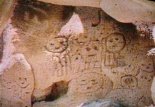
These two petroglyphs from Puerto Rico and Georgia portrayed
the same supernatural being in identical styles of art. Credit: Richard Thornton

Rock art specialists from around North America have finally solved this century old archaeological riddle. The stone slab is evidence that native peoples from Puerto Rico or Cuba once lived within the interior of Eastern North America.

See the full story at UCTP Taino News...

Source: Examiner.com
Author: Richard Thornton

10/18/2010

Remembering the Ancestors

NEW YORK CITY - Luis Ramos has become a local hero amongst the Indigenous Indian people of New York. Luis Ramos a very humble man of medium built has managed to put together a powerful celebration. This event is called "Indigenous Day of Remembrance". This event takes place in the heart of New York City at Columbus Circle.

You see Luis is a Taino Indian and he has a vested Interest in the history and truth of Christopher Columbus. The Taino people were the first to discover the Mass Murderer Christopher Columbus. Many do not know that Columbus was much hated by his own peers, he could not get support in Portugal, so he went to Spain charmed Queen Isabella and King Ferdinand. When you get a chance read "the Book Of Privileges" these Privileges were set up as contracts between Columbus and Spain.

Christopher Columbus was born in 1451, in Genoa Italy. Most school children are left to believe their hero was born in Spain. They are also being taught that he set foot in the United States when in reality it was Sal Salvador. The journey was suppose to be heading for Asia I have doubts that he was really lost when in fact he had help from the Moors whom were master explorers and navigators.

Perhaps he even deceived the King and Queen of Spain perhaps he had a hidden agenda and needed funding for his quest. These arguments and thoughts are still being discussed within my circle of researchers and friends.

As we assemble in Columbus Circle, Prayers are being sent out to the Creator for all the Indian people that have crossed over, lost their lives to this Mass Murderer, Christopher Columbus whom was the first Mass Murderer and Serial Killer recorded in American history. At least by Indigenous people.

We as Native people protest the Myth of Christopher Columbus and demand that his Statue come down, I would like to see the Board Of Education take responsibility for much of the Myth of this man. It gets pretty lame when you have to tell Indigenous children"forget about the truth just pass your test and get your diplomas then go speak the truth"

I want to thank Luis Ramos for this Remembrance day. I am hoping that the event grows and grows it was so good to see all Nations coming together for the one thing we have in common which was the domino affect that Columbus had on us all.

If you are in New York get information on Columbus from U.C.T.P which stands for the United Confederation Of Taino People, and their friend and brother Luis Ramos organizer of the event.

Author: Firebird Graywolf
Source: Indian Country Today

10/12/2009

Kids Study the Dark Side of Columbus

By CHRISTINE ARMARIO, AP

TAMPA, Fla. (Oct. 11) — Jeffrey Kolowith's kindergarten students read a poem about Christopher Columbus, take a journey to the New World on three paper ships and place the explorer's picture on a timeline through history.

Kolowith's students learn about the explorer's significance — though they also come away with a more nuanced picture of Columbus than the noble discoverer often portrayed in pop culture and legend.

"I talk about the situation where he didn't even realize where he was," Kolowith said. "And we talked about how he was very, very mean, very bossy."

Columbus' stature in U.S. classrooms has declined somewhat through the years, and many districts will not observe his namesake holiday on Monday. Although lessons vary, many teachers are trying to present a more balanced perspective of what happened after Columbus reached the Caribbean and the suffering of indigenous populations.

"The whole terminology has changed," said James Kracht, executive associate dean for academic affairs in the Texas A&M College of Education and Human Development. "You don't hear people using the world 'discovery' anymore like they used to. 'Columbus discovers America.' Because how could he discover America if there were already people living here?"

In Texas, students start learning in the fifth grade about the "Columbian Exchange" — which consisted not only of gold, crops and goods shipped back and forth across the Atlantic Ocean, but diseases carried by settlers that decimated native populations.

In McDonald, Pa., 30 miles southwest of Pittsburgh, fourth-grade students at Fort Cherry Elementary put Columbus on trial this year — charging him with misrepresenting the Spanish crown and thievery. They found him guilty and sentenced him to life in prison.

"In their own verbiage, he was a bad guy," teacher Laurie Crawford said.

Of course, the perspective given varies across classrooms and grades. Donna Sabis-Burns, a team leader with the U.S. Department of Education's School Support and Technology Program, surveyed teachers nationwide about the Columbus reading materials they used in class for her University of Florida dissertation. She examined 62 picture books, and found the majority were outdated and contained inaccurate — and sometimes outright demeaning — depictions of the native Taino population.

The federal holiday itself also is not universally recognized. Schools in Miami, Dallas, Los Angeles and Seattle will be open; New York City, Washington and Chicago schools will be closed.

The day is an especially sensitive issue in places with larger native American populations.

"We have a very large Alaska native population, so just the whole Columbus being the founder of the United States, doesn't sit well with a lot of people, myself included," said Paul Prussing, deputy director of Alaska's Division of Teaching and Learning Support.

Many recall decades ago when there was scant mention of indigenous groups in discussions about Columbus. Kracht remembers a picture in one of his fifth-grade textbooks that showed Columbus wading to shore with a huge flag and cross.

"The indigenous population was kind of waiting expectantly, almost with smiles on their faces," Kracht said. "'I wonder what this guy is bringing us?' Well, he's bringing us smallpox, for one thing, and none of us are going to live very long."

Kracht said an emerging multiculturalism led more people to investigate the cruelties suffered by the Taino population in the 1960s and '70s, along with the 500th anniversary in 1992.

However, there are people who believe the discussion has shifted too far. Patrick Korten, vice president of communications for the Catholic fraternal service organization the Knights of Columbus, recalled a note from a member who saw a lesson at a New Jersey school.

The students were forced to stand in a cafeteria and not allowed to eat while other students teased and intimidated them — apparently so they could better understand the suffering indigenous populations endured because of Columbus, Korten said.

"My impression is that in some classrooms, it's anything but a balanced presentation," Korten, said. "That it's deliberately very negative, which is a matter of great concern because that is not accurate."

Korten said he doesn't believe such activities are widespread — though the lessons will certainly vary.

In Kolowith's Tampa class, students gathered around a white carpet, where they examined a pile of bright plastic fruits and vegetables, baby dolls, construction paper and other items as they decided what would be best for their voyage.

"Do you think it would be good to take babies on a long and dangerous boat ride?" he asked the class. "No!" they replied.

Fifteen miles away, in Seffner, Fla., Colson Elementary assistant principal Jack Keller visited students in a colonial outfit and gray wig, pretending to be Columbus and discussing his voyages. The suffering of natives was not mentioned.

"Our thing was to show exploration," he said.

Meanwhile, Crawford's Pennsylvania class dressed up as characters from the era, assigned roles for a mock trial and put Columbus on the stand. Out of a jury of 12 students, nine found him guilty of the charges.

"Every hero is somebody else's villain," said Felipe Fernandez-Armesto, a scholar and author of several books related to Columbus, including "1492: The Year the World Began."

"Heroism and villainy are just two sides of the same coin."

Associated Press writer Dorie Turner in Atlanta contributed to this report.

10/09/2009

Filmmakers Reconsider Columbus

New York, NY (UCTP Taino News) - Filmmakers Carlos Germosen and Crystal Whelan of Nu Heightz Cinema have produced a new Public Service Announcement (PSA) urging the American Public to "Reconsider Columbus Day".The 60 second spot features a compelling message which they hope will "encourage people to learn the other side to the story of Columbus".

"We want to help shed light on the truth by using mass media" stated Whelan. She continued stating "We hope people will petition for a nationally recognized indigenous holiday to honor the people who were here first."


The producers reached out to local community activists and indigenous organizations like the United Confederation of Taino People to help develop the script.

"We were honored to be asked to collaborate on this project as our ancestors in particular were the first to be negatively impacted by Columbus" stated Roberto Borrero, a representative of the Confederation.

"The issue goes beyond Caribbean Indigenous Peoples however, it is really about society being complacent with symbols of genocide." said Borrero.


The Reconsider Columbus Day PSA is currently being featured on
You Tube and the producers are working to broadcast it on local television networks. Nu Heights Cinema has also set up a Reconsider Columbus Day website at www.reconsidercolumbusday.org to help bring more attention to the issue.

10.08.2009

9/15/2009

No cocktail for Columbus at Cuba landing monument

CAYO BARIAY, Cuba (Reuters) -- "A Columbus cocktail?" asked the bartender with a quizzical look.

A visitor had asked whether the bar at windy Bariay Bay, the first place in Cuba where Christopher Columbus set foot on his 1492 voyage, had concocted a special drink in honor of the world-famous navigator and explorer.

But like much else in communist-led Cuba, history gets a different twist at the Bar Corocote, part of an oddball monument to Columbus at the site.

"We do have the Corocote (cocktail)," says bartender Alexandr Gomez Gonzalez, pushing back the cocked hat he wears as part of his Christopher Columbus costume.

Made from honey, coconut juice and rum, the Corocote is named after the god of virility worshiped by the indigenous Taino people who lived here when Columbus made landfall on October 28, 1492.

The drink is said to boost a man's virility, Gomez said, slyly glancing toward a stone likeness of Corocote perched by the front door.

The crouching little figure, with the barest hint of a smile and a significant male appendage, looked like he had drunk several of his namesake cocktails.

Located on Cuba's northeastern coast, in Holguin province about 500 miles east of Havana, Bariay National Monument Park is far enough off the beaten path so that, especially in Cuba's summer low season, days can go by without visitors.

Park employees pass the time watching DVDs of Miami television programs while they wait for tourists.

When visitors pull up, the employees greet them with a full-costume re-enactment of Columbus' arrival.

His landing is commemorated by a lone plaque, almost lost amid sculptures of Taino gods, a replica of a Taino village -- which includes the bar -- and the ruins of a marker, toppled last year by Hurricane Ike, for a small Taino archeological site.

The shore, now a badly eroded beach, where Columbus and his crew landed their boat is unmarked and obscured by vegetation.

A few minutes drive from the landing site, the Cuban government has constructed a monument in which Spanish-style columns are arrayed in the shape of an arrow. The arrow's tip plunges into the heart of a formation of Taino gods.

Columbus might be surprised by the apparently sinister message projected by this monument, at least as it applies to his Bariay stop, because he landed there hoping to make contact with natives but saw none.

The Italian-born explorer, sailing under the Spanish crown and in search of a sea route to India, had first encountered the New World two weeks before in the Bahamas, where the islanders told him of a great landmass to the southwest.

He mistakenly thought it must be the Asian continent and set sail in that direction.

His small fleet - the Nina, Pinta and Santa Maria -- entered what is now Cuba's Bariay Bay because its wide mouth offered safe passage. Then the explorers went ashore at a small village where they assumed they would find inhabitants.

But by the time they landed, the frightened Taino villagers had run away into the surrounding wilderness.

After a quick look inside the natives' conical, wood-and- palm-frond structures, the explorers returned to their ship and sailed away the next day, landing again a few miles west at what is now Gibara.

There, he had better luck meeting natives, stayed a few days, and for many years it was thought that Gibara was where he first touched Cuban soil.

Although his visit to Bariay was brief, its lush flora and fauna and nearby mountains so impressed him that he wrote in his log it was "the most beautiful place human eyes have seen."

He gave enough of a description, including of a distinctive mosque-shaped mountain, that nearly five centuries later, historians decided Bariay, not Gibara, was the place he wrote about.

Cuba's ambivalent monument to Columbus reflects the long debate about whether his epic voyage of discovery was good or bad for the New World.

But its importance is not in question, said historian Keith Pickering, who runs www.columbusnavigation.com, a website for Columbus buffs.

"This is perhaps the most significant event in human history. It is almost as though everything from the previous five centuries leads up to it, and everything in the following five centuries flows from it," he said.

The opinion from Bar Corocote is less admiring for Columbus.

Sitting under its palm roof, taking refuge from the tropical sun while waiting for tourists, park guide Misleidis Mendez Marrero says Columbus was a historical catastrophe for Cuba's original inhabitants.

"It depends on your point of view, but I feel like it wasn't good because the natives here were practically the kings, the owners of this place -- and with the arrival of Columbus, their lives began to totally change," she said.

Author: Jeff Franks
Source: Caribbean Net News

6/02/2009

Author Dr. Ivan Van Sertima passes at 74

UCTP Taino News - Guyanese-British historian, linguist, journalist, and anthropologist Ivan Van Sertima passed away on 25 May, 2009 at 74. Van Sertima was noted for his ‘Afrocentric’ theory of pre-Columbian contact between Africa and the Americas. One of his best known publications is titled “They Came Before Columbus”. This work was criticized by academic specialists who accused Van Sertima's cultural outlook of being disparaging to Native American achievements among other issues. Van Sertima also appeared before a United States Congressional committee in 1987 to challenge giving credit for the discovery of America to Christopher Columbus.

UCTPTN 06.02.0229

3/04/2009

Surprising colonists of La Isabela

Burials excavated at the earliest European settlement in the New World, established by Christopher Columbus in 1493, have surprised archaeologists by including women and children. It had been thought from documentary evidence that the settlers had all been men.

La Isabela, on the north coast of Hispaniola, in what is now the Dominican Republic, was founded by Columbus, pictured below, late in 1493 on his second voyage. The camp at La Navidad, now in Haiti, established on his first voyage in 1492, had been abandoned by the time he got back, and he moved eastwards along the coast of Hispaniola until he found a suitable location for a permanent settlement.

Substantial traces of La Isabela survive, including Columbus's own house and the foundations of a church, all enclosed within a defensive wall. Next to the church, consecrated in January 1494, was a small cemetery in which the casualties of confrontation with the Taino were buried, together with those who had died of famine, diseases and exhaustion.

New excavations in the cemetery by a team of Dominican, Italian and Mexican archaeologists and biological anthropologists have recovered nearly 50 skeletons. What surprised the investigators was that the burials included at least five children of different ages, as well as four women.

One woman was clearly European, while a second seems to have been a Taino, because of her culturally shaped skull, modified by cradle-boarding in childhood. Metabolic diseases, broken teeth and physical stress due to heavy labour were noted in the skeletons, but there was no sign of syphilis or yaws: if any of the settlers had acquired such diseases, they had not yet progressed enough to show in the bones.

There was also no sign of battle wounds, suggesting that relations with the Taino had not produced early casualties.

DNA analyses and isotopic studies of diet are in progress, and the team hopes to find out whether Columbus's crew included Africans: recent studies in Mexico have shown a surprisingly early African presence in early burial grounds in Yucatán.

Author: Norman Hammond
Source: The Times Online

11/05/2008

It Came from the Caribs

By Tracy Assing

The hammock is sometimes used to illustrate the carefree, relaxed environment one associates with a Caribbean vacation. But that image wasn’t dreamed up by advertising – it’s symbolized the laid-back lifestyle for centuries.

Some sources credit Christopher Columbus with the “discovery” of the hammock when he saw it being used by indigenous peoples during his journey to the Caribbean. First mentioning the hammock in his logs during his first voyage in 1492, he was so impressed by these simple but efficient slings that he took several back to Spain with him.

Although the hammock was revealed to the world in this region, it was also used by Central and South American tribes at the time though it’s said to have spread from the Caribbean only centuries before the Spanish Conquest. The word “hammock” was derived from the Taino hamaca or yamaca, and the first hammocks are thought to have been woven out of tree bark. One of the oldest pieces of furniture in the history of mankind, the hammock has spawned a multi-million dollar industry, with distinctive styles and patterns emerging from different regions.

European explorers were so enchanted by it that they took careful notes of their observations. In an account of life in the West Indies, Gonzalo Fernandez de Oviedo y Valdes wrote in 1535 of the “natives”: The beds in which they sleep are called hammocks that are blankets of cotton well woven of beautiful and good quality fabrics…”

Indigenous tribes were labeled lazy by the conquistadors because they spent so much time in their hammocks, but the visitors were eventually won over by its perfection.

The hammock was lightweight and easy to set up: better than sleeping on the floor, where one could be vulnerable to snakes and damp; and it functioned as a bed, or a chair, or a sack, or a fishing net.

The hammock is not confined to terra firma, though. The English sailors whose efforts helped Britannia rule the waves adopted it in the 16th century, since they found it easier to catch 40 winks in a hammock than on a bunk bed while being tossed around at sea. Centuries later, American astronauts in the Apollo programme snoozed in hammocks between moonwalks.


================================

Getting into a hammock
Turn with your back to the hammock and sit in the sling. As you sit, reach back with your hands to steady yourself and gently spread the bed apart. Once you are in the sitting position, lean back and then pull up your feet.

Getting out
Swing your legs out and then stand up

================================

Article Source: Caribbean Beat magazine, Sept/Oct 2008, pg 96.

10/16/2008

Petition Calling for the Abandonment of Proposed Columbus Monument in Boriken (Puerto Rico)

Recalling that: In 1492, Christopher Columbus initiated a genocidal campaign against Indigenous Peoples that began with the Taíno, Karib, and Arawak Nations and extended throughout the Americas, and

Recalling that: Christopher Columbus was the first trans-Atlantic slave trader in the Western Hemisphere, and

Recognizing that: Christopher Columbus is a symbol, not of a man, but of imperialism, colonialism, and genocide, and

Further Recognizing that: Imperialism and colonialism are continuously manifesting with the exploitation of humanity and the Earth as well as in the ongoing violations of the rights of Indigenous Peoples,

THEREFORE BE IT RESOLVED: We, the undersigned call on The Holland Group, Inc and the City of Mayagüez to abandon their plans to erect a monument to Christopher Columbus on the island of Boriken (Puerto Rico) in 2010. This proposed project is not only offensive to the local Taino, Karib, Arawak and other Indigenous Peoples but it is an offense to all peoples of good conscience around the world.

Sign petition at:
http://www.thepetitionsite.com/2/say-no-to-columbus

10/10/2008

New Study Confirms Taino Ancestry Among Dominicans

Dominican Republic (UCTP Taino News) - According to a new DNA study conducted in the Dominican Republic a large segment of the country’s population retains indigenous Taino ancestry through their mother’s bloodline. The study, conducted by the University of Puerto Rico, reveals that approximately 15-18% of Dominicans have Native American Mitochondrial DNA out of a population of nearly 10,000,000.

The research is based on 1200 DNA samples taken throughout the island with some test areas revealing 90% of the subjects with Native ancestry. While the percentages are lower than similar studies conducted on the neighboring island of Puerto Rico, the estimates defy “popular” accounts that the Indigenous Peoples were completely exterminated on that island.

“This study is a confirmation of what we have already known and promoted for years” stated Roberto Borrero, a representative of the United Confederation of Taino People. “Our people continue to exist within the multi-cultural mosaic that is the Caribbean despite the genocidal campaigns that began against us 516 years ago with the arrival of Columbus.”

One interesting aspect of the study is that individuals tested in the Cibao region seem to have a different DNA sequence than those tested in the southern part of the island. While both sequences are indigenous the variants could shed some light on ancient migrations. The study also reveals that the Taino descendants from the Cibao area could have been relatively “un-mixed racially” until more recent times.

UCTPTN 10.10.2008

4/15/2008

VENEZUELA: Treasure Island

By Humberto Márquez

CARACAS, Apr 14 (IPS) - Cubagua, a 24-square-kilometre island off of Venezuela’s northern Caribbean coast, is uninhabited but guards the archaeological testimony of three stages of human history and prehistory in the Americas.

"The oldest archaeological findings date back 3,000 to 3,500 years. They reflect the passage through the area of paleo-indigenous groups -- nomads, explorers and harvesters of shellfish -- perhaps on their way to populating other parts of South America or the Caribbean," anthropologist Carlos Martín told IPS..

On his desk in the Central University of Venezuela’s School of Anthropology, Martín spreads out shells collected in Cubagua. Only at closer inspection would a lay person notice that they have been cut or carved to serve as tools.

"What looks like archaeological garbage is actually gouges and tools used to open shellfish, obtain food and carry out rudimentary woodwork" on rafts or primitive boats used to explore the Caribbean region.

Cubagua, some 300 km northeast of Caracas, is halfway between Venezuela’s northeastern shoreline and the resort island of Margarita. There are no surface sources of fresh water, and the landscape is sand and rock, with a few scattered thickets.

It is the smallest of the three islands making up the Venezuelan state of Nueva Esparta, along with Margarita and Coche islands, and is located 16 km north of Araya Peninsula, the closest mainland area. It is home to only a few itinerant fishing camps, which shrink and grow depending on the season.

"A second group of carved objects were left by indigenous peoples of the Carib or Arawak languages, who passed through Cubagua as nomads since at least 1,500 or 2,000 years ago," said Martín. "They are the artifacts of people who already used knives or other tools made of stone, shells or wood on the mainland or on Margarita Island."

German-Spanish Historian Enrique Otte found remnants of pottery and cooking hearths, as well as signs of what may have been religious rituals.

These were the indigenous people encountered by the Spaniards who arrived at these shores in the late 15th century. On his third voyage, in August 1498, Christopher Columbus reached Cubagua, where he discovered riches that whetted Europe’s appetite: pearls.

Thus began the third population wave in Cubagua: the Spaniards, who brought Guaiquerí Indians over from Margarita Island and made them dive for oysters. Forced to dive for up to 16 hours a day, many of them died of overwork. The rich pearl fisheries led to the establishment in 1500 of the first Spanish settlement in what is now South America: Nueva Cádiz.

The settlement on the northeastern shore of the island gained the formal status of a town in 1528, when it was home to 1,000 European inhabitants along with an unknown number of indigenous people and, later, groups of black slaves. Fresh water was brought in from the mouth of the Manzanares river, on the nearby mainland.

But by 1537, the oyster beds were basically wiped out, as was the native population as a result of European diseases and brutal exploitation. The town was abandoned as a permanent settlement in 1539 and destroyed by a tidal wave in 1541. The ruins were burnt by French pirates in 1543.

Nueva Cádiz "was an L-shaped city that was walled in to protect itself from pirates. It had streets, houses, two churches, a city hall, a convent and a cemetery. Outside the walls lived the Indians and blacks, in rudimentary huts and shacks," archaeologist Jorge Armand, who is carrying out work in the ruins, told IPS.

Armand and his team found and cleared the ruins of one of the churches, the Ermita de Nuestra Señora, which measured 30 by eight metres and had outside walls one metre thick and a flagstone floor. "The ruins coincide with Otte’s research and an old French map," said the archaeologist.

The Ermita "was the first Catholic church in South America, the first where the Virgin of the Valley -- the patron saint of fishermen and sailors in Venezuela -- was venerated, and it shows the importance that the Spaniards placed on Nueva Cádiz," said Armand.

The Venezuelan Institute of Cultural Patrimony is studying the possibility of building a museum in Cubagua, for students of archaeology and history, as well as tourists.

"The essential thing is conservation," said Martín. "An on-site museum is a wonderful idea, but tourism must be accompanied by education and controls, in order for it to be responsible, because we are not only talking about archaeological treasures, but also an island with a fragile environment."

Cubagua "represents three key phases of human development in the Americas. First, the passage of primitive (in the archaeological sense) groups, who could have been ancestors of the Carib Indians. Second, the organised indigenous peoples who lived on the mainland and visited Cubagua seasonally for fishing and possibly for holding rituals," said the anthropologist.

And, finally, "the Spaniards, who founded the first colonial city built on an island, over 500 years ago," until the town was wiped out "by the forces of nature and greed," he said.

"At times there is a tendency to look down on Venezuela’s prehispanic history and patrimony, because it is compared to the monumental history of Mexico, Peru or Central America. But the roots could have begun to take shape here, on this island, millennia ago, in something as basic and marvellous as the first inhabitants of the new world carving a rock that was used to pry open a clam or cut wood," said Martín. (END/2008)


3/11/2008

Poll on Taino Themed Video Game Still Open

UCTP Taino News – On February 14 a poll was created at the UCTP’s Taino News and Information Group focusing on a developing video game project that would place the player in the position of a Taino man or woman at the time of Christopher Columbus’ arrival. The goal of the game developer, Josh Samuels is to present historically accurate information regarding the Taino people and culture as well as their interactions with Columbus and his men. Samuels is seeking consultation from the UCTP on the project. The poll looks to survey initial community reaction to such a project. Community members can still register their vote at http://groups.yahoo.com/group/Taino_News/surveys?id=12719570 until March 17, 2008 when the voting poll will close.

1/15/2008

Columbus Blamed for Spreading Syphilis

UCTP Taino News - A recent genetic study is being touted as evidence to support the theory that Christopher Columbus brought syphilis to Europe from the New World.

According to a report by Reuters, U.S. researchers said “a genetic analysis of the syphilis family tree reveals that its closest relative was a South American cousin that causes yaws, an infection caused by a sub-species of the same bacteria.” Kristin Harper, an evolutionary biologist at Emory University in Atlanta states that “syphilis or a progenitor came from the New World to the Old World and this happened pretty recently in human history."

Harper believes the new genetic data supports what has come to be known as the “Columbian theory," which links the first recorded European syphilis epidemic in 1495 to the return of Columbus and his crew.

Sampling strains of bacteria, which included two strains of “yaws” from Guyana, the study concluded that while yaws is an ancient infection, venereal syphilis came about fairly recently. Harper suspects a nonvenereal subspecies of the tropical disease quickly evolved into venereal syphilis that could survive in the cooler, European climate. She admits that it is not clear how this process took place.

Harper also admits that while the study indicates that “the ancestor of syphilis came from the New World,” what exactly it was like the scientist still don’t know.

Don’t Blame the Venereal Disease on Native People

“With regard to this data, our concern is that its sensational aspects will be misinterpreted to refuel attempts to link the venereal disease to the Taino People since we were the first to meet Columbus and his crew.” stated Roberto Borrero, a representative of the United Confederation of Taino People. “This would be unfortunate especially as this new study only claims that a progenitor of the disease came from the so-called New World.”

Borrero explained that “a few of our ancestral stories do mention a particular skin condition called karakarakol, which according to what we know today describes yaws.”

Yaws is an infectious disease that occurs mainly in tropical regions. Caused by the bacterium Treponema pertenue, the disease features characteristic bumps on the skin of the face, hands, feet, and genital area. Over a period of time, the bones as well as the joints are affected as well. Most cases of yaws occur in children under 15 years of age and it is spread by direct contact with skin lesions or cuts. Treponema pertenue is described as a subspecies of the organism responsible for syphilis.

“European colonizers mention karakarakol or ‘bubas’ in their reports along with the indigenous treatment of the affliction being medicine derived from the Guaiakan tree” Borrero continued. “According to these early reports the Europeans seemed to be quite familiar with this type of disease as they refer to it as the French disease.”

Some scientists are have already voiced disagreement with the new findings indicating Harper’s conclusions relied too heavily on genetic changes from the Guyana samples.

"The debate about the origins of syphilis has continued for nearly 500 years," noted Borrero who added “In a climate that glorifies Columbus and attempts to justify the genocide of indigenous peoples by denigrating the lifestyle of our ancestors as savage and immoral, one important aspect of this research is that it suggests the disease may not have been transmitted through sex until it adapted to the environment in Europe.”

UCTPTN 01.15.2008

12/10/2007

A University of Miami project helps Cuban-Americans trace their family histories

By Madeline Baró Diaz,
Miami Bureau. Sun-sentinel.com

After Martha Ibañez Zervoudakis left Cuba as a child, her grandmother's stories connected her to an island she remembered mostly through photographs.

"Whenever my grandmother would start talking about family, I would just sit there and be hypnotized because I just loved it," said Zervoudakis, 47, a mother of four who lives in Southwest Ranches. Over the years, that interest turned into a genealogy hobby that led her to document about 2,400 relatives, with one family branch going back to the city of St. Augustine in the 17th century.

Like Zervoudakis, other Cuban-Americans have gotten hooked on tracing their family histories. Now, a year-old program at the University of Miami wants to add to their ranks. The Cuban Family History and Genealogy Project aims to turn more Cuban-Americans into amateur genealogists, giving them tips and tools for tracing their family histories.

"What happens with every migration is you bring with you your music, your food, and you pass it on to future generations ... but we lose our family history," said Jorge Piñón, a senior research associate at UM's Institute for Cuban and Cuban-American Studies who runs the project.

The goal of the project is to preserve the history of the Cuban-American community and the various ethnic groups that called Cuba home over the centuries, beginning with the Guanahatabey, Ciboney and Taino indigenous settlers. Christopher Columbus' discovery of Cuba in 1492 ushered in Spanish colonization and the decimation of the indigenous inhabitants by war, slavery and disease less than a century later.

Review full article:
http://www.cubanet.org/CNews/y07/jan07/18e7.htm

5/15/2007

Brazil's Indians offended by Pope comments


BRASILIA (Reuters) - Outraged Indian leaders in Brazil said on Monday they were offended by Pope Benedict's "arrogant and disrespectful" comments that the Roman Catholic Church had purified them and a revival of their religions would be a backward step.

In a speech to Latin American and Caribbean bishops at the end of a visit to Brazil, the Pope said the Church had not imposed itself on the indigenous peoples of the Americas.

They had welcomed the arrival of European priests at the time of the conquest as they were "silently longing" for Christianity, he said.

Millions of tribal Indians are believed to have died as a result of European colonization backed by the Church since Columbus landed in the Americas in 1492, through slaughter, disease or enslavement.

Many Indians today struggle for survival, stripped of their traditional ways of life and excluded from society.

"It's arrogant and disrespectful to consider our cultural heritage secondary to theirs," said Jecinaldo Satere Mawe, chief coordinator of the Amazon Indian group Coiab.

Several Indian groups sent a letter to the Pope last week asking for his support in defending their ancestral lands and culture. They said the Indians had suffered a "process of genocide" since the first European colonizers had arrived.

Priests blessed conquistadors as they waged war on the indigenous peoples, although some later defended them and many today are the most vociferous allies of Indians.

"The state used the Church to do the dirty work in colonizing the Indians but they already asked forgiveness for that ... so is the Pope taking back the Church's word?" said Dionito Jose de Souza a leader of the Makuxi tribe in northern Roraima state.

Pope John Paul spoke in 1992 of mistakes in the evangelization of native peoples of the Americas.

Pope Benedict not only upset many Indians but also Catholic priests who have joined their struggle, said Sandro Tuxa, who heads the movement of northeastern tribes.

"We repudiate the Pope's comments," Tuxa said. "To say the cultural decimation of our people represents a purification is offensive, and frankly, frightening.

"I think (the Pope) has been poorly advised."

Even the Catholic Church's own Indian advocacy group in Brazil, known as Cimi, distanced itself from the Pope.

"The Pope doesn't understand the reality of the Indians here, his statement was wrong and indefensible," Cimi advisor Father Paulo Suess told Reuters. "I too was upset."

1/30/2007

Caribbean Love Drink Launches In Time for Valentine's Day*

Today, Don Ramon Mamajuana announced the launch of it's Mamajuana liqueur drink mix in the U.S starting February 27th. This will be the first time that such a product from the Dominican Republic is available for the U.S. market starting.

Miami, Florida ( I-Newswire ), Jan 30, 2007 - Dominican herbal liqueur mix manufacturer; Don Ramon Mamajuana, Corp. has announced the official United States pre-launch of its Dominican love drink: Don Ramon Mamajuana( tm ), beginning February 14th, 2007. Considered a natural Aphrodisiac, this special blend of 20 roots, herbs, and spices native to the Dominican Republic has been used for centuries as a powerful vitality drink. Tourists and natives of the islands have enjoyed this secret drink for years.

Typically, the only way one can get a hold of an authentic bottle of Mamajuana is by traveling to the Dominican Republic. For the first time, it will now be available in the US.

This herbal aphrodisiac beverage first came into existence hundreds of years before Christopher Columbus arrived on the island of Hispaniola. It was initially discovered by Taino Indians who inhabited the island of the Caribbean region and utilized it for its vitality and health advantages.

Today, Mamajuana is considered by Dominican Republic natives as a National drink. It is referred to as; "The Baby Maker" and "The Male Member Enhancer's Drink"*.

Many of the natural ingredients found in Mamajuana are widely used today in western herbal supplements such as Chamomile, Star Anis, Anamú, Brazilwood, Cat's Claw (Uña de Gato) among many others.

Unlike many other traditional Mamajuana found on the islands, Don Ramon Mamajuana is specially prepared to comply with USDA and FDA regulations set for safety and cleanliness of product. Each bottle is tamper-proof sealed and includes mixing and preparation directions.

The official product launch will start this February 27th to commemorate Dominican Republic's Independence day. "We are thrilled that finally American consumers will now have the opportunity to benefit from the ability to enjoy this traditional and long-awaited product," said Ray Payano, 26 year old Co-founder and V.P. of the company. "Mamajuana is an exciting do-it-yourself beverage, that can be custom prepared by the consumer according to their taste preference" said Steve Zabielinsky, Co-founder and President.

Arriving just in time for Valentines Day, Don Ramon Mamajuana is the first product of its kind offering consumers a perfect passion liqueur mixer that will help set the mood for intimate moments and much more.

About Don Ramon Mamajuana, Corp.:

Throughout Canada, Europe, and all over the world, the herbal passion liqueur drink mix Mamajuana is recognized for its naturally vitalizing properties. Don Ramon Mamajuana Corp., headquartered in Miami, FL, offers this old-world product online and looks forward to making it available through local liquor stores, health food stores, ethnic food stores in the U.S.A, and various distinct retailers. Don Ramon Mamajuana, Corp. is also a producer and worldwide supplier of Mamajuana herbs direct to consumers.


Source: http://i-newswire.com/pr88398.html

1/10/2007

Taino and Shoelaces: Value is Relative

Columbus Traded Shoelace Tags for Gold*

Christopher Columbus and his men traded cheap brass shoelace tags for gold when they first arrived in Cuba, according to new research.

While Columbus and his crew knew they were getting the better end of the deal, the indigenous Caribbean people, called the Taino, valued the small brass tags more than gold, which was then relatively abundant in Cuba.

"Brass was new, exotic and required liaising with the Europeans, and on top of that it had a special smell and iridescence," lead researcher Marcos Martinón-Torres told Discovery News. "All of these factors probably contributed to its appeal."

The research will be published in an upcoming issue of the Journal of Archaeological Science. Martinón-Torres, a lecturer at the University College London Institute of Archaeology, explained that the Taino called brass "turey," meaning "heaven," because they thought sniffing brass allowed them to smell heaven. Written sources also suggest brass was thought to imbue wearers with supernatural powers.

The tags, which the Europeans used to prevent shoe and clothing laces from fraying, weren’t even very useful in this way for the native Cubans, who instead chose to make jewelry out of them, sometimes with the shoelace still attached.

The UCL archaeologists, in collaboration with the Ministry of Science and Technology in Cuba, found many examples of such jewelry at burial sites in northeast Cuba. The sites date to the late 15th and early 16th centuries, in the decades just following the arrival of Columbus’s 1492 Spanish fleet.

Gold was notably missing in the graves, which had not been looted.

"Columbus himself records in his diaries the trade of gold for shoelace tags," said Martinón-Torres. "Much of the gold plundered from Latin America is still circulating around Europe nowadays (remelted into new objects), as recent provenance studies have shown."

The researchers believe the European arrivals, seeing the local Cuban gold and other desirable items, traded anything they had on hand, including what were to them cheap and dispensable tags.

The technology to make brass, an alloy of copper and zinc, was unknown to the Taino. Martinón-Torres and his team further explored the source of the brass using scanning electron microscopy and X-ray microanalysis.

They found trace elements that gave the brass a unique compositional signature, which they traced to Germany. The scientists think the metal arrived in Spain via commercial routes before it wound up in the tags excavated in Cuba.

Roy Stephenson, archaeological archive manager of the Museum of London, commented, "This is fascinating work carried out by UCL, which will shed light on what appears to be quite dreary and repetitive finds, but in reality tells a compelling story about international trade."

UCL archaeology professor Thilo Rehren, who worked on the project with Martinón-Torres, also thinks Columbus' "shoelace tags for gold" trades contributed to the current economic status of both Europe and Cuba.

"The relationship between Europeans and Americans, in which metals seem to have played a very significant role, dramatically affected the later history of both peoples," said Rehren. "The removal of noble metals had a significant impact on the later economy and goes some way to explaining why Europe is rich today compared with Cuba."

*Source: Discovery News

UCTP Taino News Moderator's Note: The above information is presented for educational purposes only. The views and opinions expressed within "Columbus Traded Shoelace Tags for Gold" are not necessarily those of The Voice of the Taino People News Journal or the United Confederation of Taino People. The article also fails to mention an important factor in the Taino attraction to brass, which was their familiarity with another "brass-like" alloy our ancestors called Guanin. In ancient times this rare metal was traded and prized throughout the region in ancient times, and was valued for its "exoticness" but rather for the important spiritual significance Guanin represented.

1/08/2007

Taino Gold

By Gerald Singer


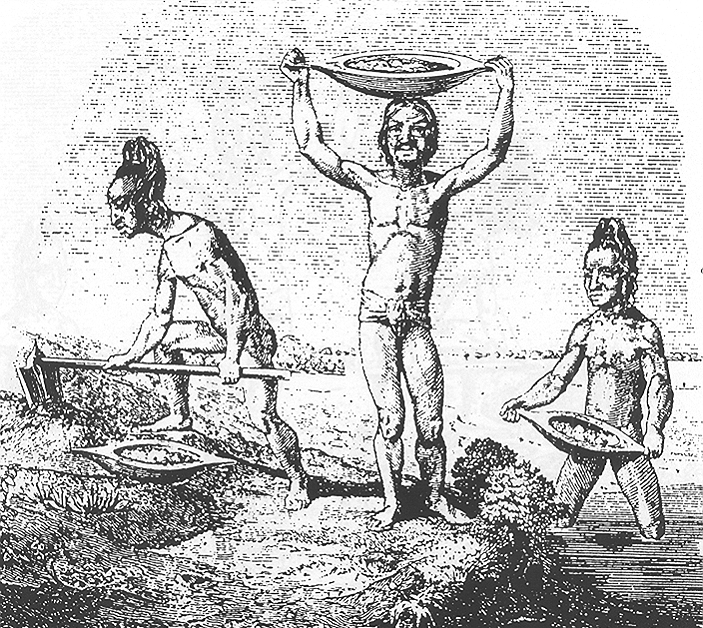
Early depiction of Taino panning for gold for the Spaniards

On September 6, 1492 Christopher Columbus set out on a voyage that was to significantly change the history of the world. His goals were to establish trade with the court of the Great Khan in China and to obtain gold, slaves, spices and other valuable commodities.

On Oct. 12, 1492, Columbus landed on the island of Guanahaní in the Bahamian archipelago. He believed that he had reached the outskirts of China. Guanahaní was inhabited by the Lucayo tribe of the Taino People. (Lucayo means dwellers on cays. Our word cay, meaning small
island, comes from the Taino language.) Columbus renamed Guanahaní San Salvador and declared it to be a territory of Spain. The Taino inhabitants who he called Indios (Indians) were declared to be Spanish subjects.

The official interpreter for Columbus' fleet was Luis de Torres who was a converted Jew. Torres was chosen as fleet interpreter because he spoke Hebrew and Arabic, which, for some reason, would enable him to communicate with the Chinese. Apparently Torres was unable to
converse with the Taino in Hebrew so another course of action was deemed necessary.

Several Tainos were kidnapped. One young man named Guaikan was taught to speak Spanish and became the interpreter for the expedition. Guaikan became Cristobol Colón's (Christopher Columbus) adopted Taino son. He took the name Diego Colón and sailed with Columbus on his subsequent voyages. Six of the captives were eventually brought to Spain and baptized with King Ferdinand and Queen Isabela acting as godparents. They were later allowed to return home with the exception of one who chose to remain at the Spanish royal court. He died two years later.

Columbus was finally able to communicate his desire to find the source of certain amulets and nose rings worn made from a yellow metal, which the Taino called guanin and the Spanish called oro. The guanin (an alloy made from gold silver and copper) had been obtained through trade with the Lucayan's neighbors who inhabited a large island to the south; today called Cuba.

The Lucayo captives guided Columbus to Cuba and agreed to help him find the gold, which was caracuriso dear to his heart. They followed their traditional canoe route through the Bahamian Cays. Their first stop was an island thought to be today's Rum Cay, where, according to the captives, the inhabitants wore massive golden bracelets and anklets. No gold was found. Columbus wrote "All they said was humbug in order to escape". (Two of the Lucayo prisoners took advantage of a lapse of vigilance and jumped overboard. Fellow Taino who had been following the fleet in their dugout canoe picked them up. The natives paddled away so fast that all attempts to recapture them were in vain.)

The fleet then sailed to what is today Long Island, which Columbus named Fernandina. Here Columbus was more successful. One of the islanders was wearing a gold nose stud, which he referred to as a caracuri. The owner of the caracuri refused Columbus' attempts at trade and ran away.

Columbus then guided the ships to an island the Taino called Saomete. He renamed it Isabela after the Queen, and it is now thought to be Crooked Island. According to his guides there was a
gold mine on this island and a king who wore cloths and had much gold. No mine or king was found, but Columbus was able to trade with the inhabitants, exchanging trinkets for gold caracuri.

From Saomete (Isabela) the fleet sailed on to Cuba. A return trip to the Bahamian Island of Great Inagua called Babeque by the Taino was attempted after Columbus learned from the Taino of Cuba that on Babeque the natives "gathered gold on the beach by candles at night,
and then made bars of it with a hammer". Headwinds forced Columbus to give up the voyage, but Martín Alonzo Pinzón, captain of the Pinta was successful. No gold was found on the beaches of that island; not at night, nor at any other time.

In a letter at least partly intended to solicit financial support from King Ferdinand and Queen Isabela, Columbus wrote: "…Finally, to compress into few words the entire summary of my voyage and speedy return, and of the advantages derivable therefrom, I promise, that
with a little assistance afforded me by our most invincible sovereigns, I will procure them as much gold as they need, as great a quantity of spices, of cotton, and of mastic and as many men for the service of the navy as their Majesties may require. I promise also rhubarb and other sorts of drugs, which I am persuaded the men whom I have left ... have found already and will continue to find…" It is interesting to note that only one report of a potential gold producing area was actually verified on the first voyage. The other riches promised were even more disappointing.

The spice that Columbus refers to in his letter was Canella alba, a plant that smells like cinnamon but is not useful as a spice. The mastic mentioned in the letter turned out to be the sap of the turpentine tree and not the valuable resin of the gum mastic tree.

The prospective slaves for service in the navy had such a low survival rate that the few survivors were returned to their island homes as an act of mercy by the crown. The rhubarb that was supposed to have been found was in fact not rhubarb at all but a plant known
now as false rhubarb. The promise of drugs probably refers to the discovery of an abundance of what was thought to be the medicinal plant aloe, but which was in reality the relatively worthless, century plant. Another worthless item that Columbus brought back to Spain as evidence of the riches that could be exploited from the continuance of his adventures was the unpleasant-tasting fruit of the icaco, which he believed to be the coconut mentioned in the
writings of Marco Polo.

Notwithstanding these inconsistencies, Columbus was successful in obtaining the desired financial support for his second voyage in which he was instructed by the crown to establish gold mines, install settlers, develop trade with the Tainos, and convert them to Christianity.

Marginally productive gold mines were eventually discovered in Hispaniola and later in Puerto Rico and Cuba. At first it was Spanish settlers who panned for gold in the rivers and worked the
newly discovered mines, but the combination of disappointing yields, harsh working conditions and high mortality rates quickly led to the abandonment of this activity by the Spaniards.

The task of gold mining was then given to enslaved Tainos. Most died from disease brought on by unsanitary conditions, overwork and lack of resistance to European illnesses. Countless others succumbed to famine that resulted when the Taino were not given sufficient time
to provide for their own sustenance. The chronicler, Las Casas, reported that only ten percent survived after three months of service and that there was a constant shortage of workers. As a
result inhabitants of other Caribbean islands were captured and enslaved. The mines in Hispaniola became depleted in the 1520's and those of Puerto Rico and Cuba became exhausted within the following decade.

The Taino cacique Guacanagari, who befriended Columbus and who was later sold into slavery by his "friend" twice sent Columbus facemasks with nose, tongue and ears made of gold.

Masks traditionally have spiritual significance. Was Guacanagari trying to make a statement about the true nature of Columbus's character?

Article Source: stjohnbeachguide.com

UCTP Taino News Moderator's Note: The above information is presented for educational purposes only. The views and opinions expressed within "Taino Gold" by Gerald Singer are not necessarily those of The Voice of the Taino People News Journal or the United Confederation of Taino People.