7/01/2008

Puerto Rico archeological find mired in politics

By FRANCES ROBLES,

frobles@MiamiHerald.com

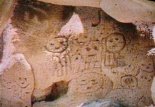
U.S. archaeologist Nathan Mountjoy sits next to stones etched with ancient petroglyphs and graves that reveal unusual burial methods in Ponce, Puerto Rico. The archaeological find, one of the best-preserved pre-Columbian sites found in the Caribbean, form a large plaza measuring some 130 feet by 160 feet that could have been used for ball games or ceremonial rites, officials said.

SAN JUAN -- The lady carved on the ancient rock is squatting, with frog-like legs sticking out to each side. Her decapitated head is dangling to the right.

That's how she had been, perfectly preserved, for up to 800 years, until the U.S. Army Corps of Engineers came upon her last year while building a $375 million dam to control flooding in southern Puerto Rico.

She was buried again last week with the hope that some day specialists will study her and Puerto Rican children will visit and learn about the lives of the Taino Indians who created her. But archaeologists and government officials first had to settle a raging debate about who should have control over her and other artifacts sent to Georgia for analysis.

The ancient petroglyph of the woman was found on a five-acre site in Jácana, a spot along the Portugues River in the city of Ponce, on Puerto Rico's southern coast. Among the largest and most significant ever unearthed in the Caribbean, archaeologists said, the site includes plazas used for ceremony or sport, a burial ground, residences and a midden mound -- a pile of ritual trash.

The finding sheds new light on the lifestyle and activities of a people extinct for nearly 500 years.

Experts say the site -- parts of it unearthed from six feet of soil -- had been used at least twice, the first time by pre-Taino peoples as far back as 600 AD, then again by the Tainos sometime between 1200 and 1500 AD.

''It was thrilling, a once-in-a-lifetime thing,'' said David McCullough, an Army Corps archaeologist. ``Just amazing.''

But like all things on this politically charged island, the discovery got caught up in a sovereignty debate: If an archaeological site rich in historic and cultural value is discovered in a federal construction site in Puerto Rico, a commonwealth of the United States, who should be in charge of it?

After months of finger-pointing and accusations of officially sanctioned plundering, the U.S. Army Corps of Engineers poured $2 million into preserving the site. Plans to put a rock dump over it were changed, and the unearthed discovery was reburied with the aspiration that archaeologists will eventually return to dedicate the 10 or 20 years needed to thoroughly study the finding.

The U.S. Army Corps of Engineers promises the collection sent to Georgia will be returned to Puerto Rico. Some 75 boxes of skeletons, ceramics, small petroglyphs and rocks were sent via Federal Express in two double-boxed shipments for analysis.

''The site is a significant contribution to our understanding of what Indians were doing,'' McCullough said. ``The thing that makes it unique is that the petroglyphs are so finely done. We originally were supposed to be there six weeks. It wound up taking four months.''

McCullough said the corps had an inkling that the site was there since the mid 1980s but had never done much testing. They started digging in earnest last year while building a dam and lake to protect the region from floods, and realized the site had significant value.

The corps found a ball court with four walls lined by tall stones, where they believe the Tainos either danced or played games. Three were covered in petroglyphs, among the best experts had ever seen. Some of the figures were carved upside down, which none of the archaeologists had ever seen before. Discoveries included a jade-colored amulet and the remains of a guinea pig, likely the feast of a tribal chief.

''The size of the ball court is bigger than just about anything else in the Caribbean,'' McCullough said.

Archaeologists believe as many as 400 people are buried there.

But in its quest to build the dam and use the location as a dumping ground for rocks, critics say the corps quickly hired a private archaeological firm to mitigate -- a hurried process of saving what can be conserved so a project can go forward. The company sent 125 cubic feet of artifacts in two shipments to its facility in Georgia for analysis, a move allegedly made without consulting Puerto Rican authorities, which locals felt violated the law.

But the question became: Whose law applied? U.S. law says such artifacts found by the corps must be warehoused in a federally approved curating facility. No such place exists in Puerto Rico. And Puerto Rican law says historical artifacts belong to the people of Puerto Rico.

''In Puerto Rico, everything that has to do with our past is sentimental, and Puerto Ricans take it to heart,'' said Marisol Rodríguez, an archaeologist at the Institute of Puerto Rican Culture. ``There's a feeling that you're taking something that's mine. It's about our national identity, regardless of the island's political status.''

Rodríguez is pleased that the site has been preserved but acknowledges she was furious at how it was originally excavated with heavy machinery.

''I was so angry. I was indignant,'' she said. ``I could not believe that a place of such importance was being treated with such disrespect.''

New South Associates, the firm hired to do the digging, says it excavated about 5 percent of the site for study.

''It was in the newspaper that we raped and pillaged the site, because it all got caught up in local politics,'' said archaeologist Chris Espenshade, New South's lead investigator on the project. ``We are required to take the artifacts to a federally approved curating facility. That played into the idea that we were stealing Puerto Rican cultural patrimony away and never bringing it back. There's no question these things should be available for Puerto Rican scholars without them having to travel to go see it.

``It's a bad situation.''

What's left of the site will remain beside a five-year dam construction project, which will continue as planned. It may be vulnerable to floods, archaeologists acknowledged, but they note that it lasted that way underground for hundreds of years.

''It's not the best way to preserve it, but it's better than the alternative: to destroy it,'' Espenshade said. ``The Corps could have destroyed it, but they took the highly unusual step to preserve it.''

Puerto Rican authorities say they are committed to opening a facility needed to properly store and exhibit the artifacts.

The Institute of Puerto Rican Culture is scouting locations and trying to secure the approximately $570,000 a year needed to operate such a warehouse. Officials hope it will open as early as mid-2009, but some experts still worry.

''Nobody could believe that in the 21st century, a federal agency would hire a private agency to dig up a site and take things,'' said Miguel Rodríguez, an archaeologist who sat on Puerto Rico's government archaeological council for a total of eight years.

He quit in January following a heart attack, which he blamed on stress over the Jácana site.

''Those are the things that happened in the 18th and 19th century, not now,'' Rodríguez said. ``Nobody dares go to Mexico, do an excavation and just take the stuff. That's officially sanctioned looting.''

While officials debate where they will find the funds for a museum, storage facility and lab, the Department of Natural Resources has hired 24-hour security to watch over the archaeological site, just to be sure no artifacts wind up for sale on the Internet.

''With the artifacts in Georgia,'' Department of Natural Resources Secretary Javier Vélez said, ``at least they are not on eBay.''

Source: Miami Herald

6/29/2008

Native Runners Continue On Sacred Journey

Photo: Two Peace and Dignity East Coast runners - Maximus Matos and Rafael Landron - joined by supporters Vanessa Inarunikia and Kuyayaku Pastrano displaying some of the sacred staffs that are being run in an incredible journey from New York to Panama.

UCTP Taino News – Runners participating in the East Coast Tributary route of the Peace and Dignity Journeys have made their way from New York through New Jersey, Pennsylvania, and Maryland heading toward Virginia. With their final destination scheduled for Panama, the group of runners and supporters began their journey in New York City on June 13 with sacred staffs representing the prayers of various Indigenous Nations. This year’s East Coast route is a historic first for the Peace and Dignity Journeys inter-continental run, which has taken place every four years since 1992.

At a ceremony for the East Coast runners held at Riverbank Park in Manhattan, approximately 75 representatives from many Indigenous nations gathered in one circle to welcome the sacred staffs the runners will carry throughout their journey. At the ceremony led by Grupo Cetiliztli Nauhcampa Quetzalcoatl, six representatives from East Coast Native Nations offered prayers. Messages of support were also received from Tonya Frichner (Onondaga) a UN representative, and Chief Dwayne Perry (Sachem Maqua/Chief Bear) of the Ramapo Mountain Lenape Nation.

The group of runners included Elizabeth Rexford (Inuit/Alaska), Elvira Colorado (Chichimec/Otomi), Hortensia Colorado (Chichimec/Otomi), Teyekahliyos “Dagots” Edwards (Onieda), Jennie Luna (Xicana/Caxcan/Mexica) as well as two Taino community members Maximus Matos (Taino) and Rafael Landron (Taino). At sunrise on Saturday, morning June 14, representatives of the United Confederation of Taino People
(UCTP) presented an additional unity staff to the group. The presentation was made by community leader Roberto Mukaro Borrero who explained that the Taino staff was a symbol of unity between the Arawak, Carib, and Taino Nations as well as a representation of the Guaraguao or Caribbean Red Tail Hawk within the Eagle and Condor prophecy.

Following the sunrise departure ceremony the group crossed the George Washington Bridge into New Jersey and made their way to Pennsylvania where they connected to Art Woolsey, PA coordinator for the Longest Walk II. Woolsey was instrumental in the logistical organizing for the runners through the state. While in Pennsylvania the group visited the grounds of the Carlisle Indian Industrial School and offered prayers at the institution’s cemetery. Over 100 indigenous children who were taken from their parents to attend the infamous boarding school died there and were interred on the grounds.

According to t
he East Coast Run coordinator Jeannie Luna the runners met up with the Longest Walk group in Greensburgh, PA. The two groups were able to share experiences and ceremony before the Peace and Dignity runners headed to Pittsburg where they were greeted by Taino community member Miguel Sobaoko Koromo Sague. A member of Council of Three Rivers American Indian Center – the only Native Center in all of PA - Sague along with other PA Native community members contributed supplies and extended much appreciated hospitality to the group. Sague who is also the founder of the Caney Spiritual Circle offered an additional Taino staff to join the UCTP’s prayer for Taíno unity.

Following their visit to a local Pow Wow in Farmington, PA that was held to honor the birth of a White Buffalo at a local zoo, the runners made their way to Friendsville, MD and Petersburgh, West Virginia.

The runners will also visit Washington DC plan and while in the area they plan to link up with the Haudenosaunee Spirit of the Youth Unity Run. These two groups will continue running together until July 5th when they will unite with the Trail of Tears runners in Tahlequah, Oklahoma for the closing ceremonies of the East Coast portion the route. From Oklahoma the sacred staffs will be run to Taos, New Mexico where they will join the main group making their way south.

This southern route from New Mexico will unite all runners of the East Coast Tributary and other routes and connect them to the main route, carrying all the prayers, work and energy towards Panama.

UCTPTN 06.29.2008

6/24/2008

The Not-So-Lost Tribe


Photo: The photo of the "Lost Amazon Tribe" widely distributed by sources such as Reuters and Survival International was a part of a hoax.

by Mike Krumboltz

Even in an age when cynical sleuths can hyper-analyze stories for truth and accuracy, the occasional hoax still slips through the cracks. Such was the case with a so-called "lost Amazon tribe."

A few months ago, mainstream news outlets (including, ahem, Yahoo!) reported that a photographer had found a lost tribe of warriors near the Brazilian-Peruvian border. Photos of the tribe backed up his claim.

As it turns out, the story is only half true. The men in the photo are members of a tribe, but it certainly ain't "lost." In fact, as the photographer, José Carlos Meirelles, recently explained, authorities have known about this particular tribe since 1910. The photographer and the agency that released the pictures wanted to make it seem like they were members of a lost tribe in order to call attention to the dangers the logging industry may have on the group.

The photographer recently came clean, and news outlets, perhaps embarrassed at having been taken for a ride, have been slow to pick up the story. Now, the word is starting to spread and articles in the Buzz are picking up steam. Expect a lot more brutal truth in the coming days.

6/20/2008

Museum Recognizes Caribbean Heritage


Photo: Several works by Arawak artist Foster Simon of Pakuri Territory in Guyana will be exhibited at the American Museum of Natural History’s Caribbean Festival.


New York, NY (UCTP Taino News) - The American Museum of Natural History will host a Caribbean Heritage Festival in recognition of the region’s cultural legacy and diversity on Sunday, June 22, 2008 from 12 noon – 5:00 p.m. The celebration will highlight the region's contributions and cultures through family friendly programs with guest presenters, performers and films. A Caribbean art display will be featured in the Museum’s Grand Gallery with artists representing Haiti, Jamaica, Trinidad, Guyana, Puerto Rico, and the Dominican Republic. Caribbean indigenous artists Aguilar Marrero and Reina Miranda of Taino Spirit as well as acclaimed Lokono Arawak artist Foster Simon of Guyana will have works exhibited. The program is presented in collaboration with the Haitian Centers Council, Inc. and is free with suggested Museum admission.

UCTPTN 06.20.2008

6/18/2008

Annual International Indian Treaty Conference to begin in Guatemala

Chimaltenago, Guatemala (UCTP Taino News) - The 34th Annual International Conference of the International Indian Treaty Council (IITC) begins this week on June 19-22, 2008 in the city of Chimaltenango, Guatemala. The conference will focus on strategic topics that designed to assist in the promotion and defense of the rights of Indigenous Peoples.

According to a recent IITC news release, the organizers are looking forward to the most diverse, pluralistic participation of representatives and authorities of Indigenous Peoples from the IITC member countries, as well as from all countries whose people have a keen interest in discussing strategies, plans, programs, visions and goals to continue working towards the challenging objective of ending the racism, discrimination, oppression, marginalization, exploitation, and imposition that Indigenous Peoples, are currently facing.

The conference organizers also note that although certain advances have been made in the field of domestic and international law, they are as yet insufficient and Indigenous Peoples are still facing difficult situations worldwide.

A delegation representing the United Confederation of Taino People (UCTP) is now in Guatemala to attend the conference and includes Naniki Reyes Ocasio of the Caney Quinto Mundo, and Mildred Karaira Gandia (UCTP Liaison), and Justin Seiba Ziegelasch, a youth delegate. In an historic moment for Taino People, the UCTP is scheduled to be officially welcomed as IITC affiliates before the assembly gathered in Chimaltenago.

The history and current situation of Mayan Peoples in Guatemala as well as implementing the United Nations Declaration on the Rights of Indigenous Peoples at the local to the international level will be some of the featured issues discussed at the conference. Other topics to be addressed include land and natural resource rights, treaties and agreements, reparations and redress processes, free prior and informed consent, self determination, environmental and racial justice. Dialogs will take place via panels, workshops, commissions, and training sessions.

Communications related to the conference can be directed to Conferencia2008@treatycouncil.org and additional information can be found at IITC website at http://www.treatycouncil.org/.


UCTPTN 06.18.2008