Showing posts with label Jamaica. Show all posts
Showing posts with label Jamaica. Show all posts


8/24/2013
Taino Delegates Join Jamaica’s Marcus Garvey Celebration
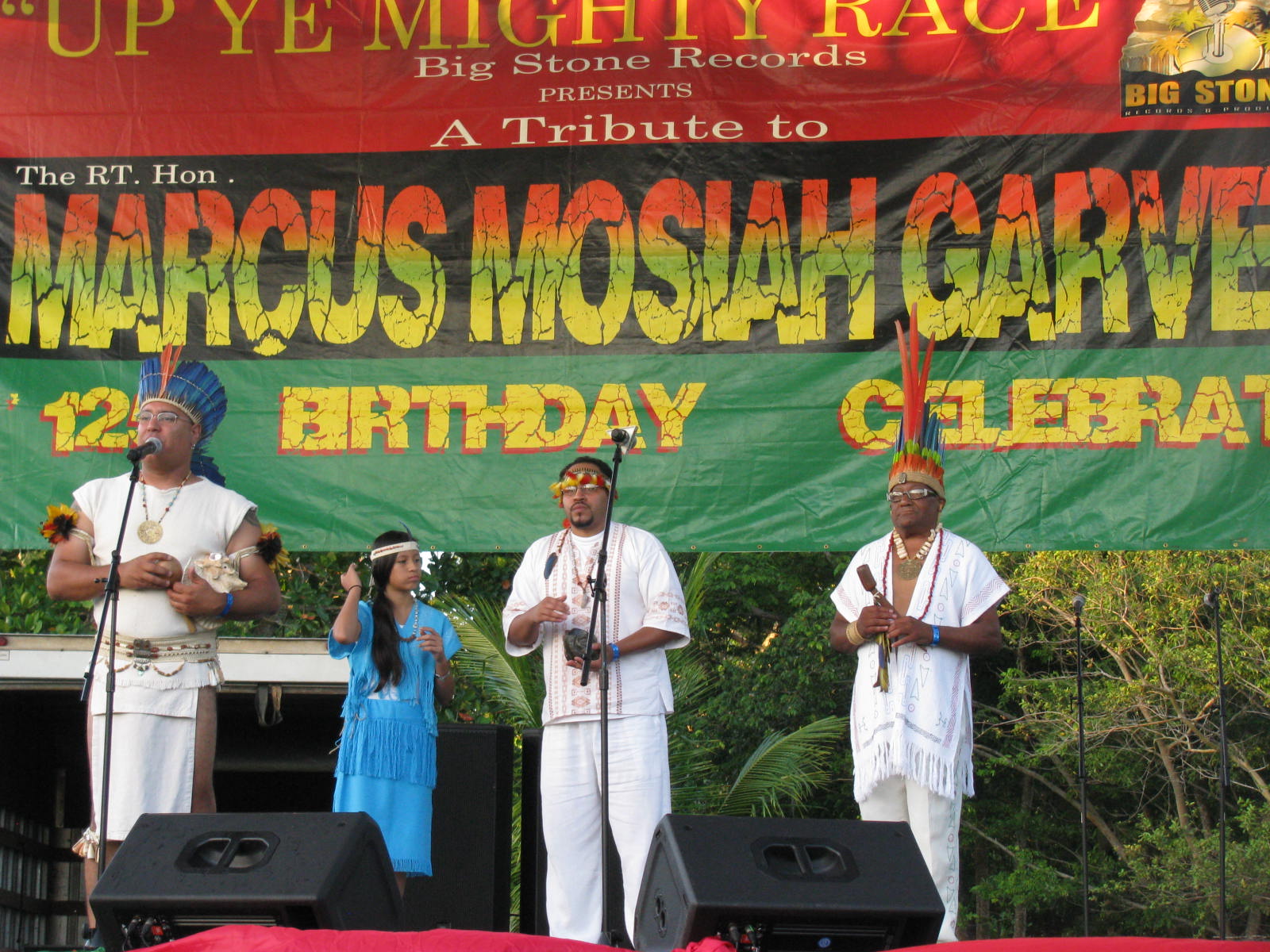 |
| A delegation of Taino People open the Marcus Garvey Celebration at Rio Nuevo Village in Jamaica |
St. Mary, Jamaica (UCTP Taino News) – This year’s annual celebration of the
birth of Jamaican National Hero, the “Right Excellent Marcus Mosiah Garvey,”
was historic in its unprecedented inclusion of an indigenous Taino delegation.
The daylong activity was held on Sunday, August 18th at the RioNuevo Village in St. Mary, Jamaica. The well-attended celebration began with
an early morning Taino ceremonial call to the “sacred directions” and featured an
interactive cultural presentation later in the day. The Taino delegation included
representatives of the Nacion Taina de las Antillas and the United Confederation of Taino People. The Taino delegates were invited to attend the
Garvey celebration by event sponsor, Irie FM, Jamaica’s number one Reggae music
radio station. Portions of the day’s
activities, including special on-site interviews, were broadcast live by Irie
FM.
Between and after their early morning and afternoon
presentations on the event’s main stage, the Taino delegates interacted with an
extremely interested public at a Taino kanei (rectangular chief’s home) built
especially for the occasion. Hundreds and hundreds of Jamaicans flocked to the
site throughout the day to speak to the Taino representatives and take photos.
These intense cultural exchanges included emotional interactions with elders
and leaders of Rastafarian community, as well as with leaders and community members
of several Jamaican Maroon communities. The “Maroons” are the descendants of
Africans who escaped enslavement and took refugee in the mountainous interior
of the island, and according to local history intermarried with remaining
Taino families. The Maroons initiated wars against the British Crown leading to
the signing of peace treaties, which included land rights for these
communities.
 |
| Irie FM's Mutabaruka interviews Taino leader R. Mukaro Borrero live in Jamaica |
“This is an historic and spiritually significant moment in our contemporary history
as it marks the first occasion that Taino people are participating in an event
of this kind in Jamaica, one of our sacred ancestral homelands” noted R. Múkaro
Borrero, a representative for the United Confederation of Taino People and
elected kasike (chief) of the Guainia Taino Tribe. Borrero continued stating,
“I trust our humble participation will set the stage for more intense campaigns
to raise a much needed Taino cultural awareness on the island.”
Borrero led the morning opening ceremony and afterward was
interviewed live by Mutabaruka, one of Irie FM’s top radio personalities. Another delegate, Kasike Rene Cibanacan was
also interviewed. These in-depth interviews reached thousands of listeners on
the island; many were emotionally and spiritually moved to come to the
celebration to meet the Taino delegates.
The “Garvey Celebration” was co-sponsored by Rio Nuevo
Village; Bigstones; Petcom Dunrobin; Fly Jamaica; JCDC St. Mary; Contractor
Music Marketing; and the Jamaica National Heritage Trust. Along with the Taino
cultural component, the event featured distinguished speakers, music and dance
performances, marching bands, African drummers, storytellers, and more.
10/06/2012

1/28/2010
Jamaicans Remember their Ancestors
Irish Town, Jamaica (UCTP Taino News) - In May 2007 the first official “Taino Day” was observed in Jamaica, however some Jamaicans would like to see more than a cursory nod given to the nation’s indigenous ancestors. Carol Miller a resident of Irish Town, St. Andrew hopes to facilitate the beginning of such a dialog this Saturday with a series of talks she is organizing on culture issues. The dialog series is entitled “Saturday Soup” and the first topic will address Jamaica’s “near forgotten ancestors” the Taino People.
Miller states that “in any given year our ancestral celebrations begin with the Accompong Maroons on January 6th, a day that celebrates the signing of the peace treaty with the British by Maroon leader Cudjoe. The celebration goes all day with never a mention of those who paved the way for the African maroons to take to the hills - the Tainos.”
She continues noting that “There is never discourse on the meeting of the two and the resulting integration of food, families and language.”
The Saturday Soup talks are open and will feature special topics and guests. Interested persons can contact the organizers at afuafofie@hotmail.com.
The United Confederation of Taino People's Office of International Relations and Regional Coordination (UCTP-OIRRC) has commended the initiative. "We need to support our relatives in Jamaica - this is one of our traditional homelands" stated UCTP representative Roberto Borrero. "We will do what we can to assist the organizers in the spirit of our ancestors."
Miller hopes that these discussions will help people make "historic, cultural, and spiritual connections” and that future national celebrations will do more to highlight the first Jamaicans.
UCTPTN 01.28.2010
Miller states that “in any given year our ancestral celebrations begin with the Accompong Maroons on January 6th, a day that celebrates the signing of the peace treaty with the British by Maroon leader Cudjoe. The celebration goes all day with never a mention of those who paved the way for the African maroons to take to the hills - the Tainos.”
She continues noting that “There is never discourse on the meeting of the two and the resulting integration of food, families and language.”
The Saturday Soup talks are open and will feature special topics and guests. Interested persons can contact the organizers at afuafofie@hotmail.com.
The United Confederation of Taino People's Office of International Relations and Regional Coordination (UCTP-OIRRC) has commended the initiative. "We need to support our relatives in Jamaica - this is one of our traditional homelands" stated UCTP representative Roberto Borrero. "We will do what we can to assist the organizers in the spirit of our ancestors."
Miller hopes that these discussions will help people make "historic, cultural, and spiritual connections” and that future national celebrations will do more to highlight the first Jamaicans.
UCTPTN 01.28.2010
11/10/2008
Remembering the Tainos: Jamaica's First People
KINGSTON (JIS) - Jamaica is regarded as a cultural melting pot due to its unique history and the racial diversity that has contributed to the country's cultural heritage.
One such group that is often overlooked are the Tainos, who are featured on the country's Coat of Arms.
"Most people probably handle money with this symbol everyday but probably never give a thought to it and it is ironic that something that is so visible, people know so little about," Senior Research Fellow at the African Caribbean Institute of Jamaica/ Jamaica Memory Bank (ACIJ/JMB), Dr. Julian Cresser, says in an interview with JIS News.
"I do think that more needs to be done, (as) the Tainos are certainly a part of the history syllabus but in terms of just the wider public knowing about them, I do think more could be done to promote knowledge about our indigenous people," he maintains.
The Tainos were the focus of the ACIJ/JMB's recent Open House Programme. "Well throughout our various exhibition programmes we have highlighted various groups that have contributed to the cultural heritage of Jamaica. We have focused in the past on the Chinese in Jamaica, we have looked at German immigration, and this year we decided to look at the Tainos," Dr. Cresser explains.
"What we have realized is that not much attention had been paid to the legacy of the Tainos and so we decided that it would be good for us to have a feature on them," he continues.
The Tainos, who are generally referred to as Arawaks, are recognized as the earliest recorded inhabitants of Jamaica. On this matter, Dr. Cresser notes that there is a distinction to be made between the words Taino and Arawak with the former referring to the inhabitants and the latter to a language.
"We believe the Tainos were the first inhabitants of Jamaica. They would have migrated from South America and reached the Greater Antilles somewhere around 700 to 1000 AD," he informs.
"Most people are more familiar with the name Arawak, we now believe that these groups of people were Arawak speaking people so Arawak refers to a group of languages spoken by these people and you had different groups of Arawak speaking people in the Greater Antilles," he further explains.
In appearance the Taino were short and muscular and had a brown olive complexion and straight hair. They wore little clothes but decorated their bodies with dyes. Religion was a very important aspect of their lives and they were mainly an agricultural people although they did have some technological innovations. Today, some of their practices and different aspects of their culture such as their language, and food, are still in use in Jamaica.
"Some of the things that are definitely part of our cultural heritage today that came from the Tainos are things like the use of cassava, especially the making of bammy that is a very popular part of our food heritage. There is also the use of tobacco, which is not just a part of Jamaica but (is used) right throughout the world. The Tainos used tobacco in a number of their religious ceremonies and rituals and in their daily life for relaxation," Dr. Cresser says.
"The Tainos also cultivated cotton and they had a process by which they wove it and were able to make hammocks. The word hammock is a derivative of a Taino word and so is barbeque, which refers to a way in which they prepared meat. So a number of these things that we see around us we may not realize that it has come down to us from the Tainos," he affirms.
Another interesting aspect of the Tainos is in relation to one of the more popular Jamaican proverbs such as being given "basket to carry water". This proverb generally refers to a situation in which a person is given an impossible task to complete.
However, Dr. Cresser points out that what many people don't realize is that some types of baskets can actually be used to carry water and that this is one such task that was carried out by the Tainos.
"Just recently I was telling somebody that you may hear the phrase "given a basket to carry water" which really means that you have been given inferior tools to do a job. But the Tainos actually used baskets to carry water. They had a process by which they made baskets from very finely woven wreath. And they were able to weave these so intricately to form a water tight basket," he enthuses.
Another important feature of the Tainos was that they had no system of writing and Dr. Cresser cites this as a major reason why Jamaica needs to record its history because to ensure that its done accurately.
"The Tainos as far as we know had no system of writing. What we know about the Tainos comes from archaeological finds, rock and stone art. They were artists and they made a number of drawings in caves. We would have also learned from the writings of the Spaniards who encountered them, as subjective as those writings may be," Dr. Cresser says.
Additionally, he points out that, "it is also believed that some Tainos made their way into the hilly interiors of Jamaica where they would have met and mixed with the earliest African Maroons and it is believed that some of the practices of the Tainos would have filtered down to us through this interaction with the Maroons".
Although the Tainos became extinct centuries ago, Dr. Cresser remains passionate about keeping their memory alive and asserts that it is important to honour and remember them.
"Just generally it is important to understand the history of Jamaica just to see how we have reached this point. The Tainos are our first inhabitants and their contact with the Europeans played a role in shaping Jamaica and I think it is important that we look at that," he emphasizes.
"Some aspects of Taino life have survived until today and because they have survived they are a part of our cultural identity and I think it is very important for people to be aware of all of those things that make up our identity, it is a part of knowing who we are," he further affirms.
The ACIJ/JMB is a division of the Institute of Jamaica, which serves to examine all aspects of Jamaica's cultural heritage and make this information accessible to the public, through its library as well as exhibition and outreach programmes.
One such group that is often overlooked are the Tainos, who are featured on the country's Coat of Arms.
"Most people probably handle money with this symbol everyday but probably never give a thought to it and it is ironic that something that is so visible, people know so little about," Senior Research Fellow at the African Caribbean Institute of Jamaica/ Jamaica Memory Bank (ACIJ/JMB), Dr. Julian Cresser, says in an interview with JIS News.
"I do think that more needs to be done, (as) the Tainos are certainly a part of the history syllabus but in terms of just the wider public knowing about them, I do think more could be done to promote knowledge about our indigenous people," he maintains.
The Tainos were the focus of the ACIJ/JMB's recent Open House Programme. "Well throughout our various exhibition programmes we have highlighted various groups that have contributed to the cultural heritage of Jamaica. We have focused in the past on the Chinese in Jamaica, we have looked at German immigration, and this year we decided to look at the Tainos," Dr. Cresser explains.
"What we have realized is that not much attention had been paid to the legacy of the Tainos and so we decided that it would be good for us to have a feature on them," he continues.
The Tainos, who are generally referred to as Arawaks, are recognized as the earliest recorded inhabitants of Jamaica. On this matter, Dr. Cresser notes that there is a distinction to be made between the words Taino and Arawak with the former referring to the inhabitants and the latter to a language.
"We believe the Tainos were the first inhabitants of Jamaica. They would have migrated from South America and reached the Greater Antilles somewhere around 700 to 1000 AD," he informs.
"Most people are more familiar with the name Arawak, we now believe that these groups of people were Arawak speaking people so Arawak refers to a group of languages spoken by these people and you had different groups of Arawak speaking people in the Greater Antilles," he further explains.
In appearance the Taino were short and muscular and had a brown olive complexion and straight hair. They wore little clothes but decorated their bodies with dyes. Religion was a very important aspect of their lives and they were mainly an agricultural people although they did have some technological innovations. Today, some of their practices and different aspects of their culture such as their language, and food, are still in use in Jamaica.
"Some of the things that are definitely part of our cultural heritage today that came from the Tainos are things like the use of cassava, especially the making of bammy that is a very popular part of our food heritage. There is also the use of tobacco, which is not just a part of Jamaica but (is used) right throughout the world. The Tainos used tobacco in a number of their religious ceremonies and rituals and in their daily life for relaxation," Dr. Cresser says.
"The Tainos also cultivated cotton and they had a process by which they wove it and were able to make hammocks. The word hammock is a derivative of a Taino word and so is barbeque, which refers to a way in which they prepared meat. So a number of these things that we see around us we may not realize that it has come down to us from the Tainos," he affirms.
Another interesting aspect of the Tainos is in relation to one of the more popular Jamaican proverbs such as being given "basket to carry water". This proverb generally refers to a situation in which a person is given an impossible task to complete.
However, Dr. Cresser points out that what many people don't realize is that some types of baskets can actually be used to carry water and that this is one such task that was carried out by the Tainos.
"Just recently I was telling somebody that you may hear the phrase "given a basket to carry water" which really means that you have been given inferior tools to do a job. But the Tainos actually used baskets to carry water. They had a process by which they made baskets from very finely woven wreath. And they were able to weave these so intricately to form a water tight basket," he enthuses.
Another important feature of the Tainos was that they had no system of writing and Dr. Cresser cites this as a major reason why Jamaica needs to record its history because to ensure that its done accurately.
"The Tainos as far as we know had no system of writing. What we know about the Tainos comes from archaeological finds, rock and stone art. They were artists and they made a number of drawings in caves. We would have also learned from the writings of the Spaniards who encountered them, as subjective as those writings may be," Dr. Cresser says.
Additionally, he points out that, "it is also believed that some Tainos made their way into the hilly interiors of Jamaica where they would have met and mixed with the earliest African Maroons and it is believed that some of the practices of the Tainos would have filtered down to us through this interaction with the Maroons".
Although the Tainos became extinct centuries ago, Dr. Cresser remains passionate about keeping their memory alive and asserts that it is important to honour and remember them.
"Just generally it is important to understand the history of Jamaica just to see how we have reached this point. The Tainos are our first inhabitants and their contact with the Europeans played a role in shaping Jamaica and I think it is important that we look at that," he emphasizes.
"Some aspects of Taino life have survived until today and because they have survived they are a part of our cultural identity and I think it is very important for people to be aware of all of those things that make up our identity, it is a part of knowing who we are," he further affirms.
The ACIJ/JMB is a division of the Institute of Jamaica, which serves to examine all aspects of Jamaica's cultural heritage and make this information accessible to the public, through its library as well as exhibition and outreach programmes.
Author: Don Dobson
Source: Jamaica Information Service
8/07/2008
Scientist: World's smallest snake in Barbados

In this photo taken in 2006 and released on Sunday, Aug. 3, 2008, by U.S. scientist S. Blair Hedges, an evolutionary biologist at Penn State University, the globe's tiniest snake is shown curled up on a U.S. quarter. Hedges said Sunday he has discovered the globe's tiniest species of snake in the easternmost Caribbean island of Barbados, with full-grown adults typically less than four inches (10 centimeters) long. He named the diminutive snake 'Leptotyphlops carlae' after his herpetologist wife, Carla Ann Hass.
(AP Photo/Penn State University, S. Blair Hedges)
(AP Photo/Penn State University, S. Blair Hedges)
By DAVID McFADDEN, Associated Press Writer
SAN JUAN, Puerto Rico - A U.S. scientist said Sunday he has discovered the globe's tiniest species of snake in the easternmost Caribbean island of Barbados, with full-grown adults typically stretching less than 4 inches (10 centimeters) long.
S. Blair Hedges, an evolutionary biologist at Penn State University whose research teams also have discovered the world's tiniest lizard in the Dominican Republic and the smallest frog in Cuba, said the snake was found slithering beneath a rock near a patch of Barbadian forest.
Hedges said the tiny-title-holding snake, which is so diminutive it can curl up on a U.S. quarter, is the smallest of the roughly 3,100 known snake species. It will be introduced to the scientific world in the journal "Zootaxa" on Monday.
"New and interesting species are still being discovered on Caribbean islands, despite the very small amount of natural forests remaining," said Hedges, who christened the miniature brown snake "Leptotyphlops carlae" after his herpetologist wife, Carla Ann Hass.
The Barbadian snake apparently eats termites and insect larvae, but nothing is yet known of its ecology and behavior. Genetic tests identified the snake as a new species, according to Hedges. It is not venomous.
Zoologist Roy McDiarmid, curator of amphibians and reptiles at the Smithsonian's National Museum of Natural History in Washington, said he has seen a specimen of the diminutive creature. He saw no reason to argue with the assertion that it is the world's smallest snake.
McDiarmid said the Barbados creature is a type of thread snake, also called worm snake, which are mostly found in the tropics. "We really know very little about these things," he said in a Sunday telephone interview from his Virginia home.
Finding the globe's tiniest snake demonstrates the remarkable diversity of the ecologically delicate Caribbean. It also illustrates a fundamental ecological principle: Since Darwin's days, scientists have noticed that islands often are home to both oversized and miniaturized beasts.
Hedges said the world's smallest bird species, the bee hummingbird, can be found in Cuba. The globe's second-smallest snake lives in Martinique. At the other end of the scale, one of the largest swallowtail butterflies lives in Jamaica.
Scientists say islands often host odd-sized creatures because they're usually inhabited by a less diverse set of species than continents. So island beasts and insects often grow or shrink to fill ecological roles that otherwise would be filled by entirely different species.
6/20/2008
Museum Recognizes Caribbean Heritage

Photo: Several works by Arawak artist Foster Simon of Pakuri Territory in Guyana will be exhibited at the American Museum of Natural History’s Caribbean Festival.
New York, NY (UCTP Taino News) - The American Museum of Natural History will host a Caribbean Heritage Festival in recognition of the region’s cultural legacy and diversity on Sunday, June 22, 2008 from 12 noon – 5:00 p.m. The celebration will highlight the region's contributions and cultures through family friendly programs with guest presenters, performers and films. A Caribbean art display will be featured in the Museum’s Grand Gallery with artists representing Haiti, Jamaica, Trinidad, Guyana, Puerto Rico, and the Dominican Republic. Caribbean indigenous artists Aguilar Marrero and Reina Miranda of Taino Spirit as well as acclaimed Lokono Arawak artist Foster Simon of Guyana will have works exhibited. The program is presented in collaboration with the Haitian Centers Council, Inc. and is free with suggested Museum admission.
UCTPTN 06.20.2008
UCTPTN 06.20.2008
5/26/2008
Professor Shepherd Calls For Expansion of Heritage Calendar
by Jamaica Information Service
MONTEGO BAY, JAMAICA (JIS) - Chairman of the Jamaica National Bicentenary Committee, Professor Verene Shepherd, has called for an expansion of the national heritage calendar to embrace all the critical moments in the country's history that have helped to shape the nation.
Professor Shepherd, who was delivering the main address at a ceremony held at the Frome Sugar Estate in Westmoreland on May 22, to commemorate the 70th anniversary of the Frome labour riots, said that while the existing calendar was commendable, there were still critical gaps in the country's history not accounted for.
"While I laud all those who helped to create the existing calendar so that we mark Reggae and Black History in February, Labour Day in May, Emancipation Day in August, and the Morant Bay Rebellion and the struggles of our heroes and heroine in October, I believe that there are critical gaps," she argued.
"I urge the cultural agencies to get together and collaborate on a more realistic national heritage calendar that will be more representative of the contributions and experiences of our people; all of our people," she stated.
Professor Shepherd clarified that she was not lobbying for all significant dates in the country's history to be declared as public holidays, but that some form of recognition should be given to these dates, no matter how small.
"Where all the commemorative events cannot be funded by the Government of Jamaica and the cultural agencies, they should be made the responsibility of parish councils and the Ministry of Education should insist that these commemorative moments are marked in all of our schools," she advocated.
Professor Shepherd said a more accurate calendar, would incorporate some of the dates recognized by the Jamaica National Bicentenary Committee, in addition to other significant dates.
These include the commemoration of the last ship with African slaves to arrive at the Kingston on February 17; the passage of the Trans-Atlantic Trade in Africans (TTA) Abolition Act on March 25; the anniversary of the outbreak Tacky's war on April 8; the trial of Sam Sharpe on April 19; and Frome massacre day on May 2.
She also cited Taino remembrance day, May 5; Indians arrival day, May 9; Sam Sharpe execution day, May 23; remembrance day for the victims of the TTA on August 23; hanging of Paul Bogle on October 25; and eruption of emancipation war on December 27.
The function was staged through the collaborative efforts of the Institute of Jamaica and the Frome Sugar Estate to mark the 1938 riots, which changed Jamaica's social and political history. A monument was laid to mark the spot where the labour unrest, which led to the riots, began.
MONTEGO BAY, JAMAICA (JIS) - Chairman of the Jamaica National Bicentenary Committee, Professor Verene Shepherd, has called for an expansion of the national heritage calendar to embrace all the critical moments in the country's history that have helped to shape the nation.
Professor Shepherd, who was delivering the main address at a ceremony held at the Frome Sugar Estate in Westmoreland on May 22, to commemorate the 70th anniversary of the Frome labour riots, said that while the existing calendar was commendable, there were still critical gaps in the country's history not accounted for.
"While I laud all those who helped to create the existing calendar so that we mark Reggae and Black History in February, Labour Day in May, Emancipation Day in August, and the Morant Bay Rebellion and the struggles of our heroes and heroine in October, I believe that there are critical gaps," she argued.
"I urge the cultural agencies to get together and collaborate on a more realistic national heritage calendar that will be more representative of the contributions and experiences of our people; all of our people," she stated.
Professor Shepherd clarified that she was not lobbying for all significant dates in the country's history to be declared as public holidays, but that some form of recognition should be given to these dates, no matter how small.
"Where all the commemorative events cannot be funded by the Government of Jamaica and the cultural agencies, they should be made the responsibility of parish councils and the Ministry of Education should insist that these commemorative moments are marked in all of our schools," she advocated.
Professor Shepherd said a more accurate calendar, would incorporate some of the dates recognized by the Jamaica National Bicentenary Committee, in addition to other significant dates.
These include the commemoration of the last ship with African slaves to arrive at the Kingston on February 17; the passage of the Trans-Atlantic Trade in Africans (TTA) Abolition Act on March 25; the anniversary of the outbreak Tacky's war on April 8; the trial of Sam Sharpe on April 19; and Frome massacre day on May 2.
She also cited Taino remembrance day, May 5; Indians arrival day, May 9; Sam Sharpe execution day, May 23; remembrance day for the victims of the TTA on August 23; hanging of Paul Bogle on October 25; and eruption of emancipation war on December 27.
The function was staged through the collaborative efforts of the Institute of Jamaica and the Frome Sugar Estate to mark the 1938 riots, which changed Jamaica's social and political history. A monument was laid to mark the spot where the labour unrest, which led to the riots, began.
2/11/2008
CARIFESTA 2008 to be held in GUYANA

UCTP Taino News - CARIFESTA stands for the Caribbean Festival of Arts and this year the region’s roving, multidisciplinary, mega arts festival will return to its birthplace – Guyana – from August 22 to 31 2008. CARIFESTA attracts a wide range of creative artists from various Caribbean and Latin American countries and was the culmination of a concept that began in 1970 when participants at an Artists and Writers Convention in Guyana complained about the absence of an outlet to showcase the rich cultural heritage of the Region. Since its inaugural launch in 1972, previous CARIFESTA have taken place in Guyana, Jamaica, Cuba, Barbados, Trinidad and Tobago, St. Kitts and Nevis, and Suriname. The Indigenous Peoples of the region have historically participated within the festival and in 2006, CARIFESTA coincided with an historic meeting of the Caribbean Organization of Indigenous Peoples (COIP) in Trinidad. During this meeting the COIP Secretariat was officially “handed over” from Guyana to Trinidad and a Declaration of Unity was entered into between the Santa Rosa Carib Community and the United Confederation of Taino People.
UCTPTN 02.11.2008
12/12/2007
Tropical storm flooding kills 9 in Caribbean

By Manuel Jimenez
SANTO DOMINGO, Dominican Republic (Reuters) - Flash flooding from Tropical Storm Olga's torrential rains killed at least eight people in the Dominican Republic and forced tens of thousands out of their homes, government officials said on Wednesday.
The storm weakened on Wednesday to a tropical depression after it exited Hispaniola, the island shared by Haiti and the Dominican Republic. But flooding remained a deadly threat as the remnants of Olga moved west across the Caribbean, forecasters at the U.S. National Hurricane Center in Miami said.
By late afternoon, Olga was just a broad mass of thunderstorms centered 65 miles north of Kingston, Jamaica. It was moving rapidly west on a course that would keep the center south of Cuba and take it over Mexico's Yucatan Peninsula by Saturday.
By late afternoon, Olga was just a broad mass of thunderstorms centered 65 miles north of Kingston, Jamaica. It was moving rapidly west on a course that would keep the center south of Cuba and take it over Mexico's Yucatan Peninsula by Saturday.
Olga's top sustained winds dropped to 35 mph (55 kph), below the threshold to be called a tropical storm, and forecasters expected it to dissipate further on Thursday.
See full story at: http://news.yahoo.com/s/nm/20071212/wl_nm/storm_olga_dc
Photo: Subtropical storm Olga is seen in the Caribbean in a satellite image taken December 11, 2007. (NOAA/Handout/Reuters)
8/19/2007
Hurricane Dean pummels Jamaica
 This NOAA satellite image taken Sunday, Aug. 19, 2007 at 1:45 PM EDT shows a dangerous category 4 hurricane, Hurricane Dean, bearing down on Jamaica with winds of 145 mph. This storm is on track to make either a direct hit on the island's southern shore or a very near pass later on today. (AP PHOTO/WEATHER UNDERGROUND)
KINGSTON, Jamaica (AP) - Hurricane Dean pummeled Jamaica with gusting winds and torrential rains Sunday after the prime minister made a last-minute plea for residents to abandon their homes and head for shelter. Many residents ignored the call, however, while tourists holed up in resorts with hurricane-proof walls.
The storm, which had already killed eight people on its destructive march across the Caribbean, triggered evacuation calls from the Cayman Islands to Texas, and forced the Space Shuttle to cut short its mission. Cruise ships changed course to avoid Dean, but some tourists in
Read the full story at:
http://news.yahoo.com/s/ap/20070819/ap_on_re_la_am_ca/tropical_weather

 AP Video
7/31/2007
Archaeologists discover slaves were wealthy and astute business men
Caribbean archaeologists say recent discoveries have forced them to rethink traditional views about the region's history.
They have just held their biennial conference in Jamaica, where the role of archaeology in understanding the Caribbean history came up for discussion.
The archaeologists say their findings are sometimes in direct contrast to what has been written by the "planter class", especially as it relates to the period of slavery.
Roderick Ebanks, who chaired the Jamaica conference, is one of the archaeologists doing research into the Caribbean's past.
He explained that they have come across the villages of enslaved workers and what they found is very different from what was written by contemporary planters.
At an excavated African workers village in Seville on the North coast of Jamaica there were keys and large padlocks in the buildings indicating there was a lot of material wealth.
As he pointed out the wealth is not surprising when you remember that the slaves create the internal marketing system. Many slaves were wealthy during slavery. Their wealth came not from handouts from planters but from their work in the grounds, their trading and their farms in the hills.
From oral tradition it was known that there was a close relationship between Africans and native Arawaks who were called Taino. Now DNA evidence is showing that the maroons carry a lot of genes of the Taino people. The African male slaves who escaped took Taino wives and those were the people who became the maroon population.
They have just held their biennial conference in Jamaica, where the role of archaeology in understanding the Caribbean history came up for discussion.
The archaeologists say their findings are sometimes in direct contrast to what has been written by the "planter class", especially as it relates to the period of slavery.
Roderick Ebanks, who chaired the Jamaica conference, is one of the archaeologists doing research into the Caribbean's past.
He explained that they have come across the villages of enslaved workers and what they found is very different from what was written by contemporary planters.
At an excavated African workers village in Seville on the North coast of Jamaica there were keys and large padlocks in the buildings indicating there was a lot of material wealth.
As he pointed out the wealth is not surprising when you remember that the slaves create the internal marketing system. Many slaves were wealthy during slavery. Their wealth came not from handouts from planters but from their work in the grounds, their trading and their farms in the hills.
From oral tradition it was known that there was a close relationship between Africans and native Arawaks who were called Taino. Now DNA evidence is showing that the maroons carry a lot of genes of the Taino people. The African male slaves who escaped took Taino wives and those were the people who became the maroon population.
*Source: http//www.cbc.bb (Friday, July 27, 2007)
Related Source:
 Mr Ebanks told Neil Nunes of the BBC about some of their findings.
7/29/2007
First Taino Day Observed in Jamaica

Saint Anns, Jamaica (UCTP Taíno News) - The Jamaica National Heritage Trust (JNHT) hosted its first Taíno Day on May 4, at Seville Heritage Park in St. Ann.
The official observance sought to commemorate the life and legacy of Jamaica's first inhabitants, who were formally referred to as the Arawaks.
The Executive Director of the JNHT, Laleta Davis-Mattis pointed out that Taino Day was a part of the Trust's annual observance of Encounter Day, which is "a day set aside to highlight the meeting of the various worlds or cultures that underpin our history and our ethnic composition," including the Spanish, English, Africans and Tainos.
The Executive Director explained that this year, "more historical significance and credence” was be placed on the Tainos and their contribution to Jamaican history.
The official observance sought to commemorate the life and legacy of Jamaica's first inhabitants, who were formally referred to as the Arawaks.
The Executive Director of the JNHT, Laleta Davis-Mattis pointed out that Taino Day was a part of the Trust's annual observance of Encounter Day, which is "a day set aside to highlight the meeting of the various worlds or cultures that underpin our history and our ethnic composition," including the Spanish, English, Africans and Tainos.
The Executive Director explained that this year, "more historical significance and credence” was be placed on the Tainos and their contribution to Jamaican history.
Activities marking the celebration included lectures and discussions; an exhibition of Taino artifacts; display and sampling of Taino food, Taino quiz and a mini zoo with Taino animals.
In an official statement to the JNHT, President of the UCTP’s Office of International Relations, Roberto Múcaro Borrero commend the initiative and looked forward to working together on next years commemoration.
6/20/2007
Of Pearls and Doing the Right Thing…
To: Blue Water Ventures
Greetings,
I read with great interest the Internet article about your Margarita shipwreck pearl find. My wife, Rose Powhatan (Pamunkey/Tauxenent ), and I gave a lecture at the Natural History Museum of New York on Powhatan and Caribbean Pearls. I would like you to consider the following:
The pearls found in this shipwrecked galleon's site were probably from the Caribbean Peal Trade located in the pearl beds off the Venezuelan island of Margarita . The sunken ship had the appropriate name since it was from its namesake island's waters that the pearls (that came to rival the old Eastern pearl trade) were harvested.
Lucayan Taínos (conch divers from the Bahama Islands) were among the first unfortunate souls used in this deplorable enterprise that helped to deplete the Bahamas of its indigenous people and the Caribbean of its ancient pearl beds. Aside from pearls found in conchs, Spanish explorers may have first encountered Indigenous American pearl trade among the mainland peoples of South America .
Father Bartholomew de las Casas reported the horrible conditions of these divers, "who once looked like men but now appeared as deformed dogs", and who were forced to dive at very deep depths from canoes by their cruel Spanish masters. He reported that if a diver surfaced too early he was pushed underwater by his master in the canoe. At the pearl diver's campsites they suffered from the bends, unhealed sores, starvation and diseases so that European royalty, nobility and merchants could have the luxury of wearing clothes dripping with excessive amounts of Caribbean pearls (See paintings of European royalty of this period). The only "positive" story to have come out of the Caribbean Pearl trade was that of an enslaved Caribbean "Indian" who was given his freedom by his master for finding the largest famous pearl named "La Peregrina" or "The Orphan" (So named because the diver found the pearl out of its shell).
The current owner of the re-hung "La Peregrena" is actress Elizabeth Taylor who was given the pearl by her late husband actor Richard Burton. La Peregrina was briefly lost in her rug; her poodle appeared with it in its mouth. Maybe both the pearls found at the Margarita's site and La Peregrina should be donated to a museum for display that would also acknowledge the holocaust-like history of the Caribbean Pearl Trade, the first European slave trade in the Americas and of the brutal early enslavement of the indigenous peoples of the Caribbean.
One Love,
Michael Auld (Yamaye Taino descendant)
------------------------------
Thousands of pearls found in shipwreck
KEY WEST, Fla. - Salvagers discovered thousands of pearls Friday in a small, lead box they said they found while searching for the wreckage of the 17th-century Spanish galleon Santa Margarita. Divers from Blue Water Ventures of Key West said they found the sealed box, measuring 3.5 inches by 5.5 inches, along with a gold bar, eight gold chains and hundreds of other artifacts earlier this week.
They were apparently buried beneath the ocean floor in approximately 18 feet of water about 40 miles west of Key West.
"There are several thousand pearls starting from an eighth of an inch to three-quarters of an inch," said Duncan Mathewson, marine archaeologist and partner in Blue Water Ventures.
James Sinclair, archaeologist and conservator consulting with Mel Fisher's Treasures, Blue Water's joint-venture partners, said the pearls are very rare because of their antiquity and condition. Sinclair said pearls don't normally survive the ocean water once they are out of the oyster that makes them.
"In this instance, we had a lead box and the silt that had sifted into the box from the site of the Margarita, which preserved the pearls in a fairly pristine state," he said.
An initial cache of treasure and artifacts from the Santa Margarita was discovered in 1980 by pioneering shipwreck salvor Mel Fisher.
The ship was bound for Spain when it sank in a hurricane in 1622. The pearls will be conserved, documented and photographed in an archaeological laboratory above the Mel Fisher Maritime Museum in Key West.
"Until they're properly cleaned and conserved we don't know their value, but it would seem they would be worth upwards of a million dollars," Mathewson said.
Greetings,
I read with great interest the Internet article about your Margarita shipwreck pearl find. My wife, Rose Powhatan (Pamunkey/Tauxenent ), and I gave a lecture at the Natural History Museum of New York on Powhatan and Caribbean Pearls. I would like you to consider the following:
The pearls found in this shipwrecked galleon's site were probably from the Caribbean Peal Trade located in the pearl beds off the Venezuelan island of Margarita . The sunken ship had the appropriate name since it was from its namesake island's waters that the pearls (that came to rival the old Eastern pearl trade) were harvested.
Lucayan Taínos (conch divers from the Bahama Islands) were among the first unfortunate souls used in this deplorable enterprise that helped to deplete the Bahamas of its indigenous people and the Caribbean of its ancient pearl beds. Aside from pearls found in conchs, Spanish explorers may have first encountered Indigenous American pearl trade among the mainland peoples of South America .
Father Bartholomew de las Casas reported the horrible conditions of these divers, "who once looked like men but now appeared as deformed dogs", and who were forced to dive at very deep depths from canoes by their cruel Spanish masters. He reported that if a diver surfaced too early he was pushed underwater by his master in the canoe. At the pearl diver's campsites they suffered from the bends, unhealed sores, starvation and diseases so that European royalty, nobility and merchants could have the luxury of wearing clothes dripping with excessive amounts of Caribbean pearls (See paintings of European royalty of this period). The only "positive" story to have come out of the Caribbean Pearl trade was that of an enslaved Caribbean "Indian" who was given his freedom by his master for finding the largest famous pearl named "La Peregrina" or "The Orphan" (So named because the diver found the pearl out of its shell).
The current owner of the re-hung "La Peregrena" is actress Elizabeth Taylor who was given the pearl by her late husband actor Richard Burton. La Peregrina was briefly lost in her rug; her poodle appeared with it in its mouth. Maybe both the pearls found at the Margarita's site and La Peregrina should be donated to a museum for display that would also acknowledge the holocaust-like history of the Caribbean Pearl Trade, the first European slave trade in the Americas and of the brutal early enslavement of the indigenous peoples of the Caribbean.
One Love,
Michael Auld (Yamaye Taino descendant)
------------------------------
Thousands of pearls found in shipwreck
KEY WEST, Fla. - Salvagers discovered thousands of pearls Friday in a small, lead box they said they found while searching for the wreckage of the 17th-century Spanish galleon Santa Margarita. Divers from Blue Water Ventures of Key West said they found the sealed box, measuring 3.5 inches by 5.5 inches, along with a gold bar, eight gold chains and hundreds of other artifacts earlier this week.
They were apparently buried beneath the ocean floor in approximately 18 feet of water about 40 miles west of Key West.
"There are several thousand pearls starting from an eighth of an inch to three-quarters of an inch," said Duncan Mathewson, marine archaeologist and partner in Blue Water Ventures.
James Sinclair, archaeologist and conservator consulting with Mel Fisher's Treasures, Blue Water's joint-venture partners, said the pearls are very rare because of their antiquity and condition. Sinclair said pearls don't normally survive the ocean water once they are out of the oyster that makes them.
"In this instance, we had a lead box and the silt that had sifted into the box from the site of the Margarita, which preserved the pearls in a fairly pristine state," he said.
An initial cache of treasure and artifacts from the Santa Margarita was discovered in 1980 by pioneering shipwreck salvor Mel Fisher.
The ship was bound for Spain when it sank in a hurricane in 1622. The pearls will be conserved, documented and photographed in an archaeological laboratory above the Mel Fisher Maritime Museum in Key West.
"Until they're properly cleaned and conserved we don't know their value, but it would seem they would be worth upwards of a million dollars," Mathewson said.
6/09/2007
Environmental group raises concerns over Negril resort
THE Jamaica Environmental Advocacy Network (JEAN) has expressed concern about the proposed building of a 6,228-room development resort on 361 acres of land on the Negril Peninsula.
The proposed development will cover a large parcel of land on Negril's west end, and the environmental network, in a statement this week, said irreparable damage would be done to secondary and primary forest of the most threatened kind in the Caribbean and Jamaica if construction of the resort goes ahead.
"This tropical dry forest includes small, highly specialised ecosystems, which are unique to Jamaica and the rest of the world. Negril Hill was an island for extended periods of time; hence its very special evolutionary history of which little is known," the statement said.
The group said an environmental impact assessment (EIA) conducted by consultants hired by the development company failed to provide a complete assessment of either the plants and animals on the site.
"The section of the EIA that deals with environmental impacts and mitigation is wholly inadequate, failing to address sewage or drainage impacts sufficiently," the environment group said.
JEAN also bashed a proposal by the consultants that coral be relocated to other sections of the coastline.
"The EIA proposes coral transplantation as a mitigation measure, but fails to provide any information on the success of coral relocation. In fact, according to experts, this is a risky and costly approach with a spotty record of success," said the group.
JEAN claims that the proposal to construct a marina and alter the shoreline, by dredging and building five sandy beaches, is a recipe for disaster and would result in negative effects on air quality, allow invasive species to take over the area, hazardous waste management, oil spills and storm water management.
The group was also concerned about the impact on Negril's cultural heritage.
"According to the journal of the Archaeological Society of Jamaica, there are five Taino cave sites in Negril, four of which are burial caves, and one of which had a petroglyph (carving)," the release stated.
JEAN also urged the National Environment and Planning Agency to call for a new EIA to be conducted and for sections of the site to be declared as conservation areas as well as the immediate stoppage of cutting and bulldozing.
Source: The Jamiaca Observer
The proposed development will cover a large parcel of land on Negril's west end, and the environmental network, in a statement this week, said irreparable damage would be done to secondary and primary forest of the most threatened kind in the Caribbean and Jamaica if construction of the resort goes ahead.
"This tropical dry forest includes small, highly specialised ecosystems, which are unique to Jamaica and the rest of the world. Negril Hill was an island for extended periods of time; hence its very special evolutionary history of which little is known," the statement said.
The group said an environmental impact assessment (EIA) conducted by consultants hired by the development company failed to provide a complete assessment of either the plants and animals on the site.
"The section of the EIA that deals with environmental impacts and mitigation is wholly inadequate, failing to address sewage or drainage impacts sufficiently," the environment group said.
JEAN also bashed a proposal by the consultants that coral be relocated to other sections of the coastline.
"The EIA proposes coral transplantation as a mitigation measure, but fails to provide any information on the success of coral relocation. In fact, according to experts, this is a risky and costly approach with a spotty record of success," said the group.
JEAN claims that the proposal to construct a marina and alter the shoreline, by dredging and building five sandy beaches, is a recipe for disaster and would result in negative effects on air quality, allow invasive species to take over the area, hazardous waste management, oil spills and storm water management.
The group was also concerned about the impact on Negril's cultural heritage.
"According to the journal of the Archaeological Society of Jamaica, there are five Taino cave sites in Negril, four of which are burial caves, and one of which had a petroglyph (carving)," the release stated.
JEAN also urged the National Environment and Planning Agency to call for a new EIA to be conducted and for sections of the site to be declared as conservation areas as well as the immediate stoppage of cutting and bulldozing.
Source: The Jamiaca Observer
4/17/2007
Release from the Archaeological Society of Jamaica

From: wacicjamaica@gmail.com
"We are pleased to announce that the first major publication on Archaeology in Jamaica will be launched in Kingston on Tuesday, May 22, 2007.
The book titled " The Earliest Inhabitants: The dynamics of the Jamaican Taino" will be formally presented at the ceremony to be held starting at 6.30 p.m. at the Rex Nettleford Hall at the University of the West Indies Campus at Mona in Kingston, Jamaica.
It is a collection of works by various archaeologists and researchers on "The Earliest Inhabitants", edited by Lesley-Gail Atkinson, published by the University of the West Indies Press and launched with the cooperation of the Archaeological Society of Jamaica
If anyone wishes more information on how to purchase the book please email:
"We are pleased to announce that the first major publication on Archaeology in Jamaica will be launched in Kingston on Tuesday, May 22, 2007.
The book titled " The Earliest Inhabitants: The dynamics of the Jamaican Taino" will be formally presented at the ceremony to be held starting at 6.30 p.m. at the Rex Nettleford Hall at the University of the West Indies Campus at Mona in Kingston, Jamaica.
It is a collection of works by various archaeologists and researchers on "The Earliest Inhabitants", edited by Lesley-Gail Atkinson, published by the University of the West Indies Press and launched with the cooperation of the Archaeological Society of Jamaica
If anyone wishes more information on how to purchase the book please email:
wacicjamaica@gmail.com"
******************************
Related Articles:
UCTP Book Announcement:
http://uctp.blogspot.com/2006/11/earliest-inhabitants-dynamics-of.html
Jamaican Gleaner Review (Nov. 19, 2006)
http://www.jamaica-gleaner.com/gleaner/20061119/arts/arts4.html
******************************
Related Articles:
UCTP Book Announcement:
http://uctp.blogspot.com/2006/11/earliest-inhabitants-dynamics-of.html
Jamaican Gleaner Review (Nov. 19, 2006)
http://www.jamaica-gleaner.com/gleaner/20061119/arts/arts4.html
12/30/2006
UDC opens refurbished Two Sisters Cave
The Urban Development Corporation (UDC) added a new attraction to its portfolio with the official opening of Two Sisters Caves in Hellshire, St Catherine on December 8.
Welcoming visitors to the attraction, President and CEO Marjorie Campbell said that "Two Sisters represents one of the jewels in the UDC's crown of natural attractions, which include the world-famous Dunn's River Falls and Park and Green Globe-certified Green Grotto Caves and Attraction".
Campbell also said that Two Sisters Caves' close proximity to Kingston makes it an important part of the tourism and recreation product of that section of the island.
The attraction also received high praise from acting director of the Tourism Product Development Company (TPDCo) Barrington Payne, who represented the minister of tourism, entertainment and culture.
"A true gem has been unearthed, one that fits into the master plan for sustainable tourism development, of being a cave, community-based and environmentally sustainable," said Payne.
Two Sisters Caves, which is believed to be a Taino ceremonial site, was refurbished by the UDC which, in addition to improving the stairs and supporting infrastructure, built a nature trail. Refreshment and souvenir kiosks have been added as well as sanitary conveniences and a children's play area.
Hellshire has been a designated area of the UDC since 1968 and projects currently under way include the 165 two-bedroom Hellshire Glades Housing Development, the phased refurbishing of the Fort Charles Beach Park and the implementation of the Hellshire Environmental Management Plan (HEMP), which will guide future developments.
Source: Jamaica Observer
Welcoming visitors to the attraction, President and CEO Marjorie Campbell said that "Two Sisters represents one of the jewels in the UDC's crown of natural attractions, which include the world-famous Dunn's River Falls and Park and Green Globe-certified Green Grotto Caves and Attraction".
Campbell also said that Two Sisters Caves' close proximity to Kingston makes it an important part of the tourism and recreation product of that section of the island.
The attraction also received high praise from acting director of the Tourism Product Development Company (TPDCo) Barrington Payne, who represented the minister of tourism, entertainment and culture.
"A true gem has been unearthed, one that fits into the master plan for sustainable tourism development, of being a cave, community-based and environmentally sustainable," said Payne.
Two Sisters Caves, which is believed to be a Taino ceremonial site, was refurbished by the UDC which, in addition to improving the stairs and supporting infrastructure, built a nature trail. Refreshment and souvenir kiosks have been added as well as sanitary conveniences and a children's play area.
Hellshire has been a designated area of the UDC since 1968 and projects currently under way include the 165 two-bedroom Hellshire Glades Housing Development, the phased refurbishing of the Fort Charles Beach Park and the implementation of the Hellshire Environmental Management Plan (HEMP), which will guide future developments.
Source: Jamaica Observer
11/28/2006
Earliest Inhabitants: The Dynamics of the Jamaican Taino
Earliest Inhabitants: The Dynamics of the JamaicanTaino
by Lesley-Gail Atkinson (Editor)
• Paperback: 250 pages
• Publisher: University of West Indies Press (July 2006)
• Language: English
• ISBN: 9766401497
This book highlights the variety of research conducted on the island's prehistoric sites and artefacts. The text is a compilation of thirteen articles, five of which have been previously published but not widely available. The remaining eight new articles are based on archaeological research within the last five years. The book will appeal to a wide audience of archaeologists, historians, students of archaeology and anyone interested in Jamaica's history.

You can find this book at:
amazon.com/Earliest-Inhabitants-Dynamics-Jamaican-Taino/dp/9766401497
by Lesley-Gail Atkinson (Editor)
• Paperback: 250 pages
• Publisher: University of West Indies Press (July 2006)
• Language: English
• ISBN: 9766401497
This book highlights the variety of research conducted on the island's prehistoric sites and artefacts. The text is a compilation of thirteen articles, five of which have been previously published but not widely available. The remaining eight new articles are based on archaeological research within the last five years. The book will appeal to a wide audience of archaeologists, historians, students of archaeology and anyone interested in Jamaica's history.

You can find this book at:
amazon.com/Earliest-Inhabitants-Dynamics-Jamaican-Taino/dp/9766401497
10/13/2006
Famed Welsh Athlete is Part-Taino

UCTP Taino News - Colin Ray Jackson, born February 18, 1967 in Cardiff, Wales is a sprint and hurdling champion of Jamaican and Scottish ancestry.
The athlete who recently turned TV sports commentator and television presenter predominantly for the BBC took part in an episode of the TV genealogy series “Who Do You Think You Are?” in September.
The program aired in the UK and in the genetic tests that are the focus of the show, Jackson genetic tests showed his ancestry to be 55% African, 7% Native American, and 38% European.
Jackson’s seven per cent Native American DNA showed that he is descended from the Tainos, the original indigenous inhabitants of Jamaica, who later mixed with escaped slaves and formed their own Maroon communities. The Maroons also fought against slavery and for Jamaican independence in the 17th century.
Cynthia Rosers, a genealogist at the Jamaican register general’s department, said: “Colin Jackson, is very light skinned. In Jamaica we would call him brown, but in American they would call him ‘redbone’.”
"The fieriness that the maroons had, first with their fight with the Spanish and then the English, I think I've got that in me now” said Jackson.
“When I lined up on many occasions to compete for Great Britain, it took a lot of heart and soul to get out there and to really be at war with my competitors... I feel really proud that I'm still linked genetically to the first settlers of Jamaica."
UCTPTN 10.13.2006
9/12/2006
Sustainability Practices in the Caribbean
by Prensa Latina
SAN JUAN (PL) - The Path to Sustainability is the general theme for the Green Globe International Conference and the Green Tourism Conference to be held November 1st - 3rd at the Half Moon Hotel in Montego Bay, Jamaica.
A press release from the Caribbean Hotel Association (CHA) says the conference is a joint staging of the 2nd biennial International Green Globe Conference (the inaugural edition was held March 2004 in New Zeeland) and the 3rd biennial Caribbean Green Tourism Conference.
The 2006 edition is organized by the Caribbean Alliance for Sustainable Tourism (CAST) assisted by its parent organization, the Caribbean Hotel Association, and Green Globe Asia Pacific (GGAP). The goal of the conference is to determine the sustainability priorities and actions that GGAP, CAST and their industry partners must pursue over the next two years, in service to the regional tourism industry.
The conference program is structured around three main topics: Tourism Sustainability; Achieving Market Value Added; and Innovative Practices. On the first day, participants will have the opportunity to discuss current sustainability problems in order to redefine the urgency for actions and solutions. In addition, they will study sustainability strategies in Jamaica and Dominica, as well as the public-private sector collaboration role within the tourism industry. Day two will focus on sustainable tourism marketing products and includes a plenary session with a Green Suppliers' Forum on Products & Technology.
Energy conservation, wastewater treatment, sustainable building design, and air quality are some of the issues to be addressed on the second day of the conference - which will also include a discussion forum for participants of the Green Globe Caribbean Program.
Activities will culminate with the case presentations from award-winning properties, the 2006 American Express Caribbean Environmental Award winners Sandals Montego Bay (large hotel category) and 3 Rivers Eco Lodge (small hotel category).
Other conference highlights are a gala opening with a featured speaker, a trade fair of sustainability products and solutions, nature tours, and informal functions with opportunities for networking and exploring the best of Jamaica, among other activities.
SAN JUAN (PL) - The Path to Sustainability is the general theme for the Green Globe International Conference and the Green Tourism Conference to be held November 1st - 3rd at the Half Moon Hotel in Montego Bay, Jamaica.
A press release from the Caribbean Hotel Association (CHA) says the conference is a joint staging of the 2nd biennial International Green Globe Conference (the inaugural edition was held March 2004 in New Zeeland) and the 3rd biennial Caribbean Green Tourism Conference.
The 2006 edition is organized by the Caribbean Alliance for Sustainable Tourism (CAST) assisted by its parent organization, the Caribbean Hotel Association, and Green Globe Asia Pacific (GGAP). The goal of the conference is to determine the sustainability priorities and actions that GGAP, CAST and their industry partners must pursue over the next two years, in service to the regional tourism industry.
The conference program is structured around three main topics: Tourism Sustainability; Achieving Market Value Added; and Innovative Practices. On the first day, participants will have the opportunity to discuss current sustainability problems in order to redefine the urgency for actions and solutions. In addition, they will study sustainability strategies in Jamaica and Dominica, as well as the public-private sector collaboration role within the tourism industry. Day two will focus on sustainable tourism marketing products and includes a plenary session with a Green Suppliers' Forum on Products & Technology.
Energy conservation, wastewater treatment, sustainable building design, and air quality are some of the issues to be addressed on the second day of the conference - which will also include a discussion forum for participants of the Green Globe Caribbean Program.
Activities will culminate with the case presentations from award-winning properties, the 2006 American Express Caribbean Environmental Award winners Sandals Montego Bay (large hotel category) and 3 Rivers Eco Lodge (small hotel category).
Other conference highlights are a gala opening with a featured speaker, a trade fair of sustainability products and solutions, nature tours, and informal functions with opportunities for networking and exploring the best of Jamaica, among other activities.
Subscribe to:
Posts (Atom)