Showing posts with label Caguana. Show all posts

7/16/2012

Boriken Youth to Begin Sacred Run


Yari Sierra promoting the 2012 Peace and Dignity Run in Ponce
Ponce, Boriken/Puerto Rico (UCTP Taino News) – One of the coordinators of the 2012 Boriken Peace and Dignity Run, Yari Sierra, hosted a final fundraising activity at Ponce's Plaza del Caribe shopping mall to promote the upcoming Taíno sacred run and related events in the Ponce area. Sierra is working hard to generate the necessary funds to cover the expenses of this year’s Run scheduled to begin in two days.

Equipped with promotional material brochures and summary pages, Sierra presented video clips of last year's successful Peace and Dignity Run along with photographs to an interested public. Many individuals stopped by her information table to learn more about this historic event and the young Taíno community members that are putting this all together.

Participants and supporters of the Boriken Peace and Dignity Run will camp out at Jayuya's "Cemi Cedetra y Casa Canales" located in Coabey on Tuesday afternoon to begin preparations for Wednesday's Sunrise ceremony. This ceremony will officially begin the 2012 Peace and Dignity Run on the island, which links to an additional run down the East Coast of the U.S., and the main continental run schedule to end in Guatemala this December. An additional run will take place in Kiskeia (Dominican Republic) around the same time period.
.
Runners will make the journey from CEDERTA in Jayuya to Utuado's Caguana Ceremonial Center on Wednesday afternoon. Thursday's morning events will start at Jacanas from where runners will trek to Tibes Ceremonial Park in Ponce.  From Tibes, the runners will head to Mayaguez with activities scheduled till the end of the week.

For more information on how you can support the 2012 Boriken Peace and Dignity Run contact yarisina1@yahoo.com or visit http://www.indiegogo.com/projects/164824 .

Author: Roger Guayacan Hernandez
Source: UCTP Taino News

5/31/2012

Alvarez Family Returns to Boriken


The Alvarez family returns to Boriken to reconnect with their roots.
Ponce, Boriken/Puerto Rico (UCTP Taino News) - The Alvarez Family returned to their old stomping grounds in Utuado, Boriken after half a century away. During their recent family reunion trip, they visited indigenous ceremonial sites on the island to further connect to, and reaffirm their roots. The trip was organized by Susan Alvarez, who contacted the United Confederation of Taino People for assistance. Alvarez is enrolled with the Confederation.

The family delegation included Susan Alvarez, along with her two children, Kathleen and Charles, and her sisters Judith and Carmen Pagano, and Carmen’s two daughters Hyacinth and Heather. They started their journey on a Friday morning, visiting ceremonial centers between Ponce and Utuado crossing thru “Las Indierras” and the Cordillera Central mountain range.  “The mountains always call me, I never felt more at home as when I was passing our beautiful, majestic mountains” said Carmen (Mita), the family matriarch.

With trip itinerary prepared by “Mountain Tours”, proprietor Roger Guayakan Hernandez was the official guide for the family. Hernandez is also a Liaison Officer for the United Confederation of Taíno People on the island. Their first stop was to Ponce's Tibes Ceremonial Center.  At the Center’s museum, the many artifacts and informative dioramas complimented the orientation presented by Taíno community member Luis Santiago of Wakia Arawaka.  This Center features a film explaining what researcher call the Igneri (Saladoid) culture to the so-called Pre-Taino who settled the site along the “Valley of Tibes” from around 300AD to 1000. The grounds feature seven "batei” and two large ceremonial "plazas".

Kathleen, Susan, and Charles Alvarez at Caguana
“This educational tour was so interesting and it explained a great deal” stated Judith.

After a tasty roast “pernil”, pollo and “costillas “luncheon at Adjuntas family restaurant - "El Boriqua", the tour proceeded to Utuado's Caguana Indigenous Ceremonial Center thru the winding mountain road along the Adjuntas/Dos Bocas River Valley.  The Caguana Ceremonial Center features 22 large stone petroglyphs lining the numerous, and large “batu (ballgame)” courts along the Tanama Valley hillside facing the spectacular “Semi” mountain peak.  This Taino site has been occupied since 900AD indicative thru “Ostiones” artifacts found along with Capa style highly decorated ceramics (1280AD- 1500AD).

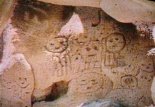
The renowned petroglyph known as "mujer de Caguana" shows her elaborate “crown” with large ear rings representing an advanced age woman of a respected social position. Her eyes are closed and her bony thorax with her lower extremities similar to a frog's legs are said to denote vitality. The circular figure on her abdomen with a dot in the middle represents her navel and her evident reproductive organ implies her as a fertility figure giving birth to many children.  Her squatting position is a sign of power and commands respect.

Commenting on the petroglyph Carmen stated “How wonderful we as women were treated with the highest of respect and honor. My grandparents were so loving and respectful to each other so we as Taino-Boricua women had a great base as how we should be treated.”

After passing thru the half century improvements (since the family’s time in the Diaspora) made to the Utuado area, the tour returned thru the old Camino Reale (King's Road Route 123), which is awaiting the last stage of the $20 million dollar connection between Adjuntas and Utuado to complete a new expressway Route 10 between Ponce and Arecibo.  The 3,000 ft elevated rural central mountain range has kept this region relatively isolated. This continues as it has for the past 500 years holding the ancestral secrets of the many villagers who have settled along the many rivers and tributaries for the past few thousand years.

“WOW!” exclaimed Carmen. “The trip thru the mountains was hair-raising in many ways, from the winding roads to the majestic views. We all knew we were home”. She continued stating “It feels so good to be home.  We will be back.  We will continue to study and learn about our people’s ways.  We will teach our children.  I was so happy my daughters, sisters, nephew and niece were here to experience this wonderful beautiful experience.”

With great pride she added “We came home to the land of enchantment, we Taino came home to the beauty of Boriken.”


10/14/2009

Economic Crises in Boriken (Puerto Rico)

Boriken/Puerto Rico (UCTP Taino News) - Puerto Rican Governor Luis Fortuño has implemented widespread job cuts affecting all sectors of the island's population. In the midst of Puerto Rico's worsening economic crises, Fortuño plans promote the privatization of basic infrastructural services such as electricity, water, and the education system.

Reports estimate that nearly 20,000 civil servants already have or will lose their jobs. Analysts note that the loss of jobs in the government sector will affect similar losses in the private sector.

The island's cultural patrimony is one area that will be particularly impacted by job losses. Reports indicate that museums and national parks under the control of the Institute of Puerto Rican Culture (ICP) such as the Caguana Indigenous Ceremonial Center will now be forced to close. These institutions will not only lose staff for daily operations but collections and archives are now potentially at risk without proper supervision and controls.

In the form of several recent amendment proposals to controversial "Law 7", ICP President Marisol Rodriguez supported Governor Fortuño's plan to do away with the protective functions of the Institute's mandate. The result of these proposals would facilitate development projects that are expected to have an adverse affect on the island's national patrimony. Opponents state that these amendments are in clear violation of a 60 year law that created the ICP protections in the first place.

The Consejo General de Tainos Borincanos, a local Taino organization has proposed a volunteer initiative to the Institute to keep Caguana open.

In response to the current economic crises and the administration's privatization policies, diverse workers unions as well as community and student organizations plan to unite in a mass National General Strike throughout the Puerto Rico on the 15th of October.

UCTPTN 10.14.2009

6/29/2009

Guzmán Celebrating 50 Years in the Arts

Utuado, Borikén (UCTP Taíno News) – Celebrated artist and elder community member, Miguel Angel Guzmán will be featured in a special exhibition honoring his 50 years in the Arts. The exhibition will be held at Galeria Maboití, Museo del Cemi in Cedetra, Jayuya. The exhibit will open on July 2 at 6pm with a musical presentation by Guzmán and a reception. The honorable Georgie Gonzalez, the Mayor of Jayuya will host the event.

Born in Barrio Caníaco in Utuado in 1939, Guzmán recently celebrated his 70 birthday in Utuado at a special gathering attended by local artists, friends, and supporters including representatives of the Consejo General de Tainos Borincanos and the UCTP Borikén Liaison Office.

Among his many distinctions, Guzman is credited with founding Taller Herencia Indigena, the Taino arts workshop operating near the Caguana Ceremonial Center in Utuado. The Taller Herencia Indigena celebrates Borikén’s (Puerto Rico) indigenous legacy through the arts.

UCTPTN 06.29.2009

12/16/2008

Taino Spiritual Leader Crosses Over to Koaibei


Vega Baja, Boriken (UCTP Taino News) - Boriken Taino community elder and spiritual leader, Ángel Manuel Galagarza, 84, crossed into Koaibei (the Spirit World) on Sunday, December 13 at 5:00am. A resident of the Vega Baja, Puerto Rico, elder Galagarza was a respected activist, husband, father, and grandfather. He was a founding member of the Consejo General de Tainos Borincanos.

“He was and remains so very special to so many Taino as his home was always open to his people whether they lived on or off the island” stated Roberto Borrero, Chairman of the United Confederation of Taino People. “Aracoel Manuel was the kind of person you don’t meet often these days - like Albizu Campos and Gandi put together. He was always a gentleman and his council will be deeply missed.” continued Borrero.

“He was a humble but strong advocate for our sacred sites and a spiritual caretaker for the Caguana Ceremonial Center in Utuado” stated Carmen Rodriguez Bracero of Vega Baja. Rodriguez Bracero was a long time friend, student, and care-giver to Galagarza after the passing of his beloved wife Monsita.

She also noted “Visitors to Caguana come to the batei and see that each one is dedicated to a kasike from historic times. Abuelo Manuel was the person who initiated and made those signs. ”

A viewing for the elder will take place on 16 December only and a memorial service will soon be announced.


UCTPTN 12.16.2008

11/23/2007

Kearns: Federal grave robbing of Taino remains

by: Rick Kearns / Indian Country Today
© Indian Country Today November 23, 2007. All Rights Reserved

The U.S. Army Corps of Engineers and its associates took ancient indigenous remains and artifacts from a newly discovered site in Puerto Rico in late October and flew them to a lab in Atlanta, Ga., for tests. There are laws in Puerto Rico prohibiting anyone from removing these kinds of materials from the island, and there are Taino people, real live human beings, who are furious over this latest episode of federal body snatching.

Probably in response to the public complaints of Puerto Rican scholars and archaeologists, the feds have promised to return everything that they have stolen, although we have to take their word for what has recently appeared as the list of items that will be returned.

As Yogi Berra once said, ''This is deja vu all over again.''

For Puerto Ricans of all kinds, especially for those of us with Taino roots - and that means most Puerto Ricans - we've heard this line before and we have no reason to believe them. On top of everything else, there is a sad echo effect at play here: It's the racist way in which the United States treats Puerto Rico and the way some officials treat Tainos or even the idea of Tainos that creates a sickening echo, one that keeps ringing in our ears and should be telling us something.

That something is to gain sovereignty for the island. It's the only way we can protect our heritage, our people and even the remains of our ancestors, as our Native cousins in North America have learned over and over again.

The series of events that lead to this latest outrage played out fairly quickly. Within the last few months, the Corps started clearing a section of southern Puerto Rico for the construction of a dam, for the purpose of preventing flooding that is all too common in that region. At some point the Corps hired New South Associates, an archaeological and historical consulting firm, to handle any potential discoveries. It has been widely known that the area north of the city of Ponce was home to some major Taino ceremonial sites; the centers at Tibes and Caguana are good examples of these highly developed community areas.

Near the end of October, a major Taino site was unearthed during the construction process. Archaeologists from both the United States and Puerto Rico are hailing it as being the best-preserved pre-Columbian site in the Caribbean, with the potential to reveal many aspects of Taino and pre-Taino life in the area, from eating habits to spiritual ceremonies. The newly discovered site has a ritual ball field (known as a batey) that measures 130 feet by 160 feet, surrounded by giant stones etched with petroglyphs, one of which portrays a masculine human figure with legs of a frog. Along with the plaza, many ceramic pieces were unearthed as well as graves of ancient peoples, some of whom were buried facedown with their legs bent at the knees.

Experts are already estimating that the site includes materials dating back as far as 600 A.D. with other items from approximately 1,500 A.D., a few years after the invaders arrived.

These facts are the only points of agreement. Otherwise, the tableau turns into a crime scene.

According to members of the General Council of Borinquen Tainos, leading Puerto Rican archaeologists and scholars from the island's Institute of Culture, the Corps and New South destroyed untold amounts of artifacts and human remains with bulldozers and backhoes. Puerto Rican archaeologists and local Taino leaders then protested these procedures, eventually embarrassing the federal grave robbers enough so that they had to halt the excavation. Sadly, the official chicanery did not stop there.

See full story at:

11/13/2007

Caguana Ceremonial Center


Sitting in the lush central mountain range of Puerto Rico (Borike), the ancestral home of the Boriken Taíno people, Caguana is the largest and most complex ceremonial site in the West Indies. Caguana Ceremonial Center consists of a large central plaza, a ceremonial dance area, ten rectangular earth-and-stone– lined ball courts and plazas and one circular plaza, as well as the remains of an oval-shaped structure and a sacred cemi mound. Ethno-historical accounts of early "explorers" noted that ceremonial sites like Caguana were places where highly important ceremonial ball games were held. Today, one can still see stone collars, elbow stones, and petroglyphs carved on perimeter stones. Caguana is today one of many sacred sites for the Taíno people.

Because of its rich archaeological significance, Caguana became a National Historic Landmark in 1993. However, this designation has not prevented vandalism and tourist devastation to the ceremonial center. Now, the Taíno are calling upon the Puerto Rico government and the U.S. National Park Service to "ensure that any governmental projects promoting tourism go hand in hand with protecting and safeguarding the integrity of local Taíno culture, sacred sites and the environment. "

Read the full report written by DeAnna Rivera with UCTP President R. Mucaro Borrero and Grandmother Naniki Reyes Ocasio at the Sacred Lands Film Project.

10/28/2007

Taino Concerned over New Archeological Find in Puerto Rico


Ponce, Puerto Rico (UCTP Taíno News) – Tomorrow at 9am, the President of the Consejo General de Tainos Borincanos, Elba Anaca Lugo will issue a public statement concerning a recent archeological “discovery” in Ponce, Puerto Rico via University of Puerto Rico Radio (WRTC 89.7 FM). Lugo’s statement will highlight the declaration issued by the Consejo General and the Caney Quinto Mundo in response to this major archeological find said to date back from 600 A.D. to 1500 A.D. Lugo will also note violations observed by the local indigenous Taíno community in relation to this already controversial case.

The Taíno archeological site was uncovered last week while land was being cleared for construction of a dam to control flooding in the area.

At the site a number of unique archeological finds have already been documented including monolithic stones displaying petroglyphs (carvings) that are surrounding ceremonial plazas as well as burial grounds. At least one of the stone monoliths depicted a human figure with frog legs similar to one found at another site – Caguana - in the island’s mountainous interior.

Although local archeologists have been aware of the historic importance of the area since at least 1985, the Institute of Puerto Rican Culture has called for the construction to stop as heavy machinery has already destroyed important artifacts. The investigation and the “discovery” is one that is sure to bring the subject of ancient indigenous culture back into to the spotlight on the island. The case however is already amidst controversy regarding the construction permits, their relation to the U.S. Army Corps of Engineers, and the island’s Institute of Culture.

Same Old Story

Local Taíno leaders and activists are all too familiar with the scenario unfolding in Ponce. In July 2005, a group of indigenous community leaders entered the Caguana Ceremonial Center in Utuado to mount a peaceful protest to not only bring attention to condition of that “park” but the ongoing destruction of sacred sites around the island. This historic action, which ended in the arrests of several Taíno leaders, is known locally and internationally as “El Grito Indigena Taíno de Caguana.”

Reports indicate that at this new archeological discovery in Ponce, the U.S. Army Corps of Engineers gave permission for the construction to begin with evidence that there was the potential for a major find in the area. As in other similar cases, the U.S. Army Corps is said to have already removed major artifacts to undisclosed locations in the U.S. One question locals have concerns the Puerto Rican Institute of Cultural and if it was aware of and allowed the U.S. Army Corps to engage in this practice without challenge.

At least a year before “El Grito de Caguna”, local Taíno leaders raised the alarm about another major archeological site that was being destroyed to make way for construction. This case occurred in Arecibo at “Ojo del Agua.” The U.S. Army Corps of Engineers and the Institute of Culture were also involved in this case and again, many unique artifacts have left Puerto Rico without pubic knowledge or consultation. The Consejo General de Tainos Borincanos and the Caney Mundo brought the destruction at Arecibo to the attention of both the U.S. Army Corps of Engineers and the Institute. The local Taíno called for a halt to the construction and for consultative meetings to discuss their concerns but their requests were ignored. The construction continued and the destruction to that site remains an inconceivable loss barely mentioned by local media.

“The lack of respect for the local community and the continuous destruction and looting of our national patrimony were among the major reasons why we chose to enter Caguana and symbolically reclaim the site through our protest.” stated Elba Anaca Lugo.

“These corrupt practices have been going on in Boriken (Puerto Rico) for many years and we, the Taíno People have continuously attempted to bring these cases to the attention of the government authorities who in turn continue to ignore our concerns.” continued Lugo. “This is a violation of our basic human rights.”

Speaking on behalf of the United Confederation of Taíno People (UCTP), Roberto Mucaro Borrero stated “The UCTP is in full support of the Consejo General de Tainos Borincanos and the Caney Quinto Mundo with relation to their declaration concerning the ancient Taíno site recently found in Ponce, Puerto Rico.”

“As they represent the concerns of the local indigenous community, the UCTP looks toward the Consejo General and the Caney Quinto Mundo for guidance in this situation and will do all that it can to highlight their exclusion from the consultation process” noted Borrero.

Representatives of the Consejo General visited the site on Saturday, October 27, 2007 to survey the situation first-hand as well as to perform traditional ceremony on behalf of their ancestors. Lugo’s statement and commentary on UPR radio tomorrow morning is the first in a series that the Consejo General de Tainos Borincanos will dedicate to this issue.

Photo: Prof. Elia Vega García

10/07/2007

Opinion: Columbus Day Celebrates Genocide

By Roberto Mukaro Agueibana Borrero

As Columbus Day fast approaches so does the realization that it is one of the most controversial of 8 U.S federal holidays. At least 17 States do not celebrate or recognize the holiday and plans for annual protests and related educational initiatives are well under way across the United States.

While some Americans question why there is so much controversy directed toward the “discoverer of the New World”, I am reminded of the collective “human spirit” that brought together the nations who developed the Convention on the Prevention and Punishment of the Crime of Genocide in 1948. The United States was among the original signatories of this Convention whose second article states that genocide means any of the following acts committed with intent to destroy, in whole or in part, a national, ethnical, racial or religious group, as such:

(a) Killing members of the group;
(b) Causing serious bodily or mental harm to members
of the group;
(c) Deliberately inflicting on the group conditions of
life calculated to bring about its physical
destruction in whole or in part;
(d) Imposing measures intended to prevent births
within the group;
(e) Forcibly transferring children of the group to
another group.

In light of this definition, as we review the legacy of Columbus - from the acts he personally committed to atrocities committed by his “countrymen” and successors - one would be hard pressed to not see the connections to the genocide of Caribbean and other Indigenous Peoples throughout the hemisphere.

Whether “mixed or full blood”, the contemporary descendants of the first Indigenous Peoples to meet Columbus, the Taino, Carib, and Arawak Peoples are survivors of what can be considered a centuries-old campaign of genocide committed against our communities. From the encomienda system to the sterilization of our women to the commodity and genetically modified foods that have been imposed on our rural or urban “ghetto-ized” communities, this genocidal campaign continues albeit in subtle forms. These vestiges of old colonial regimes masquerading as a new world order affect the well-being of not only our present but our future generations.

Although Columbus himself never set foot in the United States, Indigenous Peoples throughout the country recognize that the celebration of the federally (tax payer) funded holiday called Columbus Day is a symbol of genocide. Promotion of Columbus as a “hero” is racism as its one-sided mainstream presentation attempts to sanitize the injustices committed during his time or the injustices that continue to be committed against our Peoples today. Indeed, Columbus Day supporters vindicate the celebration of these injustices under the guise of an alleged “civilizing” of savage, non-European peoples.

With regard to racism, I refer to the Webster’s definition, which holds that it is “a belief that race is the primary determinant of human traits and capacities and that racial differences produce an inherent superiority of a particular race.” In the same definition, racism is further defined as “racial prejudice or discrimination.”

Again, by reviewing the motives behind the Columbus enterprise as well as his actions toward and against the Indigenous Peoples of the Caribbean, we can link not only the man himself but his legacy and symbolism directly to racism. This link can be made much in the same way there was an outcry against flying the Confederate Flag on U.S. government grounds. The Confederate flag is linked by many to the legacy of slavery and it is generally accepted that slavery in the past or present constitutes a gross human rights violation unacceptable by “civilized” standards today.

Columbus was a slave trader and the majority of his contemporaries promoted and exported this institution. Fueled by his philosophy of racial superiority, Columbus instituted systems on behalf of the King and Queen of Spain, which fundamentally denied the self-determination of Caribbean Indigenous Peoples. This racist philosophy has been supported at all levels of imposed government regimes including past and present educational systems.

Contemporary Taino descendants should have a particular interest in this subject as government and educational institutions continue to deny our right to self-determination by denying our existence. The denial of our right to self-determination is a violation of our basic human rights. Our right to self-determination was recently acknowledged by the United Nations with its adoption of the Declaration on the Rights of Indigenous Peoples. Non-Taino academics who are elevated to the status of “experts” on our culture without any consultation with our communities are intentionally or unintentionally parties to these human rights violations. While we remain “invisible” peoples with no rights, “they” remain free to say and promote what they want to say about ancestors, our people and our heritage.

Make no mistake if you are a Taino, your rights are being violated everyday whether you want to admit it or not. These violations do not discriminate against “full bloods or mix bloods” as they are violations against our communities as a whole. Our most recent example of the violation of our rights as Taino people is evidenced by the “Grito de Caguana” protest in Boriken (Puerto Rico) and the arrest of Taino people occupying our sacred ceremonial grounds. These violations, these examples of racial prejudice and discrimination as well as the promotion of symbols of genocide against our ancestors and our peoples must not be tolerated even at the most subtle level.

Referring back to Convention on the Prevention and Punishment of the Crime of Genocide, Article 3 states that along with genocide; conspiracy to commit genocide; direct and public incitement to commit genocide; attempt to commit genocide; and complicity in genocide are all punishable by law.

As we turn our attention toward the state-sponsored promotion of symbols of genocide such as Columbus and Columbus Day, it becomes ever clearer that our present and future generations can not afford our complicity. While the legacy of Columbus is a part of our collective history, it is not a legacy that should be sanctified with a national celebration at the expense of those whose ancestors gave their lives defending their liberty against a brutal and unjustifiable oppression.

Roberto Mukaro Agueibana Borrero is the President of the United Confederation of Taino People`s Office of International Relations and Regional Coordination. He is also the current Chairperson of the NGO Committee on the United Nations International Decade of the World`s Indigenous Peoples, a Special Committee of the Conference of Non-Governmental Organizations in Consultative Relationship with the United Nations - CoNGO.

11/22/2006

En busca de Iguanaboina

Por Carmen Leonor Rivera-Lassén / classen@elnuevodia.com

Los bateyes del Centro Ceremonial Indígena de Caguana cobran un nuevo significado: eran un espacio sagrado para los taínos

“Lo sorprendente de esta obra de arte es que en ambas representaciones de serpientes, el artífice taíno, utilizó, probablemente, de manera intencional, elementos de perspectiva e ilusión óptica”. - Robinson Rosado, arqueólogo

El amigo llegó, papeles en mano, a narrar un hallazgo que por fin podía confirmar. Los bateyes del Centro Ceremonial Indígena de Caguana, entre las montañas de Utuado, cobraban un nuevo sentido. Un sentido que las vincula a un mito compartido por los pueblos indígenas del Caribe, Centro y Suramérica: el mito de Iguanaboina, cuyas iguanas y serpientes emergen de la tierra de Caguana.

En el año 1965, cuando Robinson Rosado tenía 18 años, vio por primera vez la serpiente en las piedras de Caguana. Compartió su observación con algunos compañeros y lo que obtuvo fue risas y comentarios sarcásticos. Con la Sociedad Arqueológica Ciba de Ciales, que fundó, volvió en 1980. No se había olvidado de su serpiente y trató de llamar de nuevo la atención a su observación, sin éxito. Un año después, volvió con otros miembros de la Sociedad y, de nuevo, nadie vio la serpiente.

Esas reacciones lo animaron a estudiar a fondo, por varios años, los mitos indígenas antillanos que podían estar relacionados a las representaciones en piedra como aquellas que nacían de la tierra utuadeña. Lo que más le llamaba la atención al estudioso, y que nadie parecía ver como él, era el arreglo particular de los monolitos y de lo que siempre se conoció como las calzadas en Caguana. En las piedras había algo más que una mujer y el arreglo del batey pudo ser para algo más que el juego de pelota. Rosado investigó y leyó todo lo que llegó a sus manos, entrevistó a antropólogos y arqueólogos, y visitó otros centros ceremoniales en Puerto Rico, la República Dominicana y Centroamérica para sustentar lo que de aquella primera observación parecía convertirse en un importante hallazgo.

“Aunque ya se había descubierto el Centro Ceremonial Indígena de Caguana, la utilización de éste por el taíno no se había podido interpretar adecuadamente. El hallazgo de las iguanas-serpientes representa la llave arqueológica que revela el código secreto que contiene su arquitectura, su arte. Descifra en gran medida el arcano simbolismo de sus petroglifos y la primordial función de este centro ceremonial: el culto a la deidad mítica de Iguanaboina, probablemente representada en el principal petroglifo, la mujer de Caguana”, dice Rosado.

Esto nos recuerda que la aparición de grandes hallazgos arqueológicos y sus respectivas interpretaciones es un fenómeno de los siglos XIX y XX. Tras años de sostenerse las teorías de los descubridores iniciales, surgieron otras interpretaciones que ampliaron los alcances de las mismas. Es así como ahora, al volver sobre los datos arqueológicos, las líneas de Nazca dejan de ser meras incisiones de gran tamaño en la piedra para ser muestra del conocimiento geométrico de los pueblos peruanos; los montículos de Ohio se toman como lugares donde los primeros pobladores de la región celebraron sus ceremonias culturales; cobra importancia como códice de la cultura maya la escalinata jeroglífica en las ruinas de Copán; se establece la ciudadela de Huánuco Pampa como el lugar donde ubica el más grande de los observatorios astronómicos de los incas y se establece que la función de la pirámide maya era como soporte de un templo.

LaREVISTA habló con Robinson Rosado sobre el significado de su hallazgo. Sus contestaciones señalan hacia la incorporación de nuestros taínos a un mapa o ruta de centros de veneración y práctica de rituales mágico-religiosos en las Antillas.

¿En qué consiste el hallazgo?

Consiste en cuatro gigantescas formaciones pétreas que representan serpientes, iguanas o la combinación de ambos reptiles. De las cuatro representaciones de reptiles, las conformadas por las calzadas o aceras de piedra norte y sur son dos representaciones artísticas de serpientes. Las otras dos formaciones probablemente representan iguanas, conformadas por las hileras de monolitos al este y oeste del batey principal.

Con las formaciones pétreas o representaciones de reptiles, el artífice, quien probablemente fue un bohíque o sacerdote taíno, quiso plasmar el concepto híbrido -mitad iguana, mitad serpiente- de la deidad de Iguanaboina. Es probable que las piedras que están ubicadas estratégicamente al final y al principio de cada hilera de monolitos del lado este y oeste, si se combinan de adelante hacia atrás y viceversa, con las calzadas de piedras norte y sur, y con las hileras de monolitos, formen ocho representaciones de reptiles. Cuatro serían de serpientes y cuatro de iguanas. Formarían una especie de muro de reptiles alrededor del perímetro del batey principal.

Postulo que debido al descubrimiento de la imagen de serpientes y de probables iguanas, el petroglifo principal, conocido como “la mujer de Caguana”, es realmente la representación de Iguanaboina. Este petroglifo sería la representación de “la mujer iguana-serpiente de Caguana”.

¿Cómo se dio el hallazgo?

Se dio durante la excursión que realicé en 1965, cuando cursaba el cuarto año de escuela superior, al Centro Ceremonial de Caguana. Fue cuando por primera vez asocié la calzada norte y la primera piedra de la hilera de monolitos del lado este del batey principal con la silueta de una serpiente. A principios del 2004, volví a Caguana y esta vez fotografié la calzada. Al revelar las fotos y observarlas, me reiteré en la idea de que podía ser la representación artística de una serpiente, realizada por los taínos con algún propósito. En enero de 2006, estimulado por el resultado de las fotografías, tomé un video de ambas calzadas y de los monolitos del batey principal. Al observarlo, mi sorpresa fue inmensa, al ver que era evidente el parecido de las calzadas con la silueta de una serpiente. Al observar un acercamiento de la primera piedra de la hilera de monolitos del lado este, me percaté de que además de tener un parecido con la forma casi triangular de la cabeza de un reptil, tenía dos orificios. Podían coincidir con los orificios del ojo y la nariz del reptil. Igualmente, pude observar que la parte superior de la piedra de la posible representación de la cabeza pétrea del reptil presentaba evidencia de haber sido modificada por medio de una devastación intencional, con el posible propósito de lograr un parecido con la cabeza de una serpiente o una iguana.

¿Cuál es la tesis que has desarrollado?

Mi tesis la componen las siguientes premisas:

· La existencia en Caguana de la representación de la deidad Iguanaboina, parte del mito recogido por fray Ramón Pané a finales del siglo XV en La Española.

· Hay una correlación entre el mito recogido por Pané y el hallazgo de las iguanas-serpientes de Caguana.

· Las aceras o calzadas de piedra norte y sur del batey principal son representaciones de serpientes, y las hileras de monolitos este y oeste del batey principal y la hilera de monolitos de la plaza ovalada son representaciones de iguanas.

· El mito de Iguanaboina evolucionó de un culto a la iguana y la serpiente en una cueva, al culto en una plaza ceremonial.

· La plaza principal del Centro de Caguana era el lugar principal donde los taínos celebraban el culto a Iguanaboina. Era un espacio sagrado donde convergían el mito, el símbolo y el rito.

· El culto a la deidad taína de Iguanaboina fue una adaptación antillana del culto de Quetzalcoatl, la serpiente emplumada, de nahuas, toltecas y aztecas, y de su contraparte, Kukulkán o Cucumatz, de la cultura maya-quiché.

¿Por qué estas estructuras no se habían asociado antes a las figuras de las serpientes o iguanas?

Los primeros estudios del Centro Ceremonial de Caguana y de su batey principal fueron realizados entre 1914 y 1915 por el Dr. Franz Boas y un grupo de investigadores. El lugar, además de estar cubierto por maleza, estaba en ruinas y era difícil asociar las estructuras a serpientes o iguanas. Igualmente pasó más tarde con los investigadores John Alden Mason y Robert T. Aitken, quienes tampoco pudieron hacer la asociación debido a las mismas circunstancias.

En el año 1956, el Dr. Ricardo Alegría solicitó a la Asamblea Legislativa los fondos necesarios para adquirir los terrenos donde ubica el Centro Ceremonial, excavarlo y restaurar los monumentos. Gracias a ese extraordinario esfuerzo, este patrimonio cultural se rescató para que las generaciones actuales y futuras pudieran apreciarlo, estudiarlo, disfrutarlo y conservarlo. Alegría y sus colaboradores cercanos hicieron una labor que debemos agradecer y valorar. Pienso que no se percataron de las representaciones de estos reptiles por varias razones. Dada la morfología aparentemente simple de las calzadas norte y sur y de las hileras de monolitos este y oeste, resulta difícil detectarlas y asociarlas a algún símbolo o patrón.

A primera instancia, y más aún viéndolas de cerca, cualquier otro investigador en las mismas circunstancias las hubiese asociado con simples aceras o calzadas de piedra. Solamente pueden detectarse las siluetas de las calzadas y asociarse a serpientes o iguanas desde ciertos ángulos, distancia y perspectiva. Otra razón fue debido a la gran cantidad y calidad gráfica de los petroglifos en el batey principal de Caguana, que podían observarse a simple vista. Estos petroglifos con representaciones antropomórficas y zoomórficas eran tan sugestivos e interesantes que las personas que restauraron las calzadas y las hileras de monolitos se concentraron en ellos. Los investigadores, después de finalizada la restauración del lugar, continuaron concentrando sus estudios en los petroglifos sin prestar atención a las calzadas, ni a la rara morfología de las hileras de monolitos. Continuaron viendo y asociando las aceras o calzadas a una función obvia y práctica de servir para caminar sobre ellas. No asociaron su forma a su otra función, la ceremonial. Lo mismo pasó con los miles de turistas que han visitado el lugar, cuya atención la capturó lo majestuoso de los petroglifos.

Otra razón por la que nadie se percató de la existencia de las formas de las serpientes es que las siluetas no pueden catalogarse como esculturas. Son una especie de instalación o composición. El artífice indígena elaboró la imagen utilizando el elemento natural de la piedra, con diferentes tamaños y posiciones, sobre un soporte de tierra. Lo mismo se puede decir de las representaciones de iguanas-serpientes con las hileras de monolitos. Lo sorprendente de esta obra de arte es que en ambas representaciones de serpientes, el artífice taíno, utilizó, probablemente, de manera intencional, elementos de perspectiva e ilusión óptica. Vistas de cerca, las serpientes o calzadas tienen un ancho aproximado de 5 pies. Cuando se miran desde cierta distancia y de cierto ángulo, en ambas configuraciones se recrea por medio de la perspectiva la morfología exacta de una serpiente. Se puede observar a la perfección que las figuras se vuelven más angostas desde la parte superior hasta reducirse a un ancho de pocas pulgadas, al final de la calzada, lo que correspondería al rabo.

No se puede descartar que el artista taíno haya querido incorporar en las tallas una de las características de las serpientes y de las iguanas, el mimetismo o la habilidad de confundirse con el entorno que les rodea por medio de la coloración o de los diseños de su piel. Por la forma en que están instaladas, las piedras de las calzadas norte y sur se pueden asociar claramente con las escamas de la piel de una serpiente. Las piedras de las hileras de los monolitos este y oeste recrean el lomo de la iguana con sus espinas.

Deseo aclarar que el único investigador que intuyó anteriormente una relación entre calzada y serpiente fue el arqueólogo Osvaldo García Goyco.

¿Quién era Iguanaboina?

Era una deidad taína documentada por Pané, de carácter híbrido. Estaba constituida por los cemíes gemelos Marohu, representado por la imagen de la iguana, y Boinayel, representado por la imagen de la serpiente. Esta deidad, por medio de sus dos cemíes, era adorada en la cueva de Iguanaboina. Representaba para los taínos las poderosas energías de Yocajú Bagua Maorocotí, la deidad principal. Las energías de este dios eran canalizadas a través de la representación de Iguanaboina mediante un culto mágico-religioso. Por medio de éste, los taínos obtenían la fertilidad para sus conucos, para todos los seres vivientes de los cuales obtenían su sustento, así como para los árboles y plantas de donde obtenían la materia prima para elaborar diferentes artefactos de su cultura material, vivienda y productos medicinales.

¿Cómo se relaciona el mito recopilado por fray Ramón Pané a las serpientes de Caguana?

En su segundo viaje a América en el año 1493, el almirante Cristóbal Colón encomendó a Ramón Pané, fraile de la Orden de los Jerónimos, la misión de investigar y documentar las creencias religiosas de los indígenas de la isla de Bohío o Haytí, a la que después se conoció como La Española. Recibió la orden de vivir en el Fuerte de La Magdalena y para aprender la lengua fue a vivir con el cacique Guarionex. Pané terminó su trabajo alrededor de 1498 y cuando Colón volvió a España en 1500, cargó con el documento. En el capítulo 11 de su libro ‘Relación acerca de las antigüedades de los indios’ aparece la mención de Iguanaboina.

¿Qué otras figuras, además de la serpiente, aparecen entre los petroglifos de Caguana?

Aparece la probable figura o petroglifo de un jaguar. Es una hipótesis preliminar que habré de comprobar posteriormente. La probable existencia de ese petroglifo es sumamente importante, pues el jaguar está asociado en la mitología antillana a la serpiente. Es un símbolo que no había aparecido aquí, en el contexto del Centro Ceremonial de Caguana. En Mesoamérica está presente esta asociación de la serpiente y el jaguar; acá reflejaría una influencia maya.

-----------

*Source: El Nuevo Dia - La Revista www.endi.com/