Showing posts with label Roberto Mukaro Agueibana Borrero. Show all posts

6/22/2022

Native America Calling: Indigenous resistance to gentrification in Puerto Rico

 Today on Native America Calling, 1PM ET, Shawn Spruce speaks with Roberto Múkaro Borrero (Taino), president of United Confederation of Taino People; Gualterio Alomar (Taino), president of the Organization for Culture of Hispanic Origins; and Tai Pelli (Taino), International relations and Human Rights Officer for the United Confederation of Taino People. https://www.indianz.com/News/2022/06/22/native-america-calling-indigenous-resistance-to-gentrification-in-puerto-rico/


8/19/2016

Taino Support Standing Rock Sioux Tribe’s Opposition to Dakota Access Pipeline

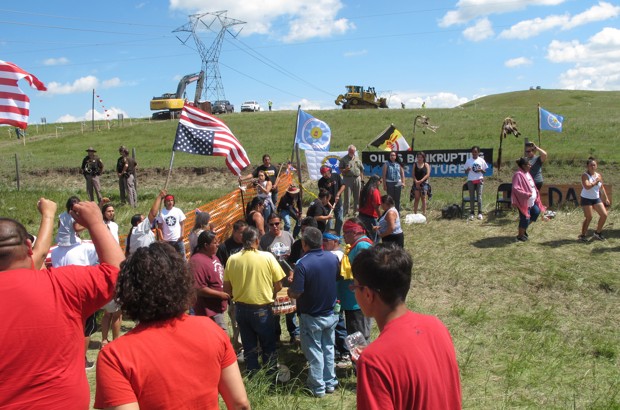
Native Americans protest the Dakota Access oil pipeline on Friday, Aug. 12, 2016. 
(AP Photo/James MacPherson)
Ft. Yates, North Dakota (UCTP Taino News) – The U.S. Army Corps of Engineers (USACE) approved construction permits for the Dakota Access Pipeline, which will bring it within a half a mile from the Standing Rock Sioux Indian Reservation. If completed, this pipeline would transport approximately 470,000 barrels of crude oil per day and cross the Missouri River, which is the only source of water to the reservation. A key issue is that the USACE did not consulate with or gain consent from the Standing Rock Sioux Tribe (SRST), which is a violation of the 1868 Ft. Laramie Treaty, the United Nations Declaration on the Rights of Indigenous Peoples and other International Human Rights instruments whose provisions the United States is obliged to uphold. According to tribal officials the pipeline will damage or destroy sacred sites and burial grounds along its proposed route. The SRST has issued a call of support for its opposition to the pipeline, which the United Confederation of Taino People (UCTP) responded to on August 16, 2016 in an official communication to Standing Rock Chairman Dave Archambault II. 


The Confederation’s solidarity letter supported the Standing Rock Sioux Tribe’s courageous efforts to stop the construction of the Dakota Access Pipeline and that it is clear that federal laws and treaties were bypassed in the planning process requiring direct consultation with the Tribe.” The Tribe’s External Affairs Director Steven Sitting Bear confirmed receipt of the Confederation letter stating, “Standing Rock appreciates the Taino People’s support.” 


Roberto Múkaro Agüeibaná Borrero, President of the UCTP noted that “Taino People have experience with the U.S. Army Corps of Engineers and their lack of consultation with regard to sacred sites and burial grounds.” Borrero continued stating that “despite provisions in the Historic Preservation Act for consultation, the USACE proceeded to remove ancestral remains without meeting with local Taino even after several official requests were made with regard to the Hacanas (Jacanas) PO29 archeological site in 2007.” 

“Considering these past actions and the current situation affecting the Standing Rock Sioux Tribe, the USACE continues to violate the right to free, prior, and informed consent of Indigenous Peoples as defined in the UN Declaration on the Rights of Indigenous Peoples. This is contrary to the Obama administration commitment to implement the Declaration.” 

The Standing Rock Sioux Tribe has filled an injunction to halt the construction of the pipeline scheduled to be heard case being heard in Federal Court in early September 2016. 

UCTPTN 08.19.2016


2/22/2011

Exhibit Exploring Ties Between Native and African Americans to Close

Suffern, NY (UCTP Taino News) – The exhibit, "IndiVisible: African-Native American Lives in the Americas" is on view at Rockland Community College through March 9 as part of school’s Black History Month celebration. The exhibition explores the complex relationships between Native Americans and African-Americans.

According to the exhibit: "African and Native peoples came together in the Americas . Over centuries, African-Americans and Native Americans created shared histories, communities, families and ways of life. Prejudice, laws and twists of history have often divided them from others, yet African-Native American people were united in the struggle against slavery and dispossession, and then for self-determination and freedom."

This Saturday, February 26, a day long program delving deeper into the issues will take place at Rockland Community College Tech Center, 2nd Floor, 145 College Rd., in Suffern, NY. This special closing program will feature musical and dance presentations, story-telling, personal reflections, and theatrical readings. Saturday’s program will also feature two distinguished lectures including “What Does a Real Indian Look Like?” by Prof. Heriberto Dixon and “Native American-Caribbean Connections” by Roberto Múkaro Agueibana Borrero (Taíno).

A closing blessing will be shared by Sachem (Chief) Dwaine Perry of the Ramapo Mountain Indians of New Jersey. For further information about the exhibition or the program call (845) 574-4396.

UCTPTN 02.22.2011

12/30/2010

"WE NEED TO CONTINUE TO WORK TOGETHER"

A PRESS RELEASE BY THE OFFICE OF THE PAN-TRIBAL CONFEDERACY OF INDIGENOUS TRIBAL NATIONS
#13 Highgate Gardens, Wildey. St. Michael,
Barbados W.I. BB 14005
pantribalconfederacy@gmail.com


"WE NEED TO CONTINUE TO WORK TOGETHER".
A SYNOPSIS OF THE FOLLOW-UP MEETING OF THE 3rd INDIGENOUS LEADERS SUMMIT OF THE AMERICAS

From left to right - Damon Corrie, Roberto Borrero, Ovide Mercredi, and Leilani Stewart meet in Ottawa, Canada to follow-up on the OAS Summit of the Americas process.

Interested readers may follow the developments of the 3rd ILSA at the OAS run website www.summit-americas.org as well as its FaceBook site.

"We need to continue to work together" stated Andrea Montilla of the OAS as she explained the on-going process in the Draft American Declaration on the Rights of Indigenous Peoples. Some advocated believe the proposed OAS Draft Declaration could be stronger than the UN Declaration - if the USA joins the rest of the 34 member OAS community and supports the Declaration instead of obstructing it.

Montilla also noted the importance of the OAS as well as its genuine desire to work with Indigenous Peoples throughout the Americas. The audience concurred, for all have taken note that the Organization of American States HAS indeed prosecuted MORE cases in favor of Indigenous Peoples of the Western Hemisphere than even the United Nations!

Grand Chief Ed John of the Assembly of First Nations of Canada and Celeste McKay of the Native Womens Association of Canada both gave informative opening addresses and likewise both re-affirmed the positives of collaboration with the OAS in a spirit of equity, and made excellent suggestions as to formats the OAS could consider adopting - which would enhance this special relationship between Indigenous Peoples of the Americas and the Organization of American States.

The floor was then opened for audience feedback/questions/comments.

Former Grand Chief of the Assembly of First Nations Ovide Mercredi – who presided at arguably the most tension-filled time in recent memory of relations between Native Nations and the Neo-Colonial Government of Canada in the 1990's (Oka Crisis) - addressed the gathering.

Ovide, still no stranger to controversy and an inspiration to a generation of anti-assimilationist native leaders, eloquently explained the difference between Indigenous Leaders and Political Leaders of the Nation States of the Americas.

"I am a leader of MY indigenous people - not the Prime Minister of Canada.” Likewise the Prime Minister of Canada is the leader of HIS non-indigenous peoples of the Neo-Colonial Political State of Canada. The OAS must find a way whereby the Indigenous Leaders of the Americas recognized by their own Indigenous Peoples - not merely representatives who may potentially have no actual mandate to speak on behalf of any Indigenous Nation - must be able to sit across the table from the Political Leaders of the 34 Neo-Colonial Nation-States of the Americas and have a genuine and equitable dialog for I believe this is the only way that over 500 years of inequity can be successfully addressed and redressed - in order to create a better future for generations to come.”

President Tony Belcourt of the ICCTA (Indigenous Commission for Communications Technologies in the Americas) spoke in detail about the need for a secretariat or Permanent Forum to be created by the OAS to allow for more effective participation by Indigenous Peoples within the OAS system. The suggested entity could function as a nexus between the Indigenous Leaders and Political Nation State leaders as Ovide had suggested.

Ellen Gabriel - the outgoing President of the Quebec Native Womens Association & Veteran of the crisis years of the 1990's (Oka crisis) that also propelled her to International Fame as a committed Indigenous Rights leader in Canada - raised the issue of the need to protect traditional knowledge as a way to mitigate and survive the Global Climate change that is already effecting us all – and Indigenous Peoples more severely than any others.

President Clement Chartier of the Metis National Association of Canada supported Ovide Mercredis call and added to what Tony Belcourt had said highlighting the fact that presently there exists no separate category in the OAS system for 'Indigenous Peoples' - and much to all our chagrin - we still fall under the broad (and inappropriate in our minds) category of 'Civil Society' which lumps us in with religious organisations, charities and sexual orientation advocacy groups; when in truth and in fact our issues are that of the intricately delicate relations between Colonizers and those they forcibly Colonized.

President Roberto Mukaro Agueibana Borrero of the United Confederation of Taino People (UCTP) - who has been almost singlehandedly pushing the agenda of Pan-Caribbean Indigenous Rights for over a decade - delivered a very enlightening presentation where he made several recommendations covering some areas not addressed previously. President Borrero exposed the fact that the UCTP had sent information from the 3rd ILSA (Indigenous Leaders Summit of the Americas) to virtually EVERY CARICOM (Caribbean Common Market) country asking them if they were aware of the issues being discussed with the OAS - which they are also members of - and asking for their official position on these matters. Unfortunately, true to their form of first decade of the 21st century not a single Caribbean Government had even the courtesy to respond.

Following the 5th Summit of the Americas and the 3rd ILSA (April 2009), the ONLY CARICOM government to report anything on the subject of Indigenous issues was the Government of Guyana. Unfortunately Guyana took the opportunity to blow it's own horn about its Amerindian Affairs Minister (a political appointee of the President of that country - NOT one voted for by any democratic majority of Guyana's 100 Amerindian Chiefs/Toushaus) and it's Ministry of Amerindian Affairs. In its official report to the OAS, Guyana says nothing of relevance about the Indigenous Leaders Summit of the Americas or OAS Draft American Declaration on the Rights of Indigenous Peoples process.

In conversation with President Borrero of the UCTP, Leilani Stewart, Vice President of the Pan-Tribal Confederacy of Indigenous Tribal Nations gave a very insightful analysis, which beautifully explained the validity of oral tradition as a vehicle to factually transmit information. Stewart also stress the need to strengthen the voice of Caribbean Indigenous Peoples through the well-positioned UCTP 'Indigenous media octopus'. President Damon Corrie of the Pan-Tribal Confederacy of Indigenous Tribal Nations pledged to supply the UCTP with as much information as he receives from allied communities in the Caribbean Region.

PTC.PR – 12.2010

6/08/2010

United States Reviewing Position on UN Indigenous Rights Declaration

Washington, D.C. (UCTP Taino News) - The U.S. Department of State has created a new website to enable public input during the U.S. review of its position on the UN Declaration on the Rights of Indigenous Peoples (UNDRIP). On April 20, 2010, United States Ambassador Susan E. Rice announced the decision of the U.S. to review the Declaration at the 9th Session of the United Nations Permanent Forum on Indigenous Issues.

In a recent press release the Obama Administration recognized that the UNDRIP provides a framework for addressing indigenous issues. During President Obama's first year in office, tribal leaders and interested non-governmental organizations (NGOs) encouraged the United States to reexamine its position on the Declaration.

Roberto Mukaro Agueibana Borrero, a representative of the United Confederation of Taíno People welcomed the news.

“This decision is important not only for Indigenous Peoples living in the mainland United States but for other Indigenous Peoples like the Taíno who reside in non-self-governing territories controlled by the U.S. Government” stated Borrero.

He continued noting that “unlike mainland American Indians, Alaska Natives, and Native Hawaiians, the Taíno of Borikén (Puerto Rico) for example do not benefit from U.S. Federal laws designed to protect indigenous cultural and spiritual properties.”

The United Confederation of Taíno People promoted and organized Caribbean regional support toward the Declaration’s final adoption in 2007.

“Legal application of this Declaration does not require a States’ formal recogntition of Indigenous Peoples and the UCTP is committed to engaging the U.S. government on this issue with our future generations in mind” said Borrero.

As part of the U.S. government’s review process, the U.S. Department of State, together with other Federal agencies, will be hosting consultations with federally-recognized tribes and dialogues with interested NGOs and other stakeholders.

UCTPTN 06.08.2010

4/27/2010

Taino Recognize Their Own In NYC

Roberto Borrero and members of Iukaieke Guainia at the Taino Awards

New York, New York (UCTP Taino News) -
A diverse group of Taino community members gathered on Saturday, 24 April to support the second annual “Taino awards.” The event was held at the Nuyorican Poets Café and it was presented by the KuKarey Spiritual Circle and Yamocuno Tanama Yucayeke Taino organizations.


Hosted by Caridad "Kachianao" de la Luz, the awards celebrated individuals “who unselfishly give of themselves everyday to the Taino community.” The awards recognized educators, artists, humanitarians, youth, elders and other community members.

The 2010 award recipients included Vanessa Inarunikia Pastrana, Roman Perez, Carlos Rivera, Jose Munoz Vazquez, Mildred Cruz, Miguel Sobaoko Koromo Sague, Enrique Correa, Casa Atabex Ache, Edwin Cedeno, Taino Almestica, Francisco Baerga, Luis Ramos, Joe Kaonabo Garcia, Dalia Viera, and Roberto Mukaro Agueibana Borrero.

UCTPTN 04.27.2010