Showing posts with label Climate Change. Show all posts

4/30/2017

Indigenous Peoples lead Peoples Climate March in Washington D.C.

Indigenous Peoples at the frontline of the Peoples Climate March are joined by actor Leonardo DiCaprio
WASHINGTON D.C. (UCTP Taíno News) — On Saturday, April 29, over 200,000 people took to the streets in Washington D.C. to demand action on Global Climate Change on the local, national, and international level. Indigenous Peoples were among those who led the march, which took place in sweltering heat that tied a record for April 29. The People’s Climate March for “climate, jobs, and justice” coincided with U.S. President Donald Trump’s 100th day in office. Along with the main march and related activities in Washington D.C., more than 300 “sister marches” were held across the U.S. and around the world. 

“This is more than a march, it is a global movement to affect positive change.” said Roger Guayakan Hernandez, a Borikén Taíno representing the United Confederation of Taíno People at the march. Hernandez was a “bus captain” for one of two buses from New York organized by the International Indian Treaty Council to assist local NY Tri-State Area Indigenous Peoples, as well as indigenous delegates to the United Nations Permanent Forum on Indigenous Issues participate in the Peoples Climate March. 

A large and diverse representation of Indigenous Peoples from around the country and the world were present at the march. Indigenous Peoples began the day with a sunrise water ceremony that opened with a welcome from Gabrielle Tayac of the local indigenous Piscataway Nation. During the march, Indigenous Peoples were a part of the led contingent, representing frontline communities. Among the Indigenous Peoples represented at the march from throughout the Americas and the world, were Taíno, Lokono-Arawak, and Maya from Belize alongside Lakota, Dine (Navajo), Schaghticoke, Sapara, Mexica, Mohawk, Quechua, Maori, Nuba, Maasai, and many, many other indigenous Nations.

“I am marching for Mother Earth and our future” said Mainaku Borrero, Taíno/Tlingit, 10yrs old. “Climate change is real.”

 UCTPTN 05.09.2017

10/16/2015

Lokono Chief Damon Corrie Attends Climate Change Consultation in Peru


Chief Damon Corrie (Lokono Arawak) presents a Taino necklace to
Lima meeting Chairperson Benito Callixto, head of the Indigenous Forum
of Abya Yala (FIAY in Spanish). The gift made was made by Taino leader and artist
Roberto Mukaro Borrero and presented on behalf of the Caribbean Amerindian Development Organization (CADO) and the United Confederation of Taino People.
Lima, Peru (UCTP Taino News) - Lokono Arawak leader Damon Corrie attended the UN Climate Conference (COP21) Regional Consultation for Latin America and the Caribbean in Lima, Peru from 12-15 October 2015. The consultation sought to consolidate regional positions on Climate Change, which would add to outcomes of similar consultations being conducted around the world. The Indigenous Peoples Global Climate Change Consultations are an initiative of the International Indigenous Peoples Forum on Climate Change (IIPFCC) in cooperation with the United Nations Development Programme (UNDP). Corrie was the only indigenous representative from a Caribbean Small Island State in attendance. Speaking on behalf of the Caribbean Amerindian Development Organization (CADO) and the United Confederation of Taino People (UCTP) Corrie expressed concerns of Indigenous Peoples of Caribbean small islands including global sea level and temperature rise, increasingly intense hurricanes and tropical storms, food sovereignty, and unusual rain and drought patterns. Chief Corrie intends to be present at and share these concerns, among others, at the 21st Conference of the Parties of the United Nations Framework Convention on Climate Change (COP21), which will take place in Paris, France 30 Nov. - 11 December 2015. 

UCTPTN 10.16.2015 

7/31/2014

Small Island Developing States: Last Day for Registration!


Dear colleagues,

The Third Conference on Small Island Developing States, taking place between 1-4 September in Apia, Samoa, is rapidly approaching.

Preceding the meeting, four Pre-Conference Forums will take place in select locations in Apia from 28-31 August 2014. The Pre-Conference Forums will be held outside of the UN security perimeter and therefore don’t require accreditation to the SIDS Conference. Further information on these activities is available on the SIDS website: www.sids2014.org/index.php?menu=1567
Participation in the Major Groups and other Stakeholders Forum, which will take place on Thursday, 28 (evening) and Friday, 29 August 2014, is subject to registration. Today is the last day to register - if you are planning on attending, you must fill out this form. More information on the Forum can be found here.

We would also like to use this opportunity to remind representatives of organizations that are accredited with the United Nations and plan to attend the official Conference to register here. Conference registration for Major Groups and other stakeholders’ representatives will close on Monday, 4 August 2014.

Warm regards,

Ms. Martina Muller
Major Groups Program
Communications & Outreach - UN DESA/DSD

7/30/2014

In Times Square, unions and activists preview climate march

By Conor Skelding

12:03 p.m. | Jul. 30, 2014

Roberto Mukaro Borrero (Taino) addresses rally on Climate Change in Times Square
Photo Credit: Diane Lent

Unions and activists groups rallied in Times Square on Wednesday morning to officially launch the People's Climate March, which organizers hope will be the largest climate-related march in history.

The march is set for September 21 in New York City, two days before a United Nations summit on climate change.

"It is our desire to combat climate change," said Christopher Erikson, business manager for the International Brotherhood of Electrical Workers' Local Union No. 3.

"Our momentum must be governed in an orderly fashion, that provides sustainability for our goal of a livable planet, along with the security of a reliable electrical grid," he added. "We must weigh the effects of jobs on U.S. citizens."

The march was been backed by a broad array of progressive groups. Last week, two New York health care unions announced that they would encourage members to participate the march. Councilman Donovan Richards has also introduced a resolution asking the City Council to officially endorse the march.

The rally on Wednesday included remarks from representatives for the Transport Workers Union, 1199 SEIU, and 32BJ, among other unions and activist groups.

"Indigenous Peoples all over the world are on the front lines of climate change!" shouted Roberto Borrero (Taino) of the International Indian Treaty Council. "We are the canaries in the coal mine! We can see the melting of the glaciers! We can see the desertification in Africa! We can see the rising waters for Indigenous Peoples in the Pacific islands."

"We are glad to see that some of you are finally listening to the warnings that Indigenous Peoples have been shouting for 500 years now on this side of the world," he said.

"We will be here on September 21 to march along with you. Not behind you, but as equals!" he finished, before chants of "The people, united, will never be defeated!" began.

Source: Capital New York

4/11/2009

Indigenous Peoples Global Summit on Climate Change

Anchorage, Alaska (UCTP Taíno News) - The Inuit Circumpolar Council is hosting a Global Summit on Climate Change that will bring together indigenous delegates and observers from April 20-24, 2009 in Anchorage, Alaska.

The purpose of the summit is to enable Indigenous peoples from all regions of the globe to exchange their knowledge and experience in adapting to the impacts of climate change, and to develop key messages and recommendations to be articulated to the world at the Conference of Parties (COP) to the UN Framework Convention on Climate Change in Copenhagen, Denmark in December 2009.

Among those represented at the meeting will be a delegation of Caribbean Indigenous Peoples from Watikubuli (Dominica), Barbados, Suriname, and Borikén (Puerto Rico). Each delegate will prepare a report based on experiences in relation to climate change from their local area and these reports will form the basis of a larger regional presentation.

UCTPTN 04.11.2009

8/26/2008

Researching Impact Of Global Warming On Corals

ScienceDaily (Aug. 26, 2008) — For just one late-summer night each year, the shallow waters off the coast of Puerto Rico fill with the pale-pink spawn of elkhorn corals -- the tiny, round packets of the adult corals' eggs and sperm.

This year, Iliana Baums, assistant professor of biology at Penn State, is there to collect the coral spawn as part of a research and education project to grow the newborn juvenile corals for distribution to aquaria and to the wild. "It looks like it's snowing," she said, "except that the egg and sperm packets rise underwater to the surface rather than fall to the ground."

Baums's reason for collecting the spawn is twofold: she hopes to acquire important information about how corals will respond to global warming, and she also is teaching a group of 28 aquarium professionals, as part of an international workshop, how they can participate in the protection of corals. Baums will hunt for and collect coral spawn on the nights of 21 and 22 August. For seven days thereafter, she will remain at the site, working to grow the newborn juvenile corals for distribution to aquaria and to the wild.

According to Baums, corals are extremely sensitive to changes in water temperature. "An increase in water temperature of just a couple degrees Celsius results in visible damage to adult corals and their offspring," she said. Referring to a paper published in a July 2008 issue of the journal Science in which the authors report that one-third of all reef-building corals face an elevated risk of extinction from climate change and other factors, Baums said it is imperative that scientists and marine-resource managers begin to think about how to rescue these important animals.

That's why Baums is searching for particular populations of coral that produce offspring that are better able to withstand high water temperatures. Because most coral species are triggered by moonlight to release their egg-sperm packets, Baums will begin her experiment with a nighttime trip to a designated reef off the coast of Puerto Rico. There, she will collect spawn from elkhorn corals, which are protected as a threatened species by the United States Endangered Species Act. In small rearing chambers, she will place eggs from certain populations with sperm from certain other populations.

Over the next seven days, she will raise the newly formed juvenile corals in saltwater tanks on land. She then will ship half of them to several aquaria around the world and will return the other half to the reef. "Corals are most vulnerable when they are very small, and our protected nursery will help them to get through the first critical days," said Baums.

Next, the juvenile corals in captivity will be subjected to a variety of higher-than-normal and lower-than-normal water temperatures in order to pinpoint those offspring whose parents can tolerate abnormal water conditions. Once Baums identifies these individuals, she will search their genomes for variants of genes that are responsible for resistance to abnormal water temperatures. With this knowledge, she then can develop genetic markers that will enable her to identify wild elkhorn-coral populations throughout the Caribbean that contain such gene variants.

Water from the ocean is pumped into tubs where juvenile corals will be raised for a period of seven days after scientists harvest them from the wild.

In collaboration with SECORE (SExual COral REproduction), an international organization of professional aquarists and scientists that is concerned about coral conservation, Baums will hold a workshop during the annual coral-spawning event in Puerto Rico. Through the workshop, she and other researchers will teach a group of 28 aquarium professionals from around the world how to collect coral spawn, do fertilization experiments, raise larvae, and care for larvae once they are shipped back to the participants' home institutions. The workshop, which is now in its third year, already has been given to over 60 aquarium professionals. Baums and other members of SECORE plan to continue to the workshop in future years to reach as many aquarium professionals as possible.

"Poachers often collect wild corals to satisfy the demand for aquariums, but aquarium professionals are looking for alternative, less destructive sources of these animals. SECORE's goal is to develop methods to eventually breed corals in captivity, thereby reducing some of the pressure to collect corals from the wild," she said. "We are starting by raising juveniles from wild-caught eggs and sperm, which enables us to provide aquariums with the corals they desire without damaging wild adult colonies.

In return, the aquarium operators help us to perform the experiments and give us tips on how to raise adult corals in captivity, which is something they are very good at." Baums added that the establishment of good aquarium populations is a safeguard against the extinction of elkhorn corals.

The corals that Baums ships to aquaria will undergo one of two treatments: half of them will be exposed to species of the zooxanthellae -- algae that live inside the cells of corals and provide them with necessary nutrients and energy -- that naturally occur with elkhorn corals, and half of them will be exposed to zooxanthellae from other regions of the world, where elkhorn corals are not present.

In past years, elkhorn corals in captivity readily took up foreign zooxanthellae and coped better than those that took up only native species of zooxanthellae. These observations will be tested in a controlled experiment as part of this year's workshop. While Baums said she would not release foreign strains of zooxanthellae into the wild, she does think such measures could be beneficial to corals that are maintained in aquaria.

Baums is partnering with Margaret Miller, a scientist with the National Oceanic and Atmospheric Administration (NOAA), who will do the same experiment using corals from Florida, where annual minimum water temperatures are lower. The team will compare corals in the two locations to learn if there are any differences in their abilities to withstand high and low water temperatures. A goal of the research is to find out if current temperature differences between Florida and Puerto Rico will influence the abilities of corals to tolerate future warm-water conditions associated with global warming.

This research and the workshop are funded by the NOAA and the National Science Foundation.

Photo: Scientists capture coral spawn using a special net. (Credit: Ramon Villaverde, Columbus Zoo)

4/25/2008

Thousands of Indigenous Peoples Gather at UN Headquarters

United Nations (UCTP Taino News) – In his opening address to the United Nations Permanent Forum on Indigenous Issues Secretary-General Ban Ki-Moon stated that this year’s session takes place during a “historic crossroads”. Mr. Ban said that with last year’s adoption of the Declaration on the Rights of Indigenous Peoples the two-week Forum takes on a “new role”.

The Declaration outlines the rights of the world’s estimated 370 million indigenous people and outlaws discrimination against them. It sets out rights to culture, identity, language, employment, health, education and other issues.

The Forum’s opening session included a precedent-setting presentation by Bolivian President Evo Morales Ayma, the first indigenous leader of his country. President Morales called on the world body to recognize indigenous cultures and needs, an appeal that he had made on several occasions in the past two years, using his high profile as head of state. The Bolivian President also told the gathering to be wary of transnational corporations and industrialists, denouncing such companies as "exploiters" of his country's natural resources.

Climate change is one of the special themes of this year’s session of the Forum. This is a critical issue for Indigenous Peoples around the world as they are among the first to face the direct consequences of climate change, due to their dependence upon, and close relationship, with the environment and its resources. An important issue to Caribbean Indigenous Peoples, Kalinago Chief Charles Williams of Waitikubuli (Dominica) noted that “Climate Change is a reality.”

In his address on behalf of the Indigenous Peoples Caucus of the Greater Caribbean (IPCGC) Chief Williams also declared that “Like it or not [climate change] is there for all of us and not some of us, whether we are rich or poor, whether we are weak or powerful, we will all suffer the consequences of climate change”

The IPCGC also addressed agenda items on Human Rights and Indigenous languages. In its collective statement on languages the Caucus addressed the need for the full and effective participation of Caribbean Indigenous Peoples in regional follow-up initiatives.

The IPCGC’s intervention on Human Rights was presented by the Consejo General de Tainos Borincanos. The statement focused on the current situation of Sacred Sites such as Jacanas in Ponce, Puerto Rico as well as the lack of recognition of the rights of Taino People on the island.

Over 2500 participants - including senior UN officials and representatives of States, civil society and academia – are registered for the Forum, which ends on May 2, 2008.

UCTP Photo (1): President Evo Morales Ayma of Bolivia

UCTP Photo (2): Damon Corrie, Charles Williams, and Roberto Mukaro Borrero participating within
the Indigenous Peoples Caucus of the Greater Caribbean


UCTPTN 04.25.2008

3/24/2008

UN DPI/NGO Briefing: Climate Change and its Impact on Indigenous Peoples


20 March 2008
Climate Change Panel Summary

Climate change is altering the way in which human beings coexist with their environment. The briefing examined how the issue of climate change applied to indigenous peoples, who maintain an intimate relationship with the land. Speakers included H.E. Mr. Colin D. Beck, Permanent Representative of the Permanent Mission of the Solomon Islands to the United Nations; Ms. Elsa Stamatopoulou, Chief, Secretariat of the United Nations Permanent Forum on Indigenous Issues; and Mr. Roberto Mukaro Borrero (Taino), Chairperson, NGO Committee on the International Decade for the World's Indigenous Peoples.

H.E. Mr. Collin D. Beck spoke about the effect climate change had on small island states and the challenges for indigenous peoples of the Solomon Islands. He noted the great diversity among the half million people living in his country, 90 percent of which belong to indigenous groups who speak 80 different languages. Ambassador Beck stressed that all of the basic needs of indigenous peoples came from natural resources, which were greatly influenced by the changes in the environment. Climate change issues varied within each indigenous community and were related to their specific geographical region. The frequent occurrence of natural disasters such as high tides, tsunami and cyclones in disaster prone areas caused the progress made in certain locations to regress. Ambassador Beck also mentioned the subject of indigenous peoples migrating to bigger islands because of climate change. With migration came the threat of conflict between different ethnic groups and the loss of traditional culture. Furthermore, urbanization contributed to increased poverty. The Ambassador called for the need to move away from policy making into taking action on the ground.

Ms. Elsa Stamatopoulou discussed the importance of the United Nations Permanent Forum on Indigenous Issues, which will be focusing on climate change and indigenous peoples during this year's session, more specifically the issues of indigenous peoples of the Pacific Islands. Ms. Stamatopoulou stressed the importance of raising awareness on issues faced by the indigenous peoples, and said that the effect of climate change on indigenous peoples was a matter of survival. She stated that indigenous peoples were "hardly contributors to climate change, but suffered the gravest consequences". And yet, the voices of indigenous peoples have not yet entered the mainstream of the climate change debate. Ms. Stamatopoulou also mentioned a study on biofuel development and its impact on the territories and the livelihoods of the indigenous populations. For example, corn used to fill up one SUV tank with ethanol would feed one person for a year. Ms. Stamatopoulou cited the right to food and blamed development of biofuels for the 40 percent increase in food costs worldwide. Ms. Stamatopoulous concluded by stating that solidarity was an important factor in addressing indigenous issues.

Mr. Roberto Borrero greeted the audience and introduced himself in his native indigenous language. He said that climate change was about the kind of world we were going to leave for our children and their children. He called for long-term rather than short-term solutions. Mr. Borrero examined the importance of indigenous peoples to be actively involved in preserving their culture and land. He defended the right to ownership by indigenous peoples and discussed the difficulties indigenous peoples encountered when trying to protect or preserve the land they did not own. Mr. Borrero stated that indigenous peoples noticed climate change years before the climate change debate started. For example, some indigenous elders gathering plants for traditional medicines could no longer find those. Mr. Borrero also mentioned the difficulties indigenous peoples faced accessing mainstream healthcare. He concluded by saying "for many years people have seen ice melting around the world, now it is time to melt the ice in the hearts of men."

During the question-and-answer period, a question was asked in regards to the effects nuclear testing had on indigenous peoples. Ambassador Beck mentioned the nuclear treaty preventing any more testing in his country. He also responded to a question regarding the urbanization of indigenous peoples by stressing the importance of investing in the development of rural areas. This would result in indigenous peoples not having to travel to urban areas for school or work. A question was asked about what NGOs could do to help indigenous peoples. Mr. Borrero referred to the CONGO website as a source for practical ways NGOs could assist indigenous peoples. He noted one of the most important ways NGOs could help was by disseminating information on indigenous peoples to the mainstream media and local communities.

The briefing was attended by about 100 representatives of NGOs, United Nations and Permanent Mission staff. The 1 hour and 20 minute archived webcast of the event is available at http://www.un.org/webcast/2008.html

RealPlayer needed to view UN webcasts. Click here (http://www.real.com/freeplayer/?rppr=rnwk) for a free download of the RealPlayer program.

Photo: Ms. Elsa Stamatopoulou and Roberto Mukaro Borrero speaking on Climate Change at the United Nations on March 20, 2008. (UN DPI Photo)

Source: United Nations, DPI/NGO Resource Centre, Room L-1B-31

12/12/2007

Tropical storm flooding kills 9 in Caribbean


By Manuel Jimenez

SANTO DOMINGO, Dominican Republic (Reuters) - Flash flooding from Tropical Storm Olga's torrential rains killed at least eight people in the Dominican Republic and forced tens of thousands out of their homes, government officials said on Wednesday.

The storm weakened on Wednesday to a tropical depression after it exited Hispaniola, the island shared by Haiti and the Dominican Republic. But flooding remained a deadly threat as the remnants of Olga moved west across the Caribbean, forecasters at the U.S. National Hurricane Center in Miami said.

By late afternoon, Olga was just a broad mass of thunderstorms centered 65 miles north of Kingston, Jamaica. It was moving rapidly west on a course that would keep the center south of Cuba and take it over Mexico's Yucatan Peninsula by Saturday.

Olga's top sustained winds dropped to 35 mph (55 kph), below the threshold to be called a tropical storm, and forecasters expected it to dissipate further on Thursday.


Photo: Subtropical storm Olga is seen in the Caribbean in a satellite image taken December 11, 2007. (NOAA/Handout/Reuters)

8/19/2007

Hurricane Dean pummels Jamaica

This NOAA satellite image taken Sunday, Aug. 19, 2007 at 1:45 PM EDT shows a dangerous category 4 hurricane, Hurricane Dean, bearing down on Jamaica with winds of 145 mph. This storm is on track to make either a direct hit on the island's southern shore or a very near pass later on today. (AP PHOTO/WEATHER UNDERGROUND)

KINGSTON, Jamaica (AP) - Hurricane Dean pummeled Jamaica with gusting winds and torrential rains Sunday after the prime minister made a last-minute plea for residents to abandon their homes and head for shelter. Many residents ignored the call, however, while tourists holed up in resorts with hurricane-proof walls.

The storm, which had already killed eight people on its destructive march across the Caribbean, triggered evacuation calls from the Cayman Islands to Texas, and forced the Space Shuttle to cut short its mission. Cruise ships changed course to avoid Dean, but some tourists in Jamaica could not get away before the island closed its airports late Saturday.

Read the full story at:

http://news.yahoo.com/s/ap/20070819/ap_on_re_la_am_ca/tropical_weather

story image Play AP Video

6/09/2007

Caribbean‘s reef-building coral at risk

By DANICA COTO,
Associated Press Writer

SAN JUAN, Puerto Rico - Six species of reef-building coral could vanish from the Caribbean due to rising temperatures and toxic runoff from islands` development, according to a study released Thursday.

The species — about 10 percent of the 62 varieties capable of forming reefs in the region — include staghorn and elkhorn corals, which were once among the most prominent.

Peter Edmunds, a biology professor at California State University-Northridge, said the study provided a broad perspective that is "terribly important" but does not indicate how close a particular species is to dying off in the region.

Researchers have blamed rising temperature, disease and pollutants for damage to the coral reefs, which host countless marine plants and animals.

The team also reported significant damage to mangroves, which filter pollutants, reporting the plants cover 42 percent less area in the Caribbean than they did 25 years ago.

The study was sponsored by the Caribbean Biodiversity Initiative, along with the nonprofit World Conservation Union in Switzerland and the Royal Caribbean Cruises` Ocean Fund.

5/25/2007

U.N. panel says indigenous people are particularly vulnerable to the dangers of climate change

By LILY HINDY
Associated Press Writer


UNITED NATIONS (AP) - Indigenous people around the world are particularly vulnerable to the dangers of climate change, which will threaten their traditional cultures as glaciers melt, ocean temperatures increase and coral reefs disappear, panel members said at a U.N. discussion of biodiversity.

The loss of biodiversity to climate change will hit indigenous people hardest, John Scott, Secretariat of the Convention on Biological Diversity said Tuesday.

"Indigenous and local communities ... will bear the brunt of this catastrophe because of their close association with their lands and waters," said Scott said.

The panel marking the U.N.'s International Biodiversity Day included a reindeer herder from Norway and members of indigenous groups from Hawaii, Puerto Rico and the Hindu Kush mountain range that straddles the Pakistan-Afghan border.

Panelists spoke of melting glaciers, rising ocean temperatures, avalanches, and the depletion of coral reefs as devastating to their social and cultural traditions.

Lakshan Bibi, of the Hindu Kush, said her people were affected by the air traffic from recent wars in Afghanistan and Iraq, which had greatly increased pollution in the area.

A draft report circulated in April by the convention focused on the negative effects of climate change on indigenous people in the Arctic region, small island states, and high-altitude areas, and recommended further research.

The report also recommends, however, that the environmental knowledge of indigenous people be used to help mitigate the negative effects of climate change. Scott said that indigenous farmers in the Andes mountains in Peru have introduced potatoes that can withstand drought, frost and other extreme weather conditions.

"Traditional knowledge of indigenous and local communities can play an important role in adaptation to climate change and its potential has yet to be fully explored," said Scott.

Roberto Borrero, of the Taino people in Puerto Rico, said that traditional-minded people have closer relationships to nature and more respect for the environment.

"I don't think it was an indigenous person who created pesticides, nuclear bombs or anything else of a destructive nature," said Borrero. "We need somebody with a traditional mind and attitude, or somebody who respects their environment as equally as they do their family."

4/23/2007

Indigenous Peoples’ Lands, Territories, Natural Resources: Livelihoods and Emerging Issues


Roberto Mucaro Borrero (Taino) at the United Nations, April 19
Photo: Miguel Ibanez, Habitat Pro Association


The briefing looked at the traditional lifestyles, practices, and struggles of indigenous peoples around the globe. H. E. Mr. Javier Loayza, Chargé d’affaires, Permanent Mission of Bolivia to the United Nations; Ms. Sonia Smallacombe, Social Affairs Officer, Secretariat of the Permanent Forum on Indigenous Issues; and Mr. Roberto Mucaro Borrero, Chairperson of the NGO Committee on the International Decade for the World’s Indigenous People discussed the needs, rights, and challenges of indigenous peoples in maintaining their traditional cultures, environmentally sound relationships with the land, and sustainable use of natural resources.

H.E. Mr. Javier Loayza initiated the discussion by emphatically noting, “We do not own the land, we belong to it.” He explained that this quote reflected the thinking, spirituality, and daily lifestyles of indigenous peoples. According to Mr. Loayza, the concept of privatized territory was absent from the philosophy of indigenous communities, who regard the land as a living space that provides resources. Mr. Loayza emphasized that it was vital to remember that vision when confronting the current crisis of climate change, which was rooted in the longstanding dominant economy of privatization that transformed the natural environment, irresponsibly exploited resources, and created a “socially unjust model” which “has rendered our world inhospitable.” He explained that indigenous peoples had been the victims of that unjust model since colonizers invaded and misappropriated their lands, and further stressed the polarization between the “haves” and “have nots” around the world. Mr. Loayza described the sociopolitical changes underway in Bolivia as a victory for indigenous peoples in the spirit of plural national justice. The Bolivian government was making efforts towards advancing the needs and equity of indigenous peoples and translating indigenous issues into tangible policies to help protect their environments, explained Mr. Loayza. He concluded that he hoped the cosmo-vision of the indigenous peoples would inspire the world to change their current unsustainable practices in the face of environmental degradation.

Ms. Sonia Smallacombe described the work underway for the upcoming Permanent Forum on Indigenous Issues. Its major themes of territories, lands, and natural resources include a number of related issues such as forests, desertification, sustainability, and biological diversity. According to Ms. Smallacombe, the long struggle of indigenous communities to gain recognition of their rights lied at the heart of the permanent forum; however, the draft Declaration of the Rights of Indigenous Peoples continued to remain under review and negotiation. She described the Permanent Forum as a unique international body that brought together indigenous peoples, governments, civil society, and United Nations agencies to make recommendations to ECOSOC. Indigenous leaders could offer their traditional knowledge and best practices. Ms. Smallacombe emphasized the importance of the direct participation of indigenous peoples in UN activities. She further noted the vital role that language played in keeping traditional knowledge alive, which was preserved by speech and oral traditions. The death of aborigine elders was equivalent to the burning down of a library, explained Ms. Smallacombe. She concluded by underscoring the threat of the climate change crisis in endangering the traditional lifestyles and homelands of indigenous peoples, particularly those in small Pacific Island states and the Caribbean where the water levels were rising and those in African regions blighted by desertification.

Mr. Borrero further highlighted the importance of language and communication in preserving the stock of traditional knowledge among indigenous communities throughout the world, but warned of the dangers in over-generalizing the circumstances of indigenous communities. He noted that they had different realities, but similar reactions and responses to their histories of maltreatment and victimization. According to Mr. Borrero, there were prominent linkages between the current situation of indigenous peoples and their past interactions with colonizers who took advantage of them. Speaking from a historical perspective, Mr. Borrero explained that the tragic history of the relationship between the colonizers and indigenous peoples extended far beyond the simple act of conquering and also involved unfulfilled promises and broken treaties. He cited the example of the double wampum created by Native American tribes in New York symbolizing their intention of living in harmony with the European settlers, which never came into fruition. Mr. Borrero further underscored the linkages between the development of dominant economic models and the climate change crisis along with the connections among social justice, implementation, and benefit sharing. In conclusion, Mr. Borrero urged all NGOs to support of the Declaration of the Rights of Indigenous Peoples and lobby for its passage.

During the question and answer period, Mr. Loayza noted that NGOs had a special duty advocate for the acceptance of the Declaration of the Rights of Indigenous Peoples in all levels of government. Mr. Borrero further stressed the importance of the Declaration by explaining that it was the product of 20 years of negotiation, which had recently been compromised by a few governments’ calls for revisions. He strongly urged NGOs to oppose the renegotiating of the text and support its timely adoption.

*************

This briefing held at United Nations headquarters on April 19 was organized by the Department of Public Information, and the Secretariat of the Permanent Forum on Indigenous Issues in cooperation with the NGO Committee on the UN International Decade of the World's Indigenous Peoples.

4/09/2007

UN Issues Stark Climate Change Warning

UCTP Taino News - Approximately 20 to 30 percent of plant and animal species are at risk of extinction if the global average temperature increases by another 2.2 to 4 degrees Fahrenheit, according to a major consensus report released Friday by the Intergovernmental Panel on Climate Change (IPCC). The IPCC is a United Nations body charged with assessing the scientific record on global warming. The UN panel concluded "with high confidence" that human-caused warming over the last three decades has had a discernible influence on many physical and biological systems. This report comes on the heels of an historic Supreme Court opinion authorizing the EPA to fight global warming.
==========================

UCTP Taino News Editor's Note: To urge EPA Administrator Johnson to take action on global warming, send a message via the Environmental Defense Network at:

http://action.environmentaldefense.org/campaign/tell_EPA_actnow/i6kskbrrx5x87m?

To review other UCTP Climate Change related stories visit:

http://uctp.blogspot.com/2005_11_01_uctp_archive.html

http://uctp.blogspot.com/2005_12_01_uctp_archive.html

3/02/2007

CLIMATE CHANGE:Latin America Failing to Adapt

By Diego Cavallos

MEXICO CITY (IPS) - Latin America and the Caribbean are not prepared to confront the problem of global warming, to which the region is contributing with growing emissions of greenhouses gases, says a new report by the United Nations Environment Programme (UNEP).

According to the report, "Climate Change in Latin America and the Caribbean 2006", there is a "Lack of informationàregarding how to approach adaptation" to the phenomenon, "Uncertainty regarding the interaction between climate change and other pressures," a "Short-term planning horizon," and a "Lack of mechanisms for public participation."

"The region has made great progress in terms of civil defence measures to deal with the disasters arising from climate change, but it has not done so in the area of adaptation," Ricardo Sánchez, UNEP regional director for Latin America and the Caribbean, told IPS.

Global warming is caused by greenhouse gases, which are mainly produced by the burning of fossil fuels.

In this region, the impact of climate change is seen in the growing intensity and frequency of hurricanes in the Caribbean, changes in rainfall patterns, increased water levels in rivers in Argentina and Brazil, and the shrinking of glaciers in the extreme southern region of Patagonia and the Andes mountains.

The report, drawn up by UNEP and Mexico's ministry of the environment and natural resources, warns that in the countries of Latin America and the Caribbean there is "Limited non-technical knowledge (economic, legal, institutional) for adaptation" and "Limited knowledge of tools and procedures for evaluating adaptation performance."

In the future, "climate change will increasingly be a development problem" in the region, which is already suffering economic and human losses as a result of the phenomenon, the study warns.

"Climate change is no longer science fiction, it is already hitting us, and for now it is inevitable," said Sánchez.

In October 2005, Hurricane Stan tore through several Central American countries, hitting Guatemala and El Salvador especially hard, and causing at least 1,620 deaths. Just two months earlier, Hurricane Katrina caused severe damages in the southern United States, becoming one of the most devastating hurricanes in recent U.S. history.

And in 1998, Hurricane Mitch left a death toll of around 1.2 million and material losses of 8.5 billion dollars -- more than the combined gross domestic product of Honduras and Nicaragua, the countries that bore the brunt of the storm's fury.

Other disasters were Hurricane George, which slammed into the Dominican Republic in 1998, claiming 235 lives, and Hurricane Ivan which left over 100 dead in Barbados, Trinidad and Tobago, Saint Vincent and the Grenadines, Grenada, Jamaica, Cuba and the United States in 2004.

Although emergency measures to prepare for and mitigate the impacts of hurricanes have improved, global adaptation mechanisms are also needed, including long-term plans, funding, development of alternative energy sources, and a concerted effort to fight poverty and deforestation, said Sánchez.

While the report points out that compared to industrialised countries, this region contributes relatively little to the phenomenon of climate change, it warns that its share of global greenhouse gases is growing, from seven percent in 2000 to a projected nine percent in 2050.

The study also expresses concern that CO2 emissions in the region were 75 percent higher in 2004 than in 1980.

Just over 70 percent of greenhouse gas emissions come from Brazil, Mexico, Venezuela and Argentina, it adds.

UNEP says these emissions are barely counteracted by investments and renewable energy projects, while poverty and deforestation continue to increase vulnerability to climate change.

The highest deforestation rates in the region are seen in small Caribbean nations like St. Lucia and Haiti. In Central America, meanwhile, deforestation rates range from 4.6 percent in El Salvador to 0.8 percent in Costa Rica.

In South America, the highest deforestation rates are seen in Ecuador, "which faces strong population pressure," and Argentina, where the expanding agricultural frontier continues to encroach on the country's forests.

Although Brazil, which accounts for 56 percent of the region's forests, no longer has the worst deforestation problem, the report notes that logging activity in the Brazilian Amazon jungle region increased 32 percent in the last decade, from 14,000 to more than 18,000 square kilometres a year.

The report also mentions the region's "very serious social problems in relation to inequality and poverty," and says "many difficulties stand in the way of finding development patterns that will lead to sustainability capable of meeting the social and environmental challenges for present and future generations."

In the region, the richest 10 percent of the population has 35 percent of the income, while the poorest 40 percent has just 10 percent.

"These indicators have remained stable in most of the countries despite the improvements in economic performance and, except for a few cases, in spite of the predominant social development policies," the study says.

"The failures in adaptation and vulnerability increased as a result of poverty, the degradation of natural resources, the lack of land-use planning and the lack of a significant plan prepared to counteract the damage cause by climate-related disasters," it adds. (END)

*The material in this post is distributed without profit to those who have expressed a prior interest in receiving the included information for research and educational purposes. For more information go to: http://www4.law.cornell.edu/uscode/17/107.html
http://oregon.uoregon.edu/~csundt/documents.htm If you wish to use copyrighted material from this email for purposes that go beyond 'fair use', you must obtain permission from the copyright owner.

2/02/2007

U.N. climate panel says warming is man-made

By Gerard Wynn and Alister Doyle

The world's top climate scientists said on Friday global warming was man-made, spurring calls for urgent government action to prevent severe and irreversible damage from rising temperatures.

The United Nations panel, which groups 2,500 scientists from more than 130 nations, predicted more droughts, heatwaves, rains and a slow gain in sea levels that could last for more than 1,000 years.

The scientists said it was "very likely" -- or more than 90 percent probable -- that human activities led by burning fossil fuels explained most of the warming in the past 50 years.

That is a toughening from the Intergovernmental Panel on Climate Change's (IPCC) last report in 2001, which judged a link as "likely," or 66 percent probable.

Possible signs range from drought in Australia to record high winter temperatures in Europe.

"February 2, 2007 may be remembered as the day the question mark was removed from whether (people) are to blame for climate change," said Achim Steiner, head of the U.N. Environment Program.

"Faced with this emergency, now is not the time for half measures. It is the time for a revolution, in the true sense of the term," French President Jacques Chirac said. "We are in truth on the historical doorstep of the irreversible."

The Kyoto Protocol is the main plan for capping emissions of greenhouse gases until 2012 but it has been severely weakened since the United States, the top source of greenhouse gases, pulled out in 2001. Emissions by many backers of Kyoto are far over target.

ARCTIC MELT

A 21-page summary of IPCC findings for policy makers outlines wrenching change such as a possible melting of Arctic sea ice in summers by 2100 and says it is "more likely than not" that greenhouse gases have made tropical cyclones more intense.

The report predicts a "best estimate" that temperatures would rise by between 1.8 and 4.0 Celsius (3.2 and 7.8 Fahrenheit) in the 21st century, within a likely range from 1.1 to 6.4 Celsius.
Temperatures rose 0.7 degrees in the 20th century and the 10 hottest years since records began in the 1850s have been since 1994. Greenhouse gases are released mainly by burning fossil fuels in power plants, factories and cars.

Many backers of Kyoto, binding 35 industrial nations to cut greenhouse gas emissions to 5 percent below 1990 levels by 2008-12, want outsiders led by the United States and big developing nations such as China and India to get involved.

The head of the U.S. delegation defended Bush's policies that brake the rise of emissions rather than cap them. Democrats who control both houses of Congress want tougher action.

"The President has put in place a comprehensive set of policies to address what he has called the 'serious challenge' of climate change," said Sharon Hays, Associate Director of the White House Office of Science & Technology Policy.

Bush pulled out of Kyoto, saying caps would harm the economy and that Kyoto should include developing nations. He focuses instead on big investments in hydrogen and biofuels.

The President of Kiribati, a group of 33 Pacific coral atolls threatened by rising seas, said time was running out.

"The question is, what can we do now? There's very little we can do about arresting the process," President Anote Tong said.

The report projects a rise in sea levels of between 18 and 59 centimeters (7 and 23 inches) in the 21st century -- and said bigger gains could not be ruled out if ice sheets in Antarctica and Greenland thaw.

Some leading scientists had criticized a draft for cutting the range from a 2001 forecast of a rise between 9 and 88 cm. Rising seas threaten low-lying islands, coasts of countries such as Bangladesh and cities from Shanghai to Buenos Aires.

Reuters


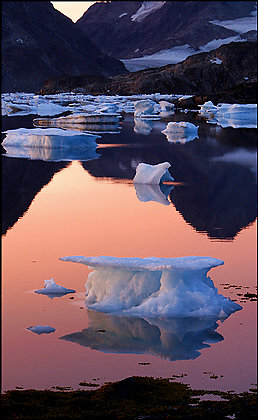
Ice floes dot the bay in Kulusuk,
Greenland, near the Arctic Circle in 2005.
Photo Credit: By John Mcconnico -- Associated Press


*For related UCTP articles on the global climate crisis, see:

UCTP Resolution on Global Climate Crises
http://uctp.blogspot.com/2005/12/uctp-resolution-on-global-climate.html

UCTP Action on Global Climate Crises
http://uctp.blogspot.com/2005/12/uctp-action-on-global-climate-crises.html

UCTP Takes Position on Climate Change
http://uctp.blogspot.com/2005/12/uctp-takes-position-on-climate-change.html

9/09/2006

Up in Smoke? Latin America and the Caribbean

The threat from climate change to the environment and human development.

Climate Change is already hitting Latin America and the Caribbean and this is increasing the vulnerability of poor communities. “Up in Smoke? Latin America and the Caribbean” is the third report from the Working Group on Climate Change and Development. The supporting organisations of this report are: Progressio (formerly CIIR), ActionAid International, Christian Aid, Tearfund, nef (the new economics foundation), Greenpeace, Friends of the Earth, CAFOD, RSPB, WWF, IIED (the International Institute for Environment and Development), Practical Action (formerly ITDG), people & planet, Columban Faith and Justice, Operation Noah, teri Europe, Medact, BirdLife International and WorldVision. These agencies have on-the-ground experience of working with communities whose fragile existences, and the ecosystems in which they live, are being further threatened by global warming. (this report is also available to download in Spanish & Portuguese)

Link to the report in pdf:
http://news.bbc.co.uk/nol/shared/bsp/hi/pdfs/290806_nef_report.pdf