Showing posts with label Trinidad. Show all posts

4/24/2009

Indigenous Peoples Invisible at Trinidad Summit

Trinidad and Tobago (UCTP Taino News) – A delegation of 10 Indigenous leaders traveled to Trinidad to attend the Organization of American States (OAS) 5th Summit of the Americas from April 17 to 19, 2009. The delegation’s intention was to further develop critical partnerships with States while presenting the views of millions of Indigenous Peoples from throughout the Americas. These views were encapsulated in a Declaration and Plan of Action developed at an Indigenous Leaders Summit, which took place in Panama City preceding the OAS Summit. While Trinidad’s Prime Minister Patrick Manning publicly declared his desire for the Summit to achieve prosperity for the peoples of the Americas with commitment and mutual respect, the Indigenous leaders experienced discriminatory exclusion.

Even at the parallel “Civil Society Summit” and other events leading into the 5th Summit, it was not possible for Indigenous Peoples to effectively participate because the government of Trinidad and Tobago would not accommodate the Indigenous Peoples Summit on site. The result of this exclusion was that the Indigenous leaders, representing millions of Indigenous Peoples from across the Americas, were not even considered “delegates” unlike members of civil society, youth, business and private sector delegates. Incredibly, a last minute decision by Trinidad's National Secretariat to increase the number of delegates from civil society from 10 to 40 individuals in the Forum with Ministers was not extended to Indigenous Peoples.

While much of the world was focused on the communications between U.S. President Barack Obama and Venezuelan President Hugo Chavez, the Indigenous Leaders noted that the final 5th States Summit Declaration of Commitment failed to address Indigenous Peoples, despite the theme “Securing our Citizens’ Future by Promoting Human Prosperity, Energy Security and Environmental Sustainability.”

In the development of the Declaration of Commitment by State Governments, there were initially three brief references to Indigenous Peoples in the area of health, education and the draft American Declaration on the Rights of Indigenous Peoples. In the final Declaration of Commitment, only two paragraphs refer to Indigenous Peoples, one which supports “voluntary” corporate social responsibility best practices, involving dialogues between the corporate sector, governments and Indigenous “groups”, and one that commits to the adoption of the American Declaration on the Rights of Indigenous Peoples.

Commenting on the process and the State Summit Declaration, Assembly of First Nations Grand Chief Edward John voiced his disappointment: “We saw the 5th Summit as an opportunity to work in partnership with States of the Americas for the betterment of our people and securing a future where Indigenous Peoples are treated with respect and equality. But if our experience at the 5th Summit is any indication of the States’ intentions, we have a long way to go. Indeed, the 5th Summit represents a step backwards for recognition of Indigenous Peoples. At the 4th State Summit in Mar del Plata, Argentina in 2005, Indigenous Leaders were given the respect we deserve and had an opportunity to speak directly to Heads of States.”

Another member of the Indigenous delegation, Héctor Huertas, a Kuna leader from Panama stated "We have a clear vision of the path to follow and we will continue meeting with the OAS and its Member States in order to ensure that they comply with their international obligations in relation to Indigenous rights and their implementation in these American States. We will be vigilant that the 6th Summit be a space to measure the true fulfillment of the States’ commitment against violence and discrimination towards Indigenous peoples.”

The 5th Summit of the Americas was the first time a Summit of the Americas was held in a Caribbean state.

UCTPTN 04.24.2009

3/05/2009

3rd Indigenous Leaders Summit On Course

Damon Corrie and Roberto Borrero at the offices of the Assembly of First Nations in Ottawa, Canada (UCTP Photo)

Ottawa, Canada (UCTP Taíno News) – A planning meeting for the upcoming 3rd Indigenous Leaders Summit of the Americas was held February 27-28, 2008 in Ottawa, Canada. The meeting was hosted by the Assembly of First Nations (AFN) and the Native Womens Association of Canada.

Three representatives from the Caribbean Region were invited to attend as members of the planning committee – Damon Corrie (Barbados), Albert DeTerville (St. Lucia), and Roberto Borrero (Puerto Rico).

The Indigenous Leaders Summit will present a Declaration and Plan of Action to the 5th OAS Summit of the Americas that will be held in Port of Spain, Trinidad from April 17 – 19, 2009.

The Summit location has not yet been confirmed, but current choices location choices include Venezuela, Panama, and St. Lucia. Trinidad is also being considered but as a result of the OAS Summit, logistics could present a problem. While the cost and other factors will determine the actual meeting site, members of the local indigenous community are still hopeful that the Indigenous Summit will come to Trinidad.

“To not have this meeting in Trinidad would be a shame” stated Chief Ricardo Bharath Hernandez of the Santa Rosa Carib Community. Currently, the Santa Rosa Community is the only community on the island recognized by the government of Trinidad and Tobago.

Close to 100 hundred indigenous leaders from throughout the hemisphere are expected to attend the meeting. Participants will be representative of 4 regions – South America; Central America & Mexico; North America (U.S.A & Canada ); and the Caribbean with about 20 participants per region.

Corrie was appointed to head the Communications Sub-Committee while DeTerville and Borrero will work with the Technical Committee. Outreach has already been circulated in the Caribbean Region for the delegate nominees.

The 3rd Indigenous Summit of the Americas will take place from April 14-15, 2009.

UCTPTN 03.05.2009

1/22/2009

New Summit Blog Launched from Trinidad

UCTP Taino News – A new blog focusing on "the upcoming Fourth Summit of the Peoples, the alternative to the fifth installment of the Organization of American States "Summit of the Americas" conferences has been launched from Trinidad. Entitled "Small World" the blog hopes to be an online forum where "voices from the Caribbean — farmers and fisherfolk, anti-smelter and gender activists etc. — can connect with each other and others across the globe".

The Fourth Summit of the Peoples is scheduled to be held April 16-18 while the OAS Summit of the Americas is schedule to take from April 17 – 19, 2009 in Port of Spain,Trinidad. The theme of the Fifth Summit of the Americas, "Securing Our Citizens' Future by Promoting Human Prosperity, Energy Security and Environmental Sustainability" was developed in close consultation with member countries and partner institutions of the Summit Process.

Small World is located on the world-wide web at http://sctheodore.wordpress.com/2009/01/21/hello-world/.

UCTPTN 01.22.2009

10/15/2008

Amerindian Heritage Day in Trinidad

UCTP Taino News - Surinamese Carib Chief Paremuru
attending the Amerindian Heritage Day Celebration
in Arima, Trinidad on October 14, 2008 at Arima Town Hall

Photo: Wendy-Ann Duncan

9/21/2008

Amerindian Heritage Day to be celebrated in Trinidad

Trinidad and Tobago (UCTP Taino News) - Amerindian Heritage Day will be commemorated this year in Trinidad and Tobago with a week long commemoration from October 13-19, 2008. Taking place in the town of Arima, the program will include ceremonies, lectures, and special cultural presentations hosted by the Santa Rosa Carib Community. Indigenous delegations from around the Caribbean region are set to attend the events, which will include a meeting of the Caribbean Organization of Indigenous Peoples (C0IP). “We are looking forward to attending this important regional meeting and continuing to work in solidarity with our relatives keeping our future generations in our hearts and minds” stated Roberto Borrero, a representative of the United Confederation of Taino People. Indigenous delegates from Guyana, Dominica, Suriname, Belize, Saint Vincent, Puerto Rico, and other countries are expected to attend.

UCTPTN 09.21.2008

6/20/2008

Museum Recognizes Caribbean Heritage


Photo: Several works by Arawak artist Foster Simon of Pakuri Territory in Guyana will be exhibited at the American Museum of Natural History’s Caribbean Festival.


New York, NY (UCTP Taino News) - The American Museum of Natural History will host a Caribbean Heritage Festival in recognition of the region’s cultural legacy and diversity on Sunday, June 22, 2008 from 12 noon – 5:00 p.m. The celebration will highlight the region's contributions and cultures through family friendly programs with guest presenters, performers and films. A Caribbean art display will be featured in the Museum’s Grand Gallery with artists representing Haiti, Jamaica, Trinidad, Guyana, Puerto Rico, and the Dominican Republic. Caribbean indigenous artists Aguilar Marrero and Reina Miranda of Taino Spirit as well as acclaimed Lokono Arawak artist Foster Simon of Guyana will have works exhibited. The program is presented in collaboration with the Haitian Centers Council, Inc. and is free with suggested Museum admission.

UCTPTN 06.20.2008

3/15/2008

Caribbean Indigenous Photo Exhibition to Close

UCTP Taino News – The National Museum of the American Indian, George Gustuv Heye is closing its Caribbean Indigenous focused photo exhibition, “The New Old World” after several extensions on March 17, 2008.

The exhibition featuring photographs by Marisol Villanueva have been on display at the Heye since June 2007. According to Villanueva the concept of The New Old World project emerged from her being a witness of the demonstrations and protests of the indigenous people on the so celebrated five hundred anniversary of the invasion of the land that is today known as the Americas or the New World.

In an interview with UCTP Taíno News, Villanueva also notes that “the initial phase of the project Antilles: Living Beyond the Myth, currently exhibiting at the Smithsonian National Museum of the American Indian (NMAI) in New York, takes place in the Caribbean Antilles, where most people think all indigenous people vanished after the Europeans got there.”

She continued stating “this exhibition challenges that myth of extinction, represented not only by the survival of the indigenous people of the Caribbean, but also by the revitalization movements and legacy that still lives in our culture.”

NMAI is also working on updates to the exhibition’s online version, adding video interviews and excerpts of a forum that accompanied it when it traveled to Puerto Rico in 2005.

Villanueva hopes the project will provide the public with the “opportunity of learning a little more about the true story of the indigenous people of the Caribbean Antilles, their way of living and to be conscious of how much of our culture still lives on.”

Photo: Melanie Calderón, Trinidad (Credit: Marisol Villanueva)

UCTPTN 03.15.2008

2/11/2008

CARIFESTA 2008 to be held in GUYANA


UCTP Taino News - CARIFESTA stands for the Caribbean Festival of Arts and this year the region’s roving, multidisciplinary, mega arts festival will return to its birthplace – Guyana – from August 22 to 31 2008. CARIFESTA attracts a wide range of creative artists from various Caribbean and Latin American countries and was the culmination of a concept that began in 1970 when participants at an Artists and Writers Convention in Guyana complained about the absence of an outlet to showcase the rich cultural heritage of the Region. Since its inaugural launch in 1972, previous CARIFESTA have taken place in Guyana, Jamaica, Cuba, Barbados, Trinidad and Tobago, St. Kitts and Nevis, and Suriname. The Indigenous Peoples of the region have historically participated within the festival and in 2006, CARIFESTA coincided with an historic meeting of the Caribbean Organization of Indigenous Peoples (COIP) in Trinidad. During this meeting the COIP Secretariat was officially “handed over” from Guyana to Trinidad and a Declaration of Unity was entered into between the Santa Rosa Carib Community and the United Confederation of Taino People.

UCTPTN 02.11.2008

10/19/2007

Taino Welcomed by Caribbean Organization of Indigenous Peoples

Arima, Trinidad (UCTP Taino News) – On October 16th, 2007 Indigenous leaders from throughout the Caribbean meet in Arima, Trinidad to discuss critical regional issues under the auspices of the Caribbean Organization of Indigenous Peoples (COIP). Hosted by Trinidad’s Santa Rosa Carib Community, delegates attending the COIP meeting represented Indigenous Peoples from Belize, Dominica, Guyana, Suriname, Trinidad, and Puerto Rico.

In an historic affirmation of Caribbean Indigenous solidarity, COIP officially welcomed Puerto Rico’s Consejo General de Tainos Borincanos as full voting members. As COIP is a recognized by Indigenous Peoples, governments, inter-governmental organizations as a Caribbean regional organization, the inclusion of the Consejo General now provides an opportunity for Boriken Taino to officially raise their concerns within this collective.

During the meeting, another important agenda item focused on COIP representation at International Forums such as the United Nations. The increasing visibility of COIP at this level is already evident as a communication from the Secretariat of the United Nations Permanent Forum on Indigenous Issues was received and transmitted to the participants during the opening ceremony for the meeting.

Held in Arima’s Town Hall, the opening ceremony for the important meeting began with welcoming remarks from the honorable Mayor of Arima, Adrian Cabralis, as well as Government Ministers, Excellencies Penelope Beckles and Joan Yuille-Wiliams.

Funding for many of the delegates to attend the meeting as well as the concurrent activities celebrating Trinidad’s “Amerindian Heritage Week” was made available by the government of Trinidad and Tobago.

10/18/2007

Carib and Taino Nations Sign Historic Treaty

Chief Charles Williams and Roberto Mucaro Borrero
Unite the Carib and Taino Nations in Trinidad. UCTP Photo


Arima, Trinidad (UCTP Taino News) – The Kallinago Carib Nation of Waitikabuli (Dominica) and the United Confederation of Taino People (UCTP) ratified an historic "Declaration of Unity" on October 16, 2007.

Kallinago Chief Charles Williams and Roberto Mucaro Borrero, the President and Chairman of the UCTP’s Office of International Relations and Regional Coordination signed the declaration on behalf of their respective communities during the celebration of Amerindian Heritage Week in Arima, Trinidad.

“Indigenous Peoples need to support each other as there is strength in unity” declared Chief Williams.

The declaration promotes solidarity between the Kallinago and the Taino at the local, national, and international levels.

“Treaties between Indigenous Nations are tangible demonstrations of our sovereignty and our internationally recognized right to self-determination” noted President Borrero. “This declaration makes it clear to all that the Kallinago and the Taino recognize each other as Indigenous Peoples of the region”.

The Kallinago Carib Nation is the only indigenous community in the Caribbean islands who maintain an officially recognized territory via a treaty with the government of Dominica. The UCTP represents Taino People throughout the region and the Diaspora.

The “Declaration of Unity” with the Kallinago Nation follows a series of similarly historic treaty ratifications by the United Confederation of Taino People. Currently, the UCTP maintains treaty relationships with the Santa Rosa Carib Community of Trinidad, the Joboshirima Arawak Community of Venezuela, the Guyanese Organization of Indigenous Peoples (GOIP), and the Eagle Clan Arawaks of Barbados and Guyana.

10/17/2007

Caribs Celebrate Amerindian Heritage Week in Trinidad


Ameridian Heritage Week Ceremony, Arima, Trinidad

Trinidad and Tobago (UCTP Taino News) – October 14 thru 19 2007 is designated Amerindian Heritage Week in the “Twin Republic” of Trinidad and Tobago. Celebrations, ceremonies, and educational activities are being led and organized by the Santa Rosa Karina (Carib) Community with the support of the government of Trinidad.

Some highlights of the week long celebration include ceremonial processions, ceremonies, crafts exhibitions, visits to sacred and historic sites, meetings with high-level government officials, and a meeting of the Caribbean Organization of Indigenous Peoples (C.O.I.P.).

In solidarity with the Santa Rosa Carib Community, indigenous delegations representing Guyana, Surinam, Belize, Venezuela, Dominica, Puerto Rico and from as far as Canada are participating in the celebration.

Under the leadership of Chief Ricardo Bharath-Hernandez, the Santa Rosa Community continues to raise the prominence of Trinidad’s indigenous descendants. At last year’s celebration the government announced the formation of a cabinet committee to review and issue recommendations regarding the island’s Indigenous Peoples. The committee, which includes government and Santa Rosa Community representatives has recently submitted its first report.

During a speech given in Arima this week, Chief Bharath-Hernandez stated that while the community appreciates the government’s support “much more needs to be done”. The Chief then referred to their Community’s outstanding land-base issue and their desire for an official holiday to recognize the contribution of the Twin-Island Republic’s Indigenous Peoples.

5/16/2007

Two-Week Session on Indigenous Issues Opens at United Nations

New York, NY (UCTP News) - As delicate ecosystems supporting millions of lives hang in the balance, indigenous representatives from around the globe began a two-week session of discussions on Monday, May 14 with top United Nations officials, Government representatives and members of civil society to highlight the struggle to defend their rights to access and use the land and natural resources in their territories.

The sixth session was opened with an invocation from Tracy L. Shenandoah, Chief of the Onondaga Nation, Eel Clan. Acknowledging “red willow” as the leader of medicines, Shenadoah said the “ the Creator had planted medicines, including berries, for people to use." He also gave thanks to the birds, especially the eagle, and to the “three sisters of all foods: corn, beans and squash.” Shenandoah also gave thanks to the waters for their help in creating peace. His statement was followed by a performance by the Laihui cultural group from Manipur, India.

Victoria Tauli-Corpuz, Chairperson of the Permanent Forum on Indigenous Issues, addressed those gathered by stating “without access to and respect for the rights over their lands, territories and natural resources, indigenous peoples’ distinct cultures -- and the possibility of determining their on development -- become eroded.”

Highlighting new developments, Tauli-Corpuz stated that one of the major thrusts for 2007 would be to press for the General Assembly’s adoption of the United Nations Declaration on the Rights of Indigenous Peoples, approved by the Human Rights Council last year. Indigenous peoples worldwide had been “deeply disappointed” by the Assembly’s decision to defer action on the Declaration last year. Noting that amendments had been made to the text in the meantime, she said that every effort should be made to ensure that what was put before the Assembly was the Council-approved version, not one “which mangled the Declaration beyond recognition.” “The fate of this Declaration is in your hands and the Governments who are here today,” she said.

Among the many expert presentations and reports by representatives on United Nations agencies and Funds, Erica-Irene A. Daes, of Greece, an elected member of the Working Group on Indigenous Populations and Special Rapporteur on Indigenous People’s Land Rights, said one of the most acute and complex situations facing the world’s indigenous peoples was the refusal by certain Governments to promote and protect their rights to land and natural resources. To understand the profound relationship of indigenous peoples to their lands and natural resources, cultural differences between indigenous and non-indigenous peoples should be recognized.

The doctrines of dispossession that had emerged in developing modern international law, particularly the concepts of “terra nullius” and “discovery”, had well-known adverse effects on indigenous peoples, she continued. Other problems included the State’s failure to acknowledge indigenous rights to territories lands and resources; to demarcate indigenous lands; to enforce or implement laws protecting indigenous lands; and the State’s expropriation of indigenous lands for national interest without the prior and informed consent of indigenous peoples. Also, the principle of permanent sovereignty over natural resources and the scope of indigenous peoples’ right to own, develop and manage their territories, lands and resources, should be reviewed, she added.

Among the participants attending the meeting, Chief Reginaldo Fredericks of the Joboshirima Lokono Arawak Community of Venezuela noted the importance of meeting stating “it is critical for us as Indigenous Peoples to follow-up on the recommendations made and report on these activities to our peoples.”

Chief Fredericks is a member of the Indigenous Peoples Caucus of the Greater Caribbean, which forms annually at the UN meeting to lobby Caribbean indigenous issues.

Caribbean indigenous delegates also participated along with indigenous representatives of other regions at a rally in support of the Declaration on the Rights of Indigenous Peoples. Speaking on behalf of indigenous leaders from Puerto Rico, Dominican Republic, Dominica, Trinidad, Guyana, Venezuela, and Barbados, UCTP President and Chairman Roberto Mucaro Borrero reaffirmed their support of the Declaration as adopted by the Human Rights Council in June 2006.

Also in attendance at the session, Taino artists John Marrero and Reina Miranda joined UCTP delegates Mildred Gandia and Borrero at the opening of the special art exhibition, which would run through the Forum. Selected works of Marrero and Miranda were on display along with various works of Lokono and Taino artists: George Simon, Mildred Torres-Speeg and Naniki Reyes Ocasio.

The Forum’s sixth session will run through 25 May and will consider solutions to end the senseless exploitation of traditional lands and natural resources, a key issue at the heart of indigenous people’s efforts to gain recognition of their rights.


UCTP delegates at the UN, (from left to right) Reina Miranda,
Roberto Borrero, Mainaku Borrero, John Marrero,
and Mildred Gandia. (UCTP Photo)

3/12/2007

Does Trinidad Recognize Its Indigenous People?

The following is a recent Editorial from the CAC Review:

What Recognition?
Along with the leadership of the Santa Rosa Carib Community, I have been one of those who has frequently written that the Government of the Republic of Trinidad and Tobago has formally recognized the same Carib Community, a formally registered organization based in the Borough of Arima. The reasons for stating this can be explained as follows:

(i) According to News Release No. 360, issued by the Information Division, Office of the Prime Minister, on May 8, 1990, "Cabinet has decided that the Santa Rosa Carib Community be recognized as representative of the indigenous Amerindians of Trinidad and Tobago, and that an annual subvention of $30,000 be granted to them from 1990. Cabinet also agreed that an Amerindian Project Committee be appointed to advise government on the development of the Community....as the oldest sector of this country's multi-cultural society, the Amerindians have, for some time, been recognized as having unique needs for their cultural and economic viability. Such needs come into higher relief and sharper focus as the country prepares to celebrate, Columbus' Quincentennial in October 1992."

The juxtaposition of ideas here is significant, because the news release highlights the context in which the decision became important: a commemorative event, held in conjunction with the Caribbean Festival of the Arts (CARIFESTA) hosted by Trinidad in 1992, where the Government sought to showcase indigenous peoples, including its own.

In the presentation of the National Trust Bill, in the parliament on Friday, March 15, 1991, the then Minister of Food Production and Marine Exploitation, Dr. Brinsley Samaroo stated the following:

"The third project that is being undertaken by this Government has to do with the way in which we have duly recognized the presence of, and importance of, the descendants of the indigenous peoples of our lands. That is another area that the Member for Naparima mentioned and I do hope he now believes that he is not being disregarded in the contributions that he has been making as we are addressing some of the issues that he raised. No one can deny that those who laid the first foundations of our civilization were the Caribs and the Awaraks [sic] the two largest nations of our early history and the smaller tribes such as the Tianos [sic] and Lucayos [sic] who also inhabited this country. These were our ancestors who taught us to use our hammocks and to boucanour [sic] fish and meat. These were the people who showed us how to live in harmony with nature and gave us our first lessons in the protection of the environment. From them we obtained such names as 'Mucarapo' from the Amerindian word Cumo Mucurabo, a place of great silk cotton trees; 'Arima', the place of water [sic]; 'Naparima', no water [sic]; and 'Tacarigua' being the name of an Amerindian chief from the Caura Valley. For many years, their local descendants, these descendants of early and first members of this country, were vainly clamouring for recognition from the past administration, as the representatives of the indigenous Amerindians of Trinidadand Tobago and for Government to help in preserving that part of the national heritage. It was this Government which gave such recognition by Cabinet decision of April, 1990. We agreed, among other things, to recognize the Santa Rosa Carib community as the representative of the indigenous Amerindians of this nation; we agreed to an annual subvention of $30,000 towards their upkeep and preservation of the national heritage; we agreed to make the contribution of the indigenous peoples, an essential part of our observation of the 500 years ofour achievements which will coincide with the quincentennial of Columbus arrival here 500 years ago. The year of course for that is 1992. At the present time, the Government is talking to these persons whom we have recognized about giving them a piece of land as a permanent site for the establishment of a village to commemorate their ancestry" (see page 27 of the House of Representatives report for that date).

(ii) As a result of that decision in 1990, the Santa Rosa Carib Community has received an annual subvention from the Government of $30,000 TT per annum, along with $5,000 TT per annum from a local government body, the Arima Borough Council, still attached to the central government. (For confirmation of the first amount, see page 56 of
the House Debates for 1992.)

(iii) Frequently, for many national events, the Government has highlighted the presence of the Santa Rosa Carib Community. This occurred on three occasions that CARIFESTA was hosted by Trinidad and Tobago, as well as several public speeches of commitment to provide the Caribs with land, and multiple visits by government ministers to a government-funded Carib Community Centre in Arima. (Where CARIFESTA is concerned, see an example of the festival-related "recognition" at: http://www.carifesta.net/art7.php.)

(iv) The Government also created a formally named "Day of Recognition," presumably to be "observed" every October 14 (see the Hansard for July 18, 2000.)

Recognizing What?
In other words, yes, in multiple ways the Government has formally and effectively recognized...what?

The fact of the matter is that the Government of Trinidad and Tobago has no legal definition of the term "indigenous peoples," and frequently appropriates the term for referring to all people born in the country, in contradiction to established international conventions. Secondly, the Government has only recognized only one specific organization, and worse yet, it has recognized it in a manner that suggests it is the only possible representative of Trinidad's "Amerindians," rendering any other claimants to an indigenous identity as fakes. Thirdly, while claiming to recognize the Caribs, the Government has not signed any international conventions or agreements that pertain specifically to the rights of indigenous peoples.

And Now Comes the UN
The United Nations Committee for the Elimination of Racial Discrimination (CERD), in a report on the countries of Latin America and the Caribbean issued in June of 2006, found fault with the Government of Trinidad and Tobago specifically on the issue of its lack of legal recognition of the indigenous people of the nation. On page 534 in that report, CERD states:

"351. The Committee expresses its concern at the absence...of specific information on the indigenous population as well as other relatively small ethnic groups of the State party in the report, and particularly the absence of a specific categorization of the indigenous population as a separate ethnic group in official statistics on the population. The Committee encourages the Government to include the indigenous population in any statistical data as a separate ethnic group, and actively to seek consultations with them as to how they prefer to be identified, as well as on policies and programmes affecting them."

In a supplement, on page 536, CERD reveals with specific reference to the Caribs:

"34. Members of the Committee asked why the Caribs had all but disappeared, exactly how many were left, why they were not treated as a separate racial group and whether measures were being taken to help them, particularly in the economic and educational fields, so as to compensate them for the injustices they had suffered."

In other words, CERD had been told by the Government of Trinidad and Tobago that the Caribs were virtually extinct, and as is typical of government statements on this matter, "the only remaining descendants are to be found in Arima." What is especially remarkable is that CERD has been making such observations, and asking such questions of the Government of Trinidad and Tobago, regularly and as far back as 1980, as the supplements to the report reveal.

It is a fact that there is no population census in Trinidad that admits the category of either indigenous, Amerindian, Carib, or anything remotely related, as a choice for self-identification. This renders extraordinary the incredible statement recently made by the Minister for Community Development, Culture and Gender Affairs, Joan Yuille Williams who proclaimed on Saturday, September 23, 2006, in the Carib Community Centre itself, that people of Amerindian and "mixed Amerindian" descent in Trinidad are "a very small minority," as I myself heard her say this. In the absence of a census that allows for such identification, there is nothing to substantiate her assertion.

So why make such an assertion?

As a politician in a race-based political party, the People's National Movement, Minister Williams knows how many votes have been won by her party over the decades by appealing to Afro-Trinidadians. Likewise, the other major political bloc in the country, formerly the United National Congress, seized considerable political power by appealing to Trinidadians of East Indian descent. These two major ethnic blocs have dominated national politics. Any third identification would radically upset the established way of calculating rewards and patronage, of dividing spoils in what is in effect a long standing Cold War that has rendered the country bipolar (perhaps in more than the political sense alone).

Secondly, the assertion is convenient when the main aim of the Government has not been to take the Caribs seriously. Instead, the Caribs are trotted out as mere showpieces for festivals and commemorative events, like a colourful little museum piece, but certainly nothing of any social or political import. The Santa Rosa Carib Community, in practice, is treated as a tokenistic, folkloric troupe--mild, smiling, doing its part to add a little more colour to the multicultural fabric waved by the nation to greet tourists.

Thirdly, the leadership of the Santa Rosa Carib Community has not vocally and directly challenged the government on these questions. This is in part due to strong political ties between the leadership and the PNM, the dependency on government funding, and the lack of any ambition to become involved in a national movement for the recuperation of indigenous identity. Such sentiments, in my experience, have been heard most loudly from expatriate Trinidadians who wish to recoup their indigenous identity, and who understand that if not a majority, at least an extremely large minority of Trinidadians could claim indigenous ancestry. Many more are in fact claiming this ancestry.

So when asking the Government of Trinidad and Tobago if it recognizes the indigenous people of the country, and it answers, "the Santa Rosa Carib Community has been recognized," it is important to understand the evasiveness of the answer. The answer, in any legal and political sense, is that no, there is no such recognition.

Editorial by
Dr. Maximilian C. Forte, Anthropology, Concordia University, Montreal

*Article Source:
http://cacreview.blogspot.com/2007/03/does-trinidad-recognize-its-indigenous.html

3/02/2007

CLIMATE CHANGE:Latin America Failing to Adapt

By Diego Cavallos

MEXICO CITY (IPS) - Latin America and the Caribbean are not prepared to confront the problem of global warming, to which the region is contributing with growing emissions of greenhouses gases, says a new report by the United Nations Environment Programme (UNEP).

According to the report, "Climate Change in Latin America and the Caribbean 2006", there is a "Lack of informationàregarding how to approach adaptation" to the phenomenon, "Uncertainty regarding the interaction between climate change and other pressures," a "Short-term planning horizon," and a "Lack of mechanisms for public participation."

"The region has made great progress in terms of civil defence measures to deal with the disasters arising from climate change, but it has not done so in the area of adaptation," Ricardo Sánchez, UNEP regional director for Latin America and the Caribbean, told IPS.

Global warming is caused by greenhouse gases, which are mainly produced by the burning of fossil fuels.

In this region, the impact of climate change is seen in the growing intensity and frequency of hurricanes in the Caribbean, changes in rainfall patterns, increased water levels in rivers in Argentina and Brazil, and the shrinking of glaciers in the extreme southern region of Patagonia and the Andes mountains.

The report, drawn up by UNEP and Mexico's ministry of the environment and natural resources, warns that in the countries of Latin America and the Caribbean there is "Limited non-technical knowledge (economic, legal, institutional) for adaptation" and "Limited knowledge of tools and procedures for evaluating adaptation performance."

In the future, "climate change will increasingly be a development problem" in the region, which is already suffering economic and human losses as a result of the phenomenon, the study warns.

"Climate change is no longer science fiction, it is already hitting us, and for now it is inevitable," said Sánchez.

In October 2005, Hurricane Stan tore through several Central American countries, hitting Guatemala and El Salvador especially hard, and causing at least 1,620 deaths. Just two months earlier, Hurricane Katrina caused severe damages in the southern United States, becoming one of the most devastating hurricanes in recent U.S. history.

And in 1998, Hurricane Mitch left a death toll of around 1.2 million and material losses of 8.5 billion dollars -- more than the combined gross domestic product of Honduras and Nicaragua, the countries that bore the brunt of the storm's fury.

Other disasters were Hurricane George, which slammed into the Dominican Republic in 1998, claiming 235 lives, and Hurricane Ivan which left over 100 dead in Barbados, Trinidad and Tobago, Saint Vincent and the Grenadines, Grenada, Jamaica, Cuba and the United States in 2004.

Although emergency measures to prepare for and mitigate the impacts of hurricanes have improved, global adaptation mechanisms are also needed, including long-term plans, funding, development of alternative energy sources, and a concerted effort to fight poverty and deforestation, said Sánchez.

While the report points out that compared to industrialised countries, this region contributes relatively little to the phenomenon of climate change, it warns that its share of global greenhouse gases is growing, from seven percent in 2000 to a projected nine percent in 2050.

The study also expresses concern that CO2 emissions in the region were 75 percent higher in 2004 than in 1980.

Just over 70 percent of greenhouse gas emissions come from Brazil, Mexico, Venezuela and Argentina, it adds.

UNEP says these emissions are barely counteracted by investments and renewable energy projects, while poverty and deforestation continue to increase vulnerability to climate change.

The highest deforestation rates in the region are seen in small Caribbean nations like St. Lucia and Haiti. In Central America, meanwhile, deforestation rates range from 4.6 percent in El Salvador to 0.8 percent in Costa Rica.

In South America, the highest deforestation rates are seen in Ecuador, "which faces strong population pressure," and Argentina, where the expanding agricultural frontier continues to encroach on the country's forests.

Although Brazil, which accounts for 56 percent of the region's forests, no longer has the worst deforestation problem, the report notes that logging activity in the Brazilian Amazon jungle region increased 32 percent in the last decade, from 14,000 to more than 18,000 square kilometres a year.

The report also mentions the region's "very serious social problems in relation to inequality and poverty," and says "many difficulties stand in the way of finding development patterns that will lead to sustainability capable of meeting the social and environmental challenges for present and future generations."

In the region, the richest 10 percent of the population has 35 percent of the income, while the poorest 40 percent has just 10 percent.

"These indicators have remained stable in most of the countries despite the improvements in economic performance and, except for a few cases, in spite of the predominant social development policies," the study says.

"The failures in adaptation and vulnerability increased as a result of poverty, the degradation of natural resources, the lack of land-use planning and the lack of a significant plan prepared to counteract the damage cause by climate-related disasters," it adds. (END)

*The material in this post is distributed without profit to those who have expressed a prior interest in receiving the included information for research and educational purposes. For more information go to: http://www4.law.cornell.edu/uscode/17/107.html
http://oregon.uoregon.edu/~csundt/documents.htm If you wish to use copyrighted material from this email for purposes that go beyond 'fair use', you must obtain permission from the copyright owner.

12/21/2006

Editorial: The OAS & CARICOM: Missing in Action*

In prior negotiations with the Organization of American State (OAS) on the draft American Declaration of the Rights of Indigenous Peoples, the United States has usually stood alone in its opposition to the advocacy efforts of the Indigenous Caucus. It was sad to see at the recent 8th session on the elaboration of the Declaration that the USA is now playing 'second fiddle' to the delegation of Canada (led by Mr. Paul Gibbard) who now have become the most strident opponents facing the Indigenous Caucus.

I must also take this opportunity to again highlight the fact that despite all of their flowery rhetoric (usually around election time) citing 'deep concern for their Amerindian citizens' - not a single CARICOM government representative participated during the 8th session, which was held in the Simon Bolivar Room at the OAS Headquarters in Washington DC. Caribbean government representatives were in the OAS building however, and I made notes of the times I saw various CARICOM delegates entering and leaving the building, having lunch at the OAS cafe etc.

Seems it was too much trouble to expect them to fill their seats like other OAS member States who were with us every day proving that actions do speak louder than words. I applaud the Latin American countries who were the staunchest allies of the Indigenous Caucus yet again.

At the very least I expected to see Guyana, Suriname, Belize, Dominica and Trinidad represented officially, for they all use the Amerindian component of “their” societies to promote various national tourism efforts. It is interesting to note however that here, amidst a discussion on an issue of the direst importance to the present and future generations of their “beloved” Amerindian populations - they show no interest in the process whatsoever.

This is an unfortunate but very revealing development indeed, especially when less than one month ago with the exception of Dominica, these same CARICOM States helped to essentially block the passage of the most important Indigenous Rights Declaration in the history of the United Nations. These states mimicked the clearly dishonest argument that African states flaunted, which was that 'they needed more time to review the Declaration". Let us all bear in mind that this Declaration process at the UN has been in existence for over 20 years!

With that in mind, Indigenous Peoples rigthtly ask 'What is it exactly that the CARICOM diplomats do besides draw large salaries from the taxpayers and live in luxury abroad?' Please give us an answer as it relates to the Indigenous Peoples on whose lands your Neo-Colonial States exist.

Submitted by Damon Gerard Corrie (Lokono Arawak)
Member of the Indigenous Caucus working Group
on the Draft American Declaration on the Rights of
Indigenous Peoples.


*The Caribbean Community and Common Market or CARICOM was established by the Treaty of Chaguaramas[8] which came into effect on August 1, 1973. The first four signatories were Barbados, Jamaica, Guyana and Trinidad and Tobago.

9/12/2006

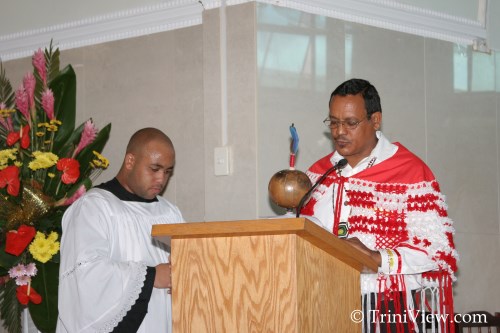
Caribs Celebrate the Feast of Santa Rosa


Carib Chief Ricardo B. Hernandez address the Church
Service in Arima, Trinidad. (Photo: Triniview)

Arima, Trinidad (UCTP Taino News) - The Santa Rosa Carib Communty Celebrated The Feast of Santa Rosa With Church Service and Street Procession followed by Various Festivities on August 27, 2006.

Review a photo gallery of the complete event and community members at Triniview: http://triniview.com/album/Carib_Festival_270806