Showing posts with label Boriken. Show all posts

6/06/2023

Taíno Leaders Attend Stonebreakers Premier in NYC


At the Stonebreakers premiere at the Brooklyn Film Festival, (L to R), Joselyn Kaxyek Borrero, UCTP President R. Mukaro Agueibaná Borrero, Film director Valerio Ciriaci, Wanda Anainaru Hernandez, and Guainia Taino Tribe Council member, Heriberto Guaraguaniki Martinez

Brooklyn, NY (UCTP Taíno News) – The documentary film, Stonebreakers, made its New York debut at the Brooklyn Film Festival on June 3, 2023. Stonebreakers documents the controversy around public “monuments” that arose during the George Floyd protests and around the 2020 presidential election. The film highlights advocacy toward the removal of statues of Columbus, Confederates, and Founding Fathers as well as community-led initiatives to highlight alternative historic and community icons.

Stonebreakers film will continue to be screened at various festivals throughout the year. The premiere in Brooklyn also featured a Q & A session after the screening that included the film’s producers, as well as film Director Valerio Ciriaci, Folklorist Joseph Sciorra, and R. Mukaro Agueibaná Borrero, President of the United Confederation of Taíno People and Kasike (chief) of the Guainía Taíno Tribe of Boriken. Both Sciorra and Kasike Borrero appear in the film. The film credits also thank the United Confederation of Taíno People among many other entities. 

“I commend the filmmakers on a powerful and important work. It is my hope this film will be seen by many as I feel it can help those who don’t understand this issue, perhaps building more empathy and support for the removal of racist icons such as Columbus statues” stated Kasike Borrero.

Information on additional screenings can be found on the Awen Films website.

UCTPTN 06.06.2023

2/07/2023

Kasike Martín "CacibaOpil" Veguilla Díaz departs to Soraya


Joint Declaration: The United Confederation of the Taino People and Iukaieke Guainía solemnly pause and unite in solidarity and respect to all our sisters and brothers of the Taino Arawak People over the physical loss of Kasike Martín "CacibaOpil" Veguilla Díaz, leader of the Taino Council Guatú Ma Cú a Borikén since its founding.

 Kasike CacibaOpil dedicated decades of his life to the reaffirmation of the Indigenous Caribbean survival, particularly that of Borikén. He was an outstanding artisan and his training as a performing artist allowed him to develop and exalt our areítos in a historically accurate manner both for ceremonial gatherings, as well as for cultural presentations throughout the Borikén archipelago and the diaspora. He developed teaching systems for his community on topics such as history, spirituality, cultural, and ceremonial practices to everyday ones such as traditional indigenous agriculture, medicines, and ways of life.

We express our deepest condolences to the entire Guatú Ma Cú Community, recognizing that many viewed Kasike CacibaOpil as a father and affectionately nicknamed him "Viejo", a term of endearment normally used for fathers.

He leaves an indelible mark on the aniki (mind, heart and spirit) just as our own ancestors left us petroglyphs. We are left with his musical compositions that honor and exalt our beloved culture and now mark the history of our Living Peoples, as the ancestors receive him in love and joy and accompany him to the sacred place we call Soraya and/or Koaibei.

UCTP/IG 7.02.2023

6/22/2022

Native America Calling: Indigenous resistance to gentrification in Puerto Rico

 Today on Native America Calling, 1PM ET, Shawn Spruce speaks with Roberto Múkaro Borrero (Taino), president of United Confederation of Taino People; Gualterio Alomar (Taino), president of the Organization for Culture of Hispanic Origins; and Tai Pelli (Taino), International relations and Human Rights Officer for the United Confederation of Taino People. https://www.indianz.com/News/2022/06/22/native-america-calling-indigenous-resistance-to-gentrification-in-puerto-rico/


12/30/2021

Taíno Confederation calls for Investigation into Archeological Site Destruction

Luquillo, Borikén (Puerto Rico) – In a recent communication to the Puerto Rican Institute of Culture, the United Confederation of Taíno People (UCTP) called for an investigation to determine the damage to an Indigenous archeological site in Luquillo. The UCTP was made aware of the issue after a video report made by advocate Eliezer Molina surfaced on social media. Molina’s video documents extensive damage to ancient pottery as a road was being made into the area's wetlands. 

In the communication to Nancy Santiago, Director, Archeological and Ethnohistory Program at the Puerto Rican Institute of Culture (ICP), the Confederation stated the site was “considered of significant cultural importance to Taíno Peoples and archeologically.” 

Upon initial inquiry, the UCTP has so far determined that the damage caused by heavy machinery is linked to developer Federico Stubbe. The construction is related to a proposed hotel tied to the Marriott company.

“The UCTP is calling on the Institute of Puerto Rican Culture and the government of Puerto Rico to implement the applicable laws for the protection of cultural patrimony in Puerto Rico and immediately halt the construction,” said R. Múkaro Agüeibaná Borrero, President, United Confederation of Taíno People. He continued, stating that “the Confederation is also calling for an in-depth cultural and environmental impact study, including an assessment of the damage, and of the legality of the construction permitting process.” 

The UCTP’s communication to the ICP also notes that what is occurring in Luquillo is a “recurring tragedy on the island as development projects are continuously fast-tracked” regardless of the damage to the archeological record or the concerns of Taíno Peoples. “UCTP representatives are in touch with and support local protests concerning the site. A group of concerned individuals have set up a camp near the area called Campamiento Cangrejo,” stated Tai Pelli, UCTP Human Rights and International Relations Officer. “They have also established a petition that the UCTP supports. 

Evidence shows that the archeological site is connected to wetlands that were protected for decades. The damage could be in violation of several laws including Puerto Rican Public Law 112, July 20th, 1988, which is supposed to protect archaeological sites. Additionally, the damage documented by Molina and others appears to violate U.S. Federal Laws including the Endangered Species Act and the Clean Water Act, Section 404, which is the primary vehicle for Federal regulation of activities that occur in wetlands.

For more information, contact oirrc@uctp.org

Confederación Taíno pide una Investigación sobre Destrucción de Sitio Arqueológico

Luquillo, Borikén (Puerto Rico) – En un comunicado reciente al Instituto de Cultura Puertorriqueña (ICP), la Confederación Unida del Pueblo Taíno, CUPT (UCTP, por sus siglas en inglés) pidió una investigación para que se determine el daño a un sitio arqueológico indígena en Luquillo. La CUPT fue alertada sobre el hecho a través de un video del defensor Eliezer Molina que surgió en las redes sociales. El video de Molina documenta daño extensivo de alfarería antigua, según se va construyendo una carretera hacia las áreas de humedales.

En la comunicación dirigida a la Sra. Nancy Santiago, Directora del Programa de Arqueología y Etnohistoria del ICP, la Confederación declaró que "considera este lugar como uno de gran importancia cultural para el Pueblo Taíno, como arqueológicamente."

Tras una investigación inicial, y hasta ahora, la CUPT ha identificado que el daño causado por equipo pesado está vinculado al desarrollador Federico Stubbe. La construcción está relacionada a un propuesto hotel vinculado a la compañía Marriott.

“La Confederación Unida del Pueblo Taíno hace un llamado al Instituto de Cultura Puertorriqueña y al gobierno de Puerto Rico a utilizar las leyes correspondientes para la protección del patrimonio cultural en Puerto Rico y a detener de inmediato la construcción”- dijo R. Múkaro Agüeibaná Borrero Presidente de la Confederación Unida del Pueblo Taíno. Seguidamente declaró que “la Confederación también está pidiendo a que se conduzca un estudio de impacto a profundidad incluyendo la evaluación de los daños ambientales y culturales así como la legalidad del proceso de permisología de dicha construcción.”

La comunicación de la CUPT al ICP también denota que lo que está ocurriendo en Luquillo es “una tragedia recurrente en la isla ya que los proyectos de desarrollo son continuamente acelerados por vía rápida” independientemente del daño al archivo arqueológico ni a las inquietudes del Pueblo Taíno.

“Representantes de la CUPT estamos en comunicación y apoyamos las protestas locales relacionadas con este lugar. Un grupo de ciudadanos ha establecido un campamento en el área, llamado Campamento Cangrejo.” indicó Tai Pelli, Oficial de Relaciones Internacionales y Derechos Humanos de la CUPT. “También se ha establecido una petición en línea la cual la CUPT apoya.” 

La evidencia demuestra que el sitio arqueológico está conectado a humedales que han sido protegidos por décadas. El daño pudiera estar en violación de varias leyes, incluyendo la ley Pública PR 112 del 20 de julio de 1988, la cual se supone proteja los sitios arqueológicos. Por otra parte, el daño documentado por Molina y otros aparenta violar leyes federales de E.E.U.U. incluyendo la Ley sobre Especies Amenazadas y la Ley de Agua Limpia, sección 404, la cual es la medida primordial de la regulación federal sobre algunas de las actividades que ocurren en los humedales. 

Para obtener más información, communíquese con oirrc@uctp.org

5/01/2021

Decolonizing Indigenous Grounds

By Nichole Bodin, MPA

The Effect of Indigenous National Parks in Modern History 

The Caguana Indigenous Ceremonial Center in Utuado is one of the Caribbean's most important Taíno archeological sites.


Artifacts created by Indigenous Peoples are an essential part of any basic archaeological research necessary for sociocultural and historic reattachment. In this modern era, there is incredibly limited information in relation to most Taíno historical aspects and our Indigenous ancestor’s circle of life dated before colonial times. Because of that, material cultural studies of Indigenous heritage are underappreciated. In order to understand the history of Borikén (Puerto Rico), which began over 6,000 years ago, worldwide recognition is needed to diffuse the authentic revelation that the so-called New World had an organized and complex society with an enriched culture. 

During the 1950s, the idea of a Caribbean sociocultural evolution intrigued some American archaeologists like Gordon Childe, Robert Redfield, Julian Stewart, and Leslie White. Their works manifested different and diverse points of view. A great number of North Americans traced sequence units of sociocultural development and they called them archaeological epochs, levels, or stages. A decade later, new studies by Herbert Spencer and Lewis Henry Morgan added advanced dimensions with regard to the understanding of the processes involved. For the past 20 years, some evolution and classification models have been deeply criticized, causing investigators to use alternative terminology. These topics related to artifacts (also called material culture) have to help to define educational and intellectual concepts in fields like visual arts, literature, architecture, urban design, and traditional popular culture. 

But somehow, the pre-colonial or pre-Colombian history of Borikén and the Antilles are still a part of practical connections of production styles that are artistic guesses over artifact interpretation. These interpretations are based on research made without any type of verification concerning their social and practical uses within the archaeological findings. As a result, the historic framework used in National Parks during their conceptualization process should have adopted a greater responsible vision to inform, preserve and interpret a more complete structure of the complexity of the human experience. This would assist in the comprehension of the past in a more coherent and intelligent manner that respects our ancestorial community and their legacy. The majority of the scholastic approaches have only allowed moldable flexibility for archaeological researchers for easy identification of a specific region into supposedly appropriate descriptions based on race interaction, ethnicity, class, and genre (in and between topics) within the broader timeline of Caribbean studies. 

The historic designation of Indigenous National Parks in Borikén falls into the same category with regard to their legitimacy in relation to the jurisdictional lines that this colony suffered at hands of Spain and the USA for hundreds of years. For instance, some of the cultural assessments for historic buildings and sites and their designations don't consider the strong relationship that a National Park has with state-sponsored museum projects. Even though these are two different aspects of historic conservation, parks and museums are bound together and their current status with local community involvement is crucial for their sustainability. 

The area that stands out as the most important restored archaeological site in Puerto Rico is located in the Caguana neighborhood of Utuado, formerly known as Capá, a part of a region of important indigenous archaeological remains. The Caguana Ceremonial Center park consists of 10 restored bateys surrounded by a variety of stones with petroglyphs. It was rediscovered as a part of an archaeological project, with a survey done at the beginning of the XX century that was sponsored by academia and its institutional scholars from the Scientific Survey of Puerto Rico and the Virgin Islands. This project was organized by Dr. Franz Boaz. This study was intended to create an inventory site from 1200 AD with different aspects of the recently acquired American colony. Because of that, current ongoing concerns about the possible lack of efforts for investigation, accompanied by the high precipitation conditions that affect the sites located at the mountainous inner center of the Island make preservation efforts deeply overlooked. The progressive deterioration of the remaining material culture found in these areas is an ongoing, unresolved topic. Caguana is an important region because it is considered that it has significant cultural resources that not only could provide clues about the social and political developments, but also it can be eligible for potential recognition within the framework of worldwide historic places. 

On July 25th, 2005, the United Confederation of Taíno People (UCTP) and other local Indigenous groups manifested their cultural concerns with disgust regarding the deteriorating condition and management of the park to the administration of the Caguana Ceremonial Center. The Taíno people called this historic action "El Grito de Caguana" and demanded social justice for the restrictions that were imposed at the Center including their policies related to the restrained use of the site during certain hours. This resulted in a peaceful 17-day protest and hunger strike that brought international attention to the conditions that were perpetuated by maintaining colonial dependency on historic antiquity. As the issues of genocide and dominant colonialism emerged during these firm protests, the real question is why these burial grounds aren't protected from certain development damages while the real descendants of the ancestors fight for the proper preservation and protection of the site. The ideal effort for cultural recognition would be a more active public involvement that fights for constant renewal and strong revival for Indigenous parks in Borikén. But what about the restoration of museums and the historic designation that does not involve any acquisition of resources for reexamining history after colonial genocide? What kind of jobs are created in order to continue and remodel an obsolete model created by an alteration of events that needs recovery and systematic healing? 

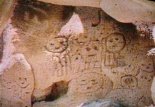
Caguana is not the largest ceremonial center, nor the only one to display petroglyphs, but it is undoubtedly unique in the Caribbean. It is located on a small terrace adjacent to the upper reaches of the Tanamá River, in the central-western mountain range, west of Utuado in Borikén. When facing to the South, it borders the igneous-plutonic massifs typical of the area, while to the North it faces unique karst formations with conical tertiary limestone dotted with small details. The 22 petroglyphs of the principal plaza has zoomorphic traits that can symbolize the ancestors of the chiefs and can be related to the sociopolitical activities done there. An in-depth study about the sociocultural aspects of the petroglyphs and artifacts that are at Caguana's museum could reestablish the lost identity of those affected by the everlasting colonialism that has perpetuated through the continuous cultural exploitation that the Caribbean still suffers. 

A way to accomplish real social justice for the victims of slavery, genocide, and racial discrimination in the Caribbean is to create new discussions on Caribbean reparations that approach the problem within the Taíno context due to the ongoing violation of Indigenous rights. How the State responds to its liable responsibility of Indigenous rights matters is more about the obsolete jurisdiction laws of land management. This situation has created a dilemma regarding the genocidal stigma and abusive exploitations, which continue to be committed against Indigenous Peoples by the same States who are alleging to represent them. The concept of national patrimony has to be revisited. The only way that academia can help resolve their ongoing misappropriation within their museum curation is by acknowledging past wrongs with a deeper process that involves ‘cultural reparations’ and community involvement.

Nichole Bodin has a Masters in Caribbean Archelogy from the Center of Advanced Studies of Puerto Rico and the Caribbean. 


1/07/2020

The UCTP Condemns Actions of US Army Core of Engineers (USACE) and Southeastern Archaelogical Research Inc. (SEARCH, Inc.)

The United Confederation of Taíno People (UCTP) condemns the actions of the US Army Core of Engineers (USACE) and Southeastern Archaelogical Research Inc. (SEARCH, Inc.) based in Orlando, Florida, which resulted in the irreparable damage to an ancient indigenous burial site, including human remains and associated funerary objects at Rio la Plata, Dorado, Puerto Rico. 

The UCTP also condemns the decision of the State Historic Preservation Office in Puerto Rico, which granted the permit to and certified the work of the USACE and SEARCH, Inc. as satisfactory even though heavy equipment was used for excavation and human remains and associated cultural materials were removed from the site without consultation with interested local indigenous peoples' organizations. The lack of consultation is a violation of the United Nations Declarations on the Rights of Indigenous Peoples. 

The desecration of the burial site and lack of consultation by the USACE in Dorado is not an isolated incident, as the UCTP has requested consultative status in the past, for example, during excavations at the PO29 Site located at Jacanas, Ponce, Puerto Rico in 2007. The USACE and PR SHPO continue to ignore the established protocol and procedures concerning "consulting parties" in accordance with the National Historic Preservation Act, 36 C.F.R. §800.2: - Participants in the Section 106 process.

While the United Confederation of Taíno People is not a "tribe" federally recognized by the U.S. Bureau of Indian Affairs, it is an Indigenous Peoples Representative Institution that represents descendants of Indigenous Peoples most closely associated with the site in Dorado. Additionally, the UCTP is aware of the availability of the ACHP's guidance regarding consultation with non-federally recognized tribes. 

Therefore, the UCTP calls on the USACE and PR SHPO to cease and desist in their ongoing violation of the rights of Indigenous Peoples and comply with the National Historic Preservation Act in Rio la Plata, Dorado, and all of Borikén (aka Puerto Rico). 

In witness thereof,
Roberto Múkaro Borrero, 
President,
United Confederation of Taíno People

11/25/2017

UCTP Representative addresses gathering on Alcatraz Island

UCTP representative Tai Pelli addresses the crowd gathered on Alcatraz Island
(Photo courtesy of Native News Online)
Alcatraz Island  (UCTP Taíno News) - Continuing an over 30-year tradition,  International Indian Treaty Council organized the 2017 "Indigenous Peoples’ Sunrise Gathering on Alcatraz Island" on Thursday, November 23, 2017. The event, which was streamed around the world, was attended by close to 5000 people. Cultural presentations and special guest speakers continued throughout the morning commemoration. In an historic first for the event, Tai Pelli, representing the United Confederation of Taíno People addressed the crowd in the English, Spanish, and Taíno languages. A member of the Guainia Taíno Tribe, Pelli provided updates on the current situation in Borikén (Puerto Rico) and the reality people on the island face as a colony of the United States. Although not scheduled to appear, former San Francisco 49rs quarterback, Colin Kaepernick, also addressed the crowd in solidarity and was honored by elders for his work. 

UCTP Taino News 11/25/2017


9/20/2017

Hurakan Maria Devastates Borikén and other Caribbean Islands


Borikén/Puerto Rico (UCTP Taíno News) — After devastating others islands in the region such as Dominica, Guadeloupe, the U.S. Virgin Islands and others, Hurakan Maria battered Borikén for hours before it spun out into the Atlantic Ocean on its way to the northeast coast of the Dominican Republic. Early reports affirm that the Category 4 storm knocked out all power, caused dangerous flooding, toppled cellphone towers and tore the roofs off homes and businesses throughout the island. This was the strongest hurricane to hit Borikén in almost a century. Maria struck just days after the region was hit by Hurricane Irma. 

UCTPTN 09/20/2017 

7/03/2017

Caribbean Indigenous Peoples participate at Mashpee Pow Wow

In photo from left to right, Gustavo Cardona, Tataniki Dones, Chalinaru Dones, and Claudia Fox Tree were some of the Caribbean Indigenous Peoples present at the 96th Mashpee Wampanoag Pow Wow 
Historic Mashpee Wampanoag Territory, Massachusetts (UCTP Taíno News) – A contingent of Caribbean Indigenous Peoples participated at the 96th annual Mashpee Wampanoag Pow Wow this past weekend from June 1-3 2017. Taíno and Arawak Tribal members joined this historic celebration of culture, traditions and heritage in solidarity with the Mashpee Wampanoag and other Indigenous Peoples from throughout the Northeast and beyond. The Pow Wow featured indigenous dancing, drumming, games, food, art, jewelry, wampum (beads made from quahog shells), gifts, crafts, and clothing. Drum and dance competitions also took place with United Confederation of Taíno People’s Massachusetts Liaison Officer, Claudia Fox Tree winning the “spot” dance and receiving a prize. This year’s Pow Wow theme was “Honoring Our Traditions” and several thousand visitors were received at the event over the weekend held at the Cape Cod Fairgrounds in East Falmouth, MA.

UCTP Taíno News 07.03.2017

6/21/2016

Taino submit statement to Special Committee on Decolonization

United Nations (UCTP Taino News) - Various petitioners submitted testimony to the UN Special Committee on the Situation with regard to the Implementation of the Declaration on the Granting of Independence of Colonial Countries and Peoples on June 20, 2016 at UN Headquarters in New York. In a resolution adopted last year, the Special Committee decided to continue hearing testimony on Puerto Rico.

The United Confederation of Taino People (UCTP) submitted a statement to the Committee Chairperson via Committee Secratary, Ms. Jullette Ukabiala. The UCTP' intervention highlighted Boriken's (Puerto Rico's) colonial situation, environmental racism on the island, and the release of political prisoner Oscar López Rivera, among other issues. The UCTP recently submitted a related statement to the United Nations Permanent Forum on Indigenous Issues  during its 15th session. 


The Special Committee on the Situation with regard to the Implementation of the Declaration on the Granting of Independence of Colonial Countries and Peoples (also known as the Special Committee on decolonization or C-24), the United Nations entity exclusively devoted to the issue of decolonization, was established in 1961 by the General Assembly with the purpose of monitoring the implementation of the Declaration (General Assembly Resolution 1514 (XV) of 14 December 1960).

UCTPTN 06.21.2016

6/20/2016

UCTP Statement to UN Decolonization Committee

To: UN Special Committee on Decolonization via email

Re: Special Committee decision of 22 June 2015 concerning Puerto Rico: hearing of petitioners, United Nations Headquarters
Monday, 20 June (2 meetings)

Greetings, Mr. Chair:
In May 2016, the United Confederation of Taíno People presented an intervention at the 15th session of the United Nations Permanent Forum on Indigenous Issues, which we are enclosing with this communication.

The rampant and vicious Environmental Racism Puerto Rico is enduring at the expense of the health of her people, water, land and air, with factors such as Military Waste; Incinerators; GMO experimentation; Carbon Ashes; Water and Natural resources being negotiated to accommodate interests of multinationals and others that just come to the island to squeeze the benefits out while destroying the economy for the locals, for there are more incentives for foreigners than there are to help the locals prosper, are just a some examples of the colonial impacts on the island of Puerto Rico .

For 118 years, the violation of Human Rights, Cultural Rights, the Right to Self-determination, Genocide and Ethnocide in Borikén (Puerto Rico) have gone with impunity while the powers of the empire, which are now on the open continue impacting the people and resources. Violations that this Committee has heard throughout the decades, and/or via the dialogues about the colonial situation of the island of Borikén, are all the result of the lack of transparency about the real relationship between the United States and the colonial powers it continues to execute upon the island and all her peoples, including the indigenous Taino peoples.

The intimidation methods used, where we have seen leaders that work towards the independence of the island, either be shot to death, incarcerated, etc., is another imperialistic way of denying the people of Borikén the right to protest and work towards the inalienable right to self-determination.

With this in mind, the United Confederation of Taino People, joins all the other petitioners and states who have made a call for the immediate release of Oscar López Rivera.

Mr. Chair, it is also our hope, as was stated by petitioner Mr. José Ortiz-Velez, earlier this afternoon, that this process goes beyond just the formulation of yet another Resolution to join another previous 34, but that it results in the release of Oscar López Rivera, and ultimately and finally as is their inherent right, for the United States to begin an immediate process of decolonization of Puerto Rico, to respect the Right to Self –Determination, and the release of this debt that was created by their imperialistic ways, while exploiting Borikén and its diverse peoples and resources for 118 years.

Hahom (Thank you).
Respectfully Submitted,
Roberto Mukaro Agueibana Borrero,
President, United Confederation of Taino People

1/17/2016

UCTP Appoints Second Liaison Officer in Connecticut


UCTP President R. Borrero and
UCTP Liaison Officer Angel Ortiz
West Haven, Connecticut (UCTP Taino News) – On December 31, 2015, Angel Ortiz was appointed a Liaison Officer in the State of Connecticut by the President of the United Confederation of Taino People, Roberto “Múkaro Agüeibaná” Borrero following final approval by the UCTP’s Governing Board. Liaison Officers serve as focal points for the Confederation in their designated areas of responsibility. Angel Ortiz now serves in this distinguished post along with Hector Baracutey Gonzalez. 

Ortiz is a Borikén Taino born in the city of Ponce, Puerto Rico. He is a member of Taino iukaieke Guainia and has resided in Connecticut since 1985. Oritz has a Bachelors Degree in Counseling, and has worked with patients suffering from Mental Health illness. He currently serves in the United States Team Coast Guard / Department of Homeland Security as Seaman, working on Search and Rescue Operations for Sector Long Island Sound; and represents the United States Coast Guard Academy in New London, Connecticut, as Academy Admissions Partner. Oritz currently lives in West Haven with his wife Carmela. 

UCTPTN 01.17.2016

3/24/2015

Say No to Racism in Puerto Rico!


Recently, the University of Puerto Rico’s School of Law filed a complaint with the Inter-American Commission on Human Rights citing the violation of human rights in Puerto Rico.A news article entitled "Human Rights in Puerto Rico; Are they making racism invisible?" published on March 12th at “El Post Antillano”, responded to the complaint critiquing the absence of the subject of Racism against Black communities, afro-descendants, and Indigenous Peoples in Puerto Rico.

Providing an example of current climate of racism against Indigenous Peoples in Puerto Rico,a group of radical pro-Spain Puerto Ricans, “Autonomía para Puerto Rico”, led by its president, Iván Arrache, recently launched a campaign seeking to remove references to the Indigenous Taino Peoples from school books used on the Island. The pro-Spain group also seeks to present a more "positive" image of Spanish Conquistadors in school curriculum. This group’s core political position is that Puerto Rico should be re-annexed to Spain and Puerto Ricans should again be subjects of the Spanish Crown. They claim thousands of followers on the island including former political figures and members of the Puerto Rican Board of Education.

In response to these racists positions against Indigenous Peoples and the People of Puerto Rico, a respected community member and representative of the United Confederation of Taino People, Tai Pellicier (Tai Pelli) posted a professional, well-documented response to these statements; she was subsequently slandered by members of the racist group in question; her personal Face Book page was hacked and rendered inaccessible. The President of the radical group, Ivan Arrache, has claimed responsibility for this cyber-attack taking place during Women’s History Month, March 2015.

The United Confederation of Taino People is calling on all people of good conscience to join us in expressing solidarity for our sister Tai Pellicier (Tai Pelli) and to denounce the racist attempt to remove the Taino from school text books and the intent to present the conquistador in a more "positive manner". In addition, we condemn violations against the basic human right of self-determination and all forms of racism, especially against those who proudly affirm indigenous Taino heritage, as well as institutionalized racism against Black communities and Afro-Descendants in Puerto Rico.

10/22/2014

The Taino Tradition of Generosity Lives in Arizona


Flagstaff, Arizona (UCTP Taino News) - Desire Caballer, a Borikén Taino of the Guainia Tribal community, lives in Flagstaff, Arizona, and began organizing to assist homeless persons in her area in June of this year. Her volunteer efforts have grown from a personal initiative, to receiving food, clothing, and toiletries donations from others; bringing her interactions with Flagstaff’s homeless community up to 3 times per week. 

Desire was inspired to make a difference after seeing a homeless teenager begging on the street for money. The scene touched her personally, as she also experienced life on the streets of Phoenix as a teen before being taken in by a concerned family who treated her as their own child. Once she was able to secure employment, the family urged her to get her on place, which she did. Today, she is married and has two beautiful children, a son - Pedro - and a daughter - Katrina. She really “wanted to give back” and her husband, Lorenzo Lee, and children are supporting her initiative with the area’s homeless. 

Katrina Caballer,  Desire Caballer, and Lorenzo Lee documenting their work in Flagstaff
“All the people [I meet on the streets] have different stories,” stated Desire, who does not have a non-for-profit, is on a fixed income, and is dealing with her own personal health issues. She continued stating, “I believe that we all need not to judge, instead we need to learn how to help, love, care, and give.” When Columbus encountered Taino People throughout in the Caribbean, he continuously remarked on their generous nature. While history is clear on Columbus’ response to this generosity, Desire Caballer is proof that the traditional Taino spirit of giving still lives among contemporary Taino people living far from their island homelands. 

 UCTPTN 10.22.2014

10/14/2013

A MESSAGE FROM THE GRANDMOTHERS COUNCIL BOHIO ATABEI...


FAMILIA, Today celebrate our people and let the world know ...We the Taino people are still here...

Remember that OVER 512 years ago COLUMBUS on behalf of the Spanish Crown and the Church of the Inquisition, Columbus invaded our homelands, killed,tortured and enslaved our people...

Remember that he changed the names of our homelands to reflect the greed and religious injustice that motivated the doctrines of discovery. These doctrines were engineered to put in place the greatest holocaust on earth.

Today this legacy of death is celebrated by governments across this continent. These are the very governments that continue to impose policies against our people that strip us of our rights and continue to destroy and steal our lands.

So today while racist,colonized minds and leaders of the modern day inquisition celebrate the sick legacy of injustice and hate while they celebrate the Hitler of the Spanish crown and all of the sick inhumane polices of the doctrines of discovery...

WE WILL CELEBRATE THE COURAGE, WISDOM AND NOBLE SPIRIT OF OUR NATIVE NATIONS. 

WE WILL CELEBRATE OUR ANCESTORS FOR WE WILL NOT SURRENDER IN FACT WE WILL NEVER SURRENDER TO THE IDEOLOGIES OF THE CONQUEST, WE WILL CONTINUE TO FIGHT BACK AND DEFEND OUR RIGHTS TO SELF DETERMINATION WE WILL STAND STRONG. 

SO RAISE STRAIGHT FROM YOUR HEART YOUR FIST IN THE AIR AND SAY WE ARE TAINO!!! AND WE ARE STILL HERE!!! TAINO YABAHO.

WE WILL NEVER NEVER SURRENDER!!!

10/08/2013

Dynamics of Culture and Race Identification


By Domingo Turey Hernandez

Writing about “race” can be a very sensitive topic and while on many people's mind, very few will speak on it. What is interesting is that many persons are under the mistaken perception that “race” is a scientific fact.[i]  Race and “concepts of race” are social constructs, and therefore, some argue that “races” are created to protect the interest of the group in power. Racial definitions are impacted by religious and social mores. In short, concepts of race are shaped in large by the powerful defenders of the dominant culture. Across many of the World's cultures, identification of race is linked to the social construct of  “hyperdescent.”

Hyperdescent is the practice of classifying a child of “mixed race” heritage as belonging to the race that is the more socially dominant of the parent's races.[ii] In early colonial era Latin America, for example, the Spanish would classify their children with indigenous women as Spanish. These children would not be counted as “Indians” in any census. Another example would be when these children of mix heritage would be classified as something all together different, something always socially above the conquered or dominated race or group. Examples of “racial classifications” under the early Spanish, Portuguese, and French include Mulattos, Ladinos, Mestizos, Zambos, Lobos, etc. More often then not, these persons were given better opportunities to own land get an education and eventually marry into an ever “Whiter” level of Society. Australia, for instance, practiced this form of hyperdescent up to the 20th century. Under the Aborigines Act, children of mixed “blood” were taken away from their Aboriginal families and put into White foster homes in an effort re-educate them into the White Race.[iii] Those promoting this system claimed this strategy would better prepare them for jobs under White employers and lead them to eventual marriage to Whites.

Today, in most if not all of Latin America, classifying race via hyperdescent continues to be the social norm. This is the opposite of “hypodescent” where a mixed race person would be seen as belonging to the least socially powerful group of the parent's race.[iv] An example of this social classification is the "One drop rule" with regard to “Black” ancestry. In essence, this U.S. born social classification promot the view that any person with "one drop of Negro blood" was considered black.[v] The "One drop rule" was a legal norm in parts of the 20th century United States.[vi] Before that time there were many examples in the U.S. of Blacks being accepted as Whites if they were less than 1/8th or 1/16th Black.

Today, many of the people who criticize Taino affirmation do so because they come from an education that embraces the concept of hypodescent. To these folks it doesn't matter how much European or Indigenous ancestry we may have, if we have any African ancestry then we are Black by default. Any effort to identify according to our family culture or even by the rules of hyperdescent is seen as an attack on “Blackness.” This view disregards the basic human right of self-determination. From a Taino perspective, self-determination is linked to self-identity.

Self-determination is about recognizing that many communities identify “race or ethnicity” using older and more traditional ways. These views need to be respected by the more dominant society.

Hyperdescent and hypodescent both exist despite their flaws. Both views are designed to dominate an oppressed group. One is designed to push the oppressed group into extinction. The other keeps the oppressed group always visible but always the "other" - never really equal. Both systems seek to control.

The traditional Taino Jibaro way was and is the acceptance of another as relative by the Family leader. This ideal made one family and family were those related by blood, marriage, and relation to our extended family members. Taino is not just blood, it is also culture and world view. It is traditions that refuse to die even to this day.
 
Domingo Turey Hernandez is a Taino Jibaro elder from Borikén (Puerto Rico). He is a member of the Caney Indigenous Spiritual Circle, the United Confederation of Taino People, and iukaieke Guainia.

Endnotes


[i] Conrad P. Kottak, "FAQ", Human Diversity and "Race", Cultural Anthropology, Online Learning, McGraw Hill, accessed 30 Sept 2012.

[ii] Eviatar Zerubavel, “Ancestors and Relatives: Genealogy, Identity, and Community,” Oxford University Press, 2012

[iv] See Conrad P. Kottak’s "FAQ"

[v] James Davis "Who is Black? One Nation's Definition," Frontline, WGBH,  accessed 30 Sept 2012.