Four Amerindian communities will shortly receive titles to their lands and a fifth will be granted an extension as soon as the Lands and Surveys Commission has completed mapping the identified areas, the Government Information Agency (GINA) said in a press release.
The communities earmarked for land titles are Rewa, Crash Water, and Apoteri in Region Nine, Karrau in Region Seven and Warapoka in Region One, the release stated. The latter is a titled community which has had its request granted for extension of its land.
According to Minister of Amerindian Affairs Carolyn Rodrigues, this development would give Amerindians full ownership of the lands they occupy. She said that following the implementation of the new Amerindian Act in March 2006, more communities were coming forward with proposals to have their lands titled. According to the minister, "this is sure testimony that the Act is working."
Minister Rodrigues was recently in Region One where she engaged in discussion with residents of several communities on their requests for titles as well, the release said. And prior to this visit she also handed over a land title to Toshao of Santa Cruz in Region One (Barima/Waini), John Campbell.
President Bharrat Jagdeo in July 2006 handed over two land titles and one extension to Kaburi in Region Seven, Fairview in Region Eight and Annai in Region Nine. Kaburi received a title for 42 square miles of land, Fairview, 82 square miles while Annai received an extension of 62 square miles, the release noted.
Earlier Jagdeo handed over another set of titles to Campbelltown and Micobie in Region Eight (Potaro/Siparuni) and Arukamai and Kamwatta in Region One (Barima/Waini).
On September 22, 2005, Toshaos of five communities received titles for their villages from the Head of State: Wiruni, Muritaro, Malali and Great Falls in Region Ten (Upper Demerara/Upper Berbice) and Orealla in Region Six (East Berbice/ Corentyne). These communities now have legal ownership to their land, GINA added.
Source: Starbroek News


1/30/2007
Burial Ceremony for Elder Huacan at Caney Quinto Mundo on 02/03/07
Takahi Guaitiao:
As most of you are aware, a beloved community elder, and UCTP representative, Hu’acan John P. Vidal, crossed over into Coaibei (the Spirit World) recently on 12/15/2006.
Hu’acan's sister, Sonia Vidal and Teresa Fair, his niece will be traveling to Boriken to fulfill one of elder Hu’acan's last wishes, which was to buried at the Caney Quinto Mundo’s Sacred Burial Grounds in his island homeland of Boriken.
We will hold Burial Ceremony for Hu’acan on Saturday, February 3, 2007. In the tradition of our ancestors, those who would like to join us are welcome. Those who cannot be here physically are welcome to join us in a prayer ceremony at 12:00pm.
You are all also welcome to send messages to be shared with the Hu’acan’s family on Friday evening as we gather around the sacred fire to share stories, songs and prayers in preparation for Saturday's Burial Ceremony.
Our Community is honored and humbled as we fulfill his last wishes to be here at the Caney.
If you will be coming on Friday or Saturday please let us know so that we can prepare for your arrival. Our email address is caney@prtc.net and our phone number is (787) 847-5039.
Tio Bo Guatukan,
Naniki Ata
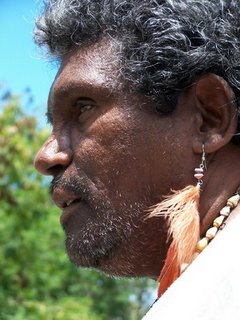
Taino Elder Hu'acan at Caney Quinto Mundo, Boriken Regional Gathering, Summer 2004
See also: Elder Hu'acan: Brother, Leader, and Friend
As most of you are aware, a beloved community elder, and UCTP representative, Hu’acan John P. Vidal, crossed over into Coaibei (the Spirit World) recently on 12/15/2006.
Hu’acan's sister, Sonia Vidal and Teresa Fair, his niece will be traveling to Boriken to fulfill one of elder Hu’acan's last wishes, which was to buried at the Caney Quinto Mundo’s Sacred Burial Grounds in his island homeland of Boriken.
We will hold Burial Ceremony for Hu’acan on Saturday, February 3, 2007. In the tradition of our ancestors, those who would like to join us are welcome. Those who cannot be here physically are welcome to join us in a prayer ceremony at 12:00pm.
You are all also welcome to send messages to be shared with the Hu’acan’s family on Friday evening as we gather around the sacred fire to share stories, songs and prayers in preparation for Saturday's Burial Ceremony.
Our Community is honored and humbled as we fulfill his last wishes to be here at the Caney.
If you will be coming on Friday or Saturday please let us know so that we can prepare for your arrival. Our email address is caney@prtc.net and our phone number is (787) 847-5039.
Tio Bo Guatukan,
Naniki Ata

Taino Elder Hu'acan at Caney Quinto Mundo, Boriken Regional Gathering, Summer 2004
See also: Elder Hu'acan: Brother, Leader, and Friend
Caribbean Love Drink Launches In Time for Valentine's Day*
Today, Don Ramon Mamajuana announced the launch of it's Mamajuana liqueur drink mix in the U.S starting February 27th. This will be the first time that such a product from the Dominican Republic is available for the U.S. market starting.
Miami, Florida ( I-Newswire ), Jan 30, 2007 - Dominican herbal liqueur mix manufacturer; Don Ramon Mamajuana, Corp. has announced the official United States pre-launch of its Dominican love drink: Don Ramon Mamajuana( tm ), beginning February 14th, 2007. Considered a natural Aphrodisiac, this special blend of 20 roots, herbs, and spices native to the Dominican Republic has been used for centuries as a powerful vitality drink. Tourists and natives of the islands have enjoyed this secret drink for years.
Typically, the only way one can get a hold of an authentic bottle of Mamajuana is by traveling to the Dominican Republic. For the first time, it will now be available in the US.
This herbal aphrodisiac beverage first came into existence hundreds of years before Christopher Columbus arrived on the island of Hispaniola. It was initially discovered by Taino Indians who inhabited the island of the Caribbean region and utilized it for its vitality and health advantages.
Today, Mamajuana is considered by Dominican Republic natives as a National drink. It is referred to as; "The Baby Maker" and "The Male Member Enhancer's Drink"*.
Many of the natural ingredients found in Mamajuana are widely used today in western herbal supplements such as Chamomile, Star Anis, Anamú, Brazilwood, Cat's Claw (Uña de Gato) among many others.
Unlike many other traditional Mamajuana found on the islands, Don Ramon Mamajuana is specially prepared to comply with USDA and FDA regulations set for safety and cleanliness of product. Each bottle is tamper-proof sealed and includes mixing and preparation directions.
The official product launch will start this February 27th to commemorate Dominican Republic's Independence day. "We are thrilled that finally American consumers will now have the opportunity to benefit from the ability to enjoy this traditional and long-awaited product," said Ray Payano, 26 year old Co-founder and V.P. of the company. "Mamajuana is an exciting do-it-yourself beverage, that can be custom prepared by the consumer according to their taste preference" said Steve Zabielinsky, Co-founder and President.
Arriving just in time for Valentines Day, Don Ramon Mamajuana is the first product of its kind offering consumers a perfect passion liqueur mixer that will help set the mood for intimate moments and much more.
About Don Ramon Mamajuana, Corp.:
Throughout Canada, Europe, and all over the world, the herbal passion liqueur drink mix Mamajuana is recognized for its naturally vitalizing properties. Don Ramon Mamajuana Corp., headquartered in Miami, FL, offers this old-world product online and looks forward to making it available through local liquor stores, health food stores, ethnic food stores in the U.S.A, and various distinct retailers. Don Ramon Mamajuana, Corp. is also a producer and worldwide supplier of Mamajuana herbs direct to consumers.
Source: http://i-newswire.com/pr88398.html
Miami, Florida ( I-Newswire ), Jan 30, 2007 - Dominican herbal liqueur mix manufacturer; Don Ramon Mamajuana, Corp. has announced the official United States pre-launch of its Dominican love drink: Don Ramon Mamajuana( tm ), beginning February 14th, 2007. Considered a natural Aphrodisiac, this special blend of 20 roots, herbs, and spices native to the Dominican Republic has been used for centuries as a powerful vitality drink. Tourists and natives of the islands have enjoyed this secret drink for years.
Typically, the only way one can get a hold of an authentic bottle of Mamajuana is by traveling to the Dominican Republic. For the first time, it will now be available in the US.
This herbal aphrodisiac beverage first came into existence hundreds of years before Christopher Columbus arrived on the island of Hispaniola. It was initially discovered by Taino Indians who inhabited the island of the Caribbean region and utilized it for its vitality and health advantages.
Today, Mamajuana is considered by Dominican Republic natives as a National drink. It is referred to as; "The Baby Maker" and "The Male Member Enhancer's Drink"*.
Many of the natural ingredients found in Mamajuana are widely used today in western herbal supplements such as Chamomile, Star Anis, Anamú, Brazilwood, Cat's Claw (Uña de Gato) among many others.
Unlike many other traditional Mamajuana found on the islands, Don Ramon Mamajuana is specially prepared to comply with USDA and FDA regulations set for safety and cleanliness of product. Each bottle is tamper-proof sealed and includes mixing and preparation directions.
The official product launch will start this February 27th to commemorate Dominican Republic's Independence day. "We are thrilled that finally American consumers will now have the opportunity to benefit from the ability to enjoy this traditional and long-awaited product," said Ray Payano, 26 year old Co-founder and V.P. of the company. "Mamajuana is an exciting do-it-yourself beverage, that can be custom prepared by the consumer according to their taste preference" said Steve Zabielinsky, Co-founder and President.
Arriving just in time for Valentines Day, Don Ramon Mamajuana is the first product of its kind offering consumers a perfect passion liqueur mixer that will help set the mood for intimate moments and much more.
About Don Ramon Mamajuana, Corp.:
Throughout Canada, Europe, and all over the world, the herbal passion liqueur drink mix Mamajuana is recognized for its naturally vitalizing properties. Don Ramon Mamajuana Corp., headquartered in Miami, FL, offers this old-world product online and looks forward to making it available through local liquor stores, health food stores, ethnic food stores in the U.S.A, and various distinct retailers. Don Ramon Mamajuana, Corp. is also a producer and worldwide supplier of Mamajuana herbs direct to consumers.
Source: http://i-newswire.com/pr88398.html
1/23/2007
Editorial: Political Intrigue at the OAS
By Damon Gerard Corrie
I am writing once again from the Organization of American States (OAS) Headquarters in Washington DC, USA to inform your readers of the behind-the-scenes goings-on at the 9th session of the working group to prepare the draft Declaration on the Rights of Indigenous Peoples. I am a member of the Indigenous Caucus working group.
Once again no CARICOM member state OAS ambassador (or even low level diplomatic representative) was present at the opening ceremony yesterday, in comparison all of the OAS ambassadors from the Latin American member states as well as USA and Canada were present as usual.
For the afternoon session, I was pleased to see a representative of the OAS diplomatic corps from Guyana was in attendance, I can only hope the rest of CARICOM will follow this lead and take an active interest in the proceedings. We could use the staunch and admirable support that Dominica and Haiti have shown at the United Nations Declaration process here at the OAS.
Once again, the representatives of the USA and Canada appear to be using the same semantic arguments and delaying tactics to stymie progress the Indigenous Caucus is attempting to make with the enthusiastic support of Bolivia and Brazil among many others.
The USA and Canada are abusing the 'consensus' system of voting that the OAS employs. From an “outsiders” point of view I personally was shocked to see on dozens of occasions that the Indigenous Caucus would have the support of all present OAS ambassadors but because the USA or Canada did not support an issue it was not passed.
I find it bewildering that the two countries that love to promote 'Democracy' all over the world, literally shoving it down other peoples throats at times, would themselves sabotage the very democratic process at the OAS. I was under the distinct impression that the majority vote ensured success in the democratic system; that being the case it is clear to me that there is no democracy at the OAS. It seems that unless certain countries get their way ad-infinitum, no-one can expect to achieve anything.
It is an awful thing to say about a system that is supposedly concerned with the rights of indigenous peoples but this is a disgustingly corrupt modus-operandi that is in urgent need of redress.
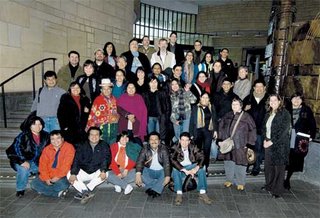
Photo courtesy National Museum of the American Indian/Katherine Fogden -- About 50 delegates of the Indigenous Rights Caucus of the Organization of American States toured the Smithsonian's National Museum of the American Indian on Jan. 21. They were in Washington, D.C., to meet about the Universal Declaration of Indigenous Rights.
I am writing once again from the Organization of American States (OAS) Headquarters in Washington DC, USA to inform your readers of the behind-the-scenes goings-on at the 9th session of the working group to prepare the draft Declaration on the Rights of Indigenous Peoples. I am a member of the Indigenous Caucus working group.
Once again no CARICOM member state OAS ambassador (or even low level diplomatic representative) was present at the opening ceremony yesterday, in comparison all of the OAS ambassadors from the Latin American member states as well as USA and Canada were present as usual.
For the afternoon session, I was pleased to see a representative of the OAS diplomatic corps from Guyana was in attendance, I can only hope the rest of CARICOM will follow this lead and take an active interest in the proceedings. We could use the staunch and admirable support that Dominica and Haiti have shown at the United Nations Declaration process here at the OAS.
Once again, the representatives of the USA and Canada appear to be using the same semantic arguments and delaying tactics to stymie progress the Indigenous Caucus is attempting to make with the enthusiastic support of Bolivia and Brazil among many others.
The USA and Canada are abusing the 'consensus' system of voting that the OAS employs. From an “outsiders” point of view I personally was shocked to see on dozens of occasions that the Indigenous Caucus would have the support of all present OAS ambassadors but because the USA or Canada did not support an issue it was not passed.
I find it bewildering that the two countries that love to promote 'Democracy' all over the world, literally shoving it down other peoples throats at times, would themselves sabotage the very democratic process at the OAS. I was under the distinct impression that the majority vote ensured success in the democratic system; that being the case it is clear to me that there is no democracy at the OAS. It seems that unless certain countries get their way ad-infinitum, no-one can expect to achieve anything.
It is an awful thing to say about a system that is supposedly concerned with the rights of indigenous peoples but this is a disgustingly corrupt modus-operandi that is in urgent need of redress.
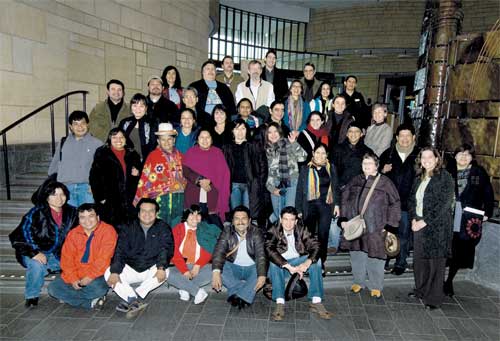
Photo courtesy National Museum of the American Indian/Katherine Fogden -- About 50 delegates of the Indigenous Rights Caucus of the Organization of American States toured the Smithsonian's National Museum of the American Indian on Jan. 21. They were in Washington, D.C., to meet about the Universal Declaration of Indigenous Rights.
1/18/2007
Manatees Have "Long-Distance" Sense of Touch, Experts Say

By Blake de Pastino for National Geographic
If you ever go swimming with a wild Florida manatee, be prepared for what might look like an amorous advance.
Renowned for their touchy-feely behavior, sea cows have been known to approach unwitting swimmers, close their eyes, open their mouths, and lean in as if busting a manatee make-out move.
But freaked-out snorkelers can relax. The behavior, scientists say, is just one example of how manatees use their uniquely developed sense of touch.
New research suggests that manatees' tactile sense is so finely tuned that the animals may experience "touch at a distance"—an ability to "feel" objects and events in the water from relatively far away.
UCTP Taino News Editor’s Note: The word "manatee" originates from the Taino word "Manati". Traditionally, the Taino consider the manati as sacred as North American Indigenous Peoples consider the buffalo sacred. Prior to colonization Taino hunters used every part of the animal for food, tools, and other resources.
See also:
http://taino-facts.blogspot.com/2007/01/manatee-or-manati.html
Subscribe to:
Posts (Atom)