1/05/2007

Ceremonial Offerings and Religious Practices Among Taíno Indians*

Ryan Martin presented “Ceremonial Offerings and Religious Practices Among Taíno Indians: An Archaeological Investigation of Gourd Use in Taíno Culture” at the IUSB Undergraduate Research Conference in March 1999 and at the National Conference on Undergraduate Research held in Rochester, New York in April 1999.

This research paper details gourd use in Taíno creation myths, religious ceremonies, and in everyday life by placing these practices within a broader cross-cultural framework. Martin concludes that gourds emphasized the ever present duality in Taíno culture.

Excerpt from “Ceremonial Offerings and Religious Practices Among Taíno Indians”:

For the Taíno, religion differed from the institutionalized faiths of modern society. ‘‘The world today is accustomed to separate realms for religion and science, church and state, theology and philosophy. But for the Taínos, religion assumed all of these functions through an interlocking system of symbols, rites, and beliefs’’ (Stevens-Arroyo (1988) page 53). For the Taíno, religion incorporated all aspects of life. The central focal point of Taíno religion was the practice of cemeism. Cemies are small figurines fashioned out of stone, wood, shell and cotton. These figurines provided a physical representation of the Taíno cult of spirits. They were a link between the psychic world of humans and nature. They helped explain the chaos of life through rituals of fertility, healing and divination, and the cult of ancestors. ‘‘The cemies served as sacred mediums allowing the power of the numinous to flow in two directions; from the spirit world out into human experience, and from human need into the cosmos’’ (Stevens-Arroyo 1988). Cemies were kept by all members of the society, but those belonging to the cacique (chief) or behique (shaman or priest) were believed to hold higher powers.

Cemies could only be constructed with the assistance of a behique. For instance, if a commoner was walking in the forest and came upon a tree which he/she thought held certain powers, he/she would call a behique to come from the village and perform a prescribed ceremony. If the tree was able to answer the behique’s questions correctly and the ceremony was performed correctly, the person was able to cut the tree down and carve his/her cemi (Ramon Pane translated in Bourne 1907).

Communication with the cemies was often achieved via the use of a hallucinogenic drug, known as cohoba. This rite of using cohoba was clearly done for religious purposes. It allowed the participant to see beyond the normal.
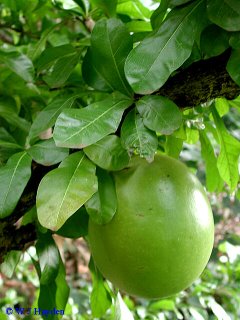

Tree calabash or Higuero (Crescentia cujete)

To view the full paper, visit: http://www.iusb.edu/~journal/1999/Paper11.html

*UCTP Taino News Moderator’s Note: The above information is presented for educational purposes only. The views and opinions expressed within “Ceremonial Offerings and Religious Practices Among Taíno Indians: An Archaeological Investigation of Gourd Use in Taíno Culture” are not necessarily those of The Voice of the Taino People News Journal or the United Confederation of Taino People.

Iwokrama, Fair View village ink co-management pact

Stabroek News (Guyana) - An agreement to co-manage natural resources between an Amerindian community and the Iwokrama International Centre for Rain Forest Development is expected to set an example of how people can live in, while conserving a protected area.

The agreement was inked between the centre and the Region Nine community of Fair View at the Hotel Tower on Thursday. The village is located near the Kurupukari crossing of the Essequibo River adjacent to the Linden-Lethem road which bisects the Iwokrama Rainforest Centre site. The proximity encouraged interactions between Fair View and Iwokrama and as a result employment by Iwokrama also became a source of livelihood for villagers.

Iwokrama Director General David Singh in remarks to the gathering noted that the agreement marked an important milestone in the development of protected areas management in Guyana and is indicative of the possibility that people can live, sustain their livelihoods, find self advancement and fulfil their aspirations, while living and working within a park. Additionally, Singh said the agreement established a global reference point for participatory decision making when it comes to natural resource use and management.

"Today we take another important step as we formally embrace the concept of people living within parks as a viable means by which one can conserve and manage a protected area. In fact, today we see the last segment of the loop that connects the 90% of forest-dependent people across the world to the management of their resources in partnership with government and other stakeholders," Singh said.

1/03/2007

Living in America: The Allure of Gold


presents

Living in America: The Allure of Gold

Gold is an enduring icon of wealth, beauty and power. Immortalized in the daily lives and cultural beliefs of ancient peoples, it was the first metal worked by humans; today it is still the most universal currency. Deposits of gold have been found on every continent except Antarctica. Gold also played a compelling role in the history of the Americas. Beginning with the voyages of Columbus through the Gold Rush era that drove a massive migration westward; this precious metal is a part of the formation of the American identity. This year’s Living in America theme recognizes the expressions, effects and allure that gold has on culture through exciting musical performances, discussions, and films for adults and families.

Ancient Expression…
Sunday, January 14
Kaufmann Theater and Linder Theaters, First Floor
-----------------------------------------------------------------------
These programs focus on pre-Columbian cultures that have used and cherished gold…

Atl-Tlachinolli
Mexican Indigenous Dance • 1:00pm • Kaufmann Theater


Mexica dance group Atl-Tlachinolli performs the centuries-old indigenous ritual dance traditions of the Aztecs. The vibrant and colorful music and dance presentation begins with ceremonial recognition of the four directions and dances conducted in four cycles. The group makes use of pre-Columbian instruments, rhythms, and regalia.


El Dorado Revisited
Panel Discussion • 2:00 p.m. • Linder Theater


Representatives of several indigenous communities present their perspectives on pre-Columbian relationships to gold and the effects that 15th century colonization fueled by the search for gold had upon these communities. Invited panelist include Jose Barreiro Ph.D. (Guajiro Taino, Cuba), Assistant Director of Research, National Museum of the American Indian; Mirian Mazaquiza (Quechua, Ecuador), Program Officer, United Nations Permanent Forum on Indigenous Issues Secretariat; and George Simon (Lokono Arawak, Guyana), critically acclaimed artist. A question and answer session will follow.

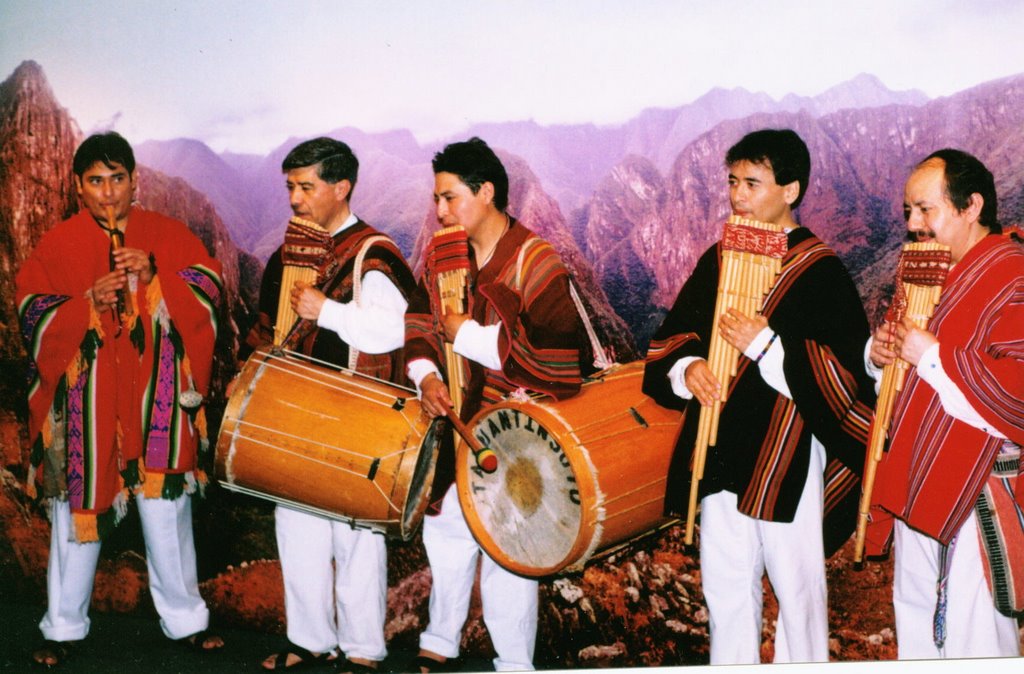
Tahauntinsuyo*
Andean Music Concert • 4:00 p.m. • Kaufmann Theater


Tahuantinsuyo, a group of traditional Andean musicians, will perform music from the ancient Incan empire, now the countries of Peru, Ecuador, Chile, Argentina, Bolivia and Colombia. Performing together internationally for over 20 years, the group uses an array of pan-pipes, flutes, drums, string instruments, and colorful traditional clothing. A series of stunning slides featuring the geography and culture of the Andes will enhance the program.


Special Event
AMNH Indigenous Crafts Fair and Artist Showcase
Grand Gallery • 11:00 a.m. -5:00 p.m.

In conjunction with AMNH’s exhibition “Gold”, experience a crafts fair and artist showcase highlighting various indigenous communities linked with pre-Columbian gold traditions in the Grand Gallery at the 77th Street entrance. Some of the acclaimed artists showcasing works include Inty Muenala (Quechua, Ecuador), Mildred Torres Speeg (Boriken Taino, Puerto Rico), George Simon (Lokono Arawak, Guyana), and others.


Taino Warrior by Mildred Torres-Speeg

All programs are free with suggested Museum admission. Neither tickets nor reservations are required. Seating is limited and is on a first-come, first-served basis. It is recommended that you arrive in plenty of time to enter the Museum and locate the program space. Please use the main entrance at Central Park West at 79th Street.

For further information, call the Museum's Department of Education at 212-769-5315 between 9:00 a.m. and 5:00 p.m. weekdays. Program information is also available on the Museum’s Web site at www.amnh.org/livinginamerica/ A three-story parking garage is open during Museum hours; enter from West 81st Street. For public transportation, call 212-769-5100.

Living in America/Global Weekends are made possible, in part, by The Coca-Cola Company, the City of New York, and the New York City Council. Additional support has been provided by the May and Samuel Rudin Family Foundation, Inc., the Tolan Family, and the family of Frederick H. Leonhardt.

*This artist appears as part of the American Museum of Natural History’s World Music Live series supported by The New York State Music Fund, established by the New York State Attorney General at

Rockefeller Philanthropy Advisors.

Program Curators: Roberto Múcaro Borrero (Boriken Taíno), Teddy Yoshikami


1/02/2007

World's most expensive smoke is a Behike.

Havana, Cuba (UCTP Taino News) - Cohiba’s “Behike” is the world's most expensive cigar at $440 each and available only in boxes of 40 for $18,860. The Cuban havanas from the Cohiba brand are so precious that no one has actually lit one yet, although the blend was tested by a group of tasters before the cigar went into hand-made production, according to Norma Fernandez, a veteran "torcedora" or cigar-roller from the El Laguito factory in Havana.

The cigars are truly "hand-made" as Ms. Fernandez rolled all 4,000 cigars herself for the strictly limited edition.

Fernandez also decided on the tobacco blend to be used which was designed to honor 40 years of the Cohiba brand. "I'm not going to reveal the formula," she told reporters.

The Cohiba "Behike" is named after the “shaman or medicine person” of Cuba's indigenous Taino People.


1/01/2007

A Few Holiday Messages

1.) A message from the Secretariat of the UN Permanent Forum on Indigenous Issues:

Dear Friends,

Please receive our very best wishes for the holidays and the New Year. May 2007 bring you and yours peace and happiness, good health and prosperity.

Avec nos meilleurs voeux.

Felices festividades.
Aaja, Broddi, Ekaterina,
Elsa, Hui, Mirian, Olivia & Sonia
Secretariat of the United Nations Permanent Forum on Indigenous Issues


2.) A message from Faye DeAbreau (Arawak):

Seasons Greetings to you and all
Takaji

What a wonderful year this has been. I look back on the seasons and realize that once again the Creator has blessed us with life and its many quirks.

In my family we have had a wedding, a couple births, a death and many squabbles between the hugs and kisses. We have had many joyful moments and some moments of intense reflection as well as some moments we are not so proud of.

Sometimes I am sad, sometimes I grieve for what has passed and what is to be. Sometimes I bubble over with joy at the same thing that made me cry yesterday. Always I am hungry, always I am thirsty and always I want to share and be close to my people. I am hungry to know my past and my future. I thirst for the knowledge that has been forgotten. I crave the lullabyes of my grandmother, whose tongue I do not understand yet crave.

I remember a time when much was not forgotten. I remember looking through the trees at the river and hearing the conch blow its herald. I remember and those memories are stored like precious jewels lest they, too, be stolen.

In this new year I ask that we have mercy on each other and show kindness more readily. Think kindly eagerly. Let's not judge each other so harshly and so easily. Let's take time to listen to the wind for it often carries so much more information than the voice. Let's speak our hearts not our minds for our minds have become embittered by history but our hearts are refreshed every dawn within the sheer joy rising with the sun.

I love you all my family. Bo'matum for sending your words of wisdom out to me. Bo'matum administrator Roberto for your kind work in keeping up with this website despite the changes in your life. I thank you for giving me the opportunity to make the friends that I have through your website.

Bo'matum wonderful readers who share so much and have given me so much. We are once again privileged to to come together to bring our strenghts to fore. I am proud to be with you. Bo'matum.


3.) A message from "TANA" :

Wishing to you all a Happy New Year, and that the Creator bring to all lots of blessings from behalf of the Taino abuelo in Vega Baja, Manuel Galagarza, and myself. And God bless you Millie Gandia for being who you are, small but big in heart, people don't value that.

Love you always, your sister,
Carmen