9/08/2006

Descubren varios cementerios indígenas en Dominicana

Descubren varios cementerios indígenas en Dominicana
Por Prensa Latina - Lunes, Agosto 28, 2006

(PL) Varios entierros indígenas con restosóseos adultos fueron encontrados a escasa profundidad en Loma de los Quemaos, cerca del poblado Padre las Casas, en la sur occidental provincia dominicana de Azua, se informó hoy.

Las fosas encontradas en ese territorio montañoso tienen una dimensión aproximada de 70 pulgadas de diámetro y en su interior hayrestos humanos completos de unos 500 años de antigüedad, en un sitiocon señales de haber sido profanado.

El importante hallazgo arqueológico fue hecho por un humilde campesino de la zona, dedicado durante años a recopilar información sobre la existencia de los indios taínos y petroglifos en la zona y aproteger el patrimonio cultural.

La citada loma guardaba en su seno nueve sitios donde existenvestigios del hombre primitivo que habitó las montañas de estacomunidad, entre ellos restos óseos, algunos semienterrados y otrostotalmente desenterrados.

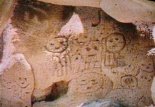
Una pared rocosa de unos tres o cuatro metros de altura es testigomudo de una importante cantidad de dibujos, entre los cuales sedestaca una figura cazando, círculos y animales. Además fue identificada una caverna en cuya entrada hay dos figuras indígenas pintadas en la pared, consideradas por los arqueólogos quecertificaron el hallazgo un magnífico ejemplo del arte indígena rupestre.

Uno de los cementerios indígenas, queda a varias horas de recorrido apie, escalando montañas y atravesando ríos de la zona, en un cerro a 800 metros sobre el nivel del mar, donde fueron encontrados también objetos de la cultura precolombina.

Lamentablemente, la mano de los depredadores había dejado su rastroen el lugar y varias tumbas habían sido profanadas, al parecer porpersonas del mismo pueblo en busca de oro.

También se detectó la presencia de gran cantidad de material arqueológico, tales como figuras en barro, hachas, cuentas de collares, conchas, trozos de cerámica, guayos y una piedra utilizada para elaboración de elementos cortantes.

En la zona, ubicada a unos 130 kilómetros de esta capital, se descubrió una caverna de varios metros de profundidad, probablemente utilizada como refugio o vivienda de los antiguos aborígenes dellugar.

9/07/2006

415 Acres To be Added to Virgin Islands National Park

Prinstine Maho Bay, St. John, VI

St. John, U.S. Virgin Islands - The Trust for Public Land (TPL), a national nonprofit land conservation organization, today announced it has signed a contract to buy and preserve a 415-acre property in the heart of St. John that ultimately will become part of Virgin Islands National Park. It would be the biggest preservation project on St. John since the National Park was created in 1956.

The property, known as Estate Maho Bay, will be added to the park when federal funds become available, said Greg Chelius, director of TPL's program in Florida and the Caribbean.

"The national park on St. John is one of the world's great treasures," said Chelius. "We are very excited to be part of the effort to preserve its incredible natural beauty."

"TPL has been working on preserving Maho Bay for more than five years and while there have been a lot of challenges, it looks like we're finally on the road," Chelius continued. "We have a lot of hurdles to go, and we have to raise millions of dollars to make this happen, but we're confident that Estate Maho Bay will be protected."

The property has more than a quarter-mile of beachfront on pristine Maho Bay and rises to almost 1,000 feet in height. It also has significant ruins from the Danish colonial era, 1700-1860 and may have pre-Columbian cultural resources from the Taino Indian people, who inhabited St. John for 800 years before Christopher Columbus arrived. Just offshore are seagrass beds, green turtles and coral reef systems which are visited by thousands of people every year.

"Protection of this large property by TPL represents a very significant event for the V.I. National Park and for St. John. Development of this watershed would have had considerable impact on the natural and cultural resources of the park as well as residents and visitors to St. John," said Rafe Boulon, native St. Johnian and chief of resource management, V.I. National Park.

TPL has been working for years to acquire the property, which was owned by 11 heirs of Harvey Monroe Marsh. In fact, John Garrison, director of TPL's Southwest Florida Office and lead project manager on this acquisition, was interested in preserving this property before coming to TPL five years ago, when he was director of Friends of the Virgin Islands National Park, a nonprofit on St. John dedicated to protecting the park.

Garrison said that the property has not been subdivided, so that each heir owns 1/11 interest in the entire parcel. Six heirs agreed to sell their interests to TPL. TPL had previously purchased one interest. The NPS owns three interests and the 11th is being retained by one of the heirs. By contract, the purchase price of the six interests is to remain confidential. The heirs are also each retaining a six-acre lot, with the ability to build up to two homes.

"Preservation of this property will be the culmination of many, many years of work," said Garrison. "A lot of credit goes to the heirs, who were willing to work with us and gave us a significant bargain on the sale, as well as to the Friends group for their continued support." A spokesperson for the Marsh family said, "Maho Bay has been in the family for over 100 years so it is important to the family to retain ancestral home sites and at the same time preserve the natural beauty of the estate for future generations to enjoy."

"The preservation of Estate Maho Bay, one of the most popular and cherished areas within VI National Park, is a significant accomplishment that will benefit the people of St. John and all those who will be able to visit and enjoy this magnificent area," said Joe Kessler, president of Friends of Virgin Islands National Park. "The Friends and all those who love VI National Park will be forever grateful to TPL for their persistence and imagination in making this a reality, to the donor for their generosity in financing the acquisition and to the heirs for their foresight and commitment to preserving Estate Maho Bay. We are pleased to have been a part of making this happen."

The Trust for Public Land (TPL) is a national nonprofit land conservation organization that conserves land for people to enjoy as parks, gardens, and natural areas, ensuring livable communities for generations to come. Since its founding in 1972, TPL has helped protect more than 2 million acres of land in 45 states. Working in Florida since 1975, TPL has protected more than 300 sites - over 200,000 acres at a market value of more than $500 million. The Trust for Public Land depends on the support and generosity of individuals, foundations, and businesses to achieve our land for people mission.

Source: Envivonmental News Network http://enn.com

9/06/2006

Guyana: Rodrigues sworn in for second term as government minister...


Guyana, South American (UCTP Taino News) - Carolyn Rodrigues, whom Guyana President Bharrat Jagdeo had announced would be resuming her portfolio, was sworn in for a second term as Minister of Amerindian Affairs.

With one hand on the bible, the Minister took her Oath before the President who presented her with the instruments of office.

Rodrigues was also sworn in as a member of the Cabinet during the short ceremony held at the Office of the President on Monday, September 4th 2006.

(Jules Gibson photo)

Op-Ed: As Taino We Must Combat Misinformation

by Domingo Turey Hernandez

I viewed on a public access channel recently, a program called "Visions of Puerto Rico." Rita Moreno read the script which included mistakes like, "El Yunke in Taino means Land of the Happy Spirit." This "translation" is not even close! Ms. Moreno then goes on to read the Yunke was considered sacred land to the Tainos. So what about the daily ceremonies that still take place there? Not only by Taino but by people of all colors who are espiritistas, curanderos, Santeros etc. El Yunke is still sacred ceremonial land.

The script also said that the palm trees so abundant on the island were not native to Boriken but was brought over from the Canary islands. This is lazy, lazy research!

There are many varieties of palm trees. While there is debate over whether the coconut palm tree was native to the islands of the Americas, the royal palms which grow taller then the coconut palm tree are indigenous to the islands. The royal palm was used for building bohios, canoas, macanas and the giant pilons used for mashing corn.

These types of corrections may sound petty but misinformation like this has been quoted as truth to say the Taino is no more. We have all heard that it is written that when Taino slavery was abolished, the notice was read in a San Juan plaza and only 60 Indians were there in the whole island to benefit from it. It seems some have forgotten that back in the 1500s Puerto Rico was the name given to the small island that today we call "el viejo San Juan". The Island as a whole was called San Juan Bautista. It was later because of a map maker's mistake that the names were interchanged. The name San Juan was given to the small "isleta" where the walled city was built and Puerto Rico for the rest of the larger island. So what the historian is saying is that when the Taino were liberated, there were only 60 enslaved Indians on the isleta which was then called Puerto Rico. Due to this misunderstanding people today say there were only
60 Indians left in the whole of Puerto Rico in the late 1500s.

People read books or see programs like "Visions of Puerto Rico" and it becomes their truth. As Taino we must write, paint, sing and document our survival. We can not expect it to be done for us. We must watch everything written or created about us and give quick feedback so that our young ones are not misinformed.

For example two books that recently upset me are one that suggests the Taino are Chinese because of the possibility the Chinese ships may have visited 50 years before Colon and another that claims the Taino are African because of possible contact with Africans.

Why can't the Taino be just that? Why does some other group have to be given the credit for what our ancestors created? Even if my great grandmothers loved some Chinese or African sailors, they had a strong and powerful culture that could stand on its own.

Further, no matter who came, our people were the majority for many years after contact. That is what the DNA studies show, that even after 500 years of massive immigration to our island by people from all over the planet; the Native blood is still the majority.

Guyana Ministry plans nationwide campaign to educate Amerindians about their rights...


Basil Joseph explains his painting to two admiring viewers. He
was one of several persons at the launching of Amerindian
Heritage Month 2006 at the Umana Yana on Friday, where items
made by the Amerindian people were on display.

Guyana, South America - Shortly before it was announced by President Bharrat Jagdeo that Carolyn Rodrigues would remain the Minister of Amerindian Affairs, she told the huge crowd that flocked the Umana Yana on Friday for the launching of Amerindian Heritage Month 2006, that the ministry planned to have to a nationwide campaign to educate the Amerindian people about their rights.

The launch which was attended by President Jagdeo, Opposition Leader Robert Corbin, members of the diplomatic community and ministers of government, among others, has become an annual event since 1995 when a bill was passed for September to be designated Amerindian Heritage Month. This year the theme is 'Succeeding in the Quest for Progress' and the Heritage Village is Annai in Region 9.

The gathering, which was significantly smaller than the one last year, was entertained with a number of Amerindian songs rendered by the hinterland students.

The first verse of the National Anthem was sung in a native Amerindian language.

Dr Desrey Fox, the curator of the Walter Roth Museum, plans to translate the entire National Anthem and the Pledge into all nine Amerindian languages.

Rodrigues in her address said that in February this year the Amerindian Act had been passed in Parliament and signed by the president in March, and that communities had already started implementing its provisions.

The minister gave the assurance that her ministry would have land issues affecting Amerindians sorted out as soon as possible: "Some Amerindian communities have already received titles to their lands. Over 13% or 11,205 square miles is the amount of land owned by the Amerindians - more than double [that] in years gone by."

Highlighting some of accomplishments of the Ministry of Amerindian Affairs, Rodrigues said that the Suddie hostel in Region 2 had been completed about four months ago to cater for those persons accompanying the injured from the interior. She added that the hostels at Port Kaituma and Moruca should be completed later this month.

Rodrigues informed the gathering that Sheleza Reid, a hinterland student had placed third at the recently concluded CSEC examinations. She had gained ten grade ones and one grade two, and was a product of the Anna Regina Secon-dary School.

In terms of further improving education, she stated that the St Cuthbert's school would be completed later this year. According to Rodrigues, improving communities was a necessity, and that was why the ministry continued to provide radio sets and outboard engines. Some communities, she continued, such as Santa Rosa and Annai had also benefited from the installation of telephones by GT&T.

Meanwhile the president in his speech said that Rodrigues would continue to act as the Minister of Amerindian Affairs since he was very impressed with her work.

Highlighting some of the things that would be done for the Amerindian people in the coming years, he announced that by 2008 the ferry stelling would be upgraded.

"At present we are building a boat for Orealla and the Demerara River so that people can get transportation facilities..."

The head of state added that efforts would be made to give Amerindian children the same educational opportunities as the rest of the country enjoyed.

In closing he said, "I hope that Guyana can take the lesson of their Amerindian brothers and sisters - that is to work together".

Following the launching people congregated outside the Umana Yana to view or buy the craft, paintings, sculpture, jewellery and food which were on display.

Among the activities scheduled for the rest of the month are an exhibition and sale of arts and craft and Amerindian dishes from September 1-6 at the Umana Yana; Heritage Day Celebrations at Annai on the 10th, a fund-raising dinner on the 22nd at the Guyana Pegasus and a Cultural Extravaganza on the 30th at the National Cultural Centre to close off activities.

Source: Starbroek News 09/03/06