5/21/2010

Exhibit on origin of Dominican people opens at Bellas Artes

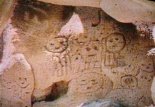
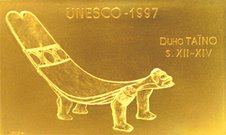
Santo Domingo.– The Palacio de Bellas Artes' National Gallery presents "Immigrants," an exhibition that tells of the origins of Dominican people and it is sponsored by the nation's General Archives.

The Dominican Republic was the first Spanish colony in the New World. Its people have origins in a unique mix of African, Spaniard and Taino roots.

Source: http://www.dominicantoday.com/

5/18/2010

Student Strike at University of Puerto Rico Enters 29th Day

SAN JUAN - In Puerto Rico, an ongoing strike by students at the University of Puerto Rico is coming to a head. Riot police have surrounded the main gates of the university and are trying to break the strike by denying food and water to students who have occupied the campus inside. The strike began nearly four weeks ago in response to budget cuts at the university of more than $100 million. Students called on the administration to reconsider the cuts and sought guarantees, such as no fee increases and no privatization of campus services.

Students initially called for a forty-eight-hour strike, but more than three weeks later the strike continues and has spread to ten out of eleven campuses. On Thursday, a mass assembly of more than 3,000 students voted overwhelmingly to continue the strike. The next day, riot police seized control of the main campus gates.

The striking students have received widespread support from professors at the university, as well as unions around the country. Crowds have gathered outside the university gates, where police have encircled the striking students inside. Parents, family members, other supporters have tried to throw bottles of water and food over the fence to support the strikers.

Source: Democracy Now

5/17/2010

Highway Blocked As 5.8 Quake Strikes Puerto Rico

San Juan, Puerto Rico (AHN) - Puerto Rico was jolted by a moderate earthquake on Sunday morning. The 5.8-magnitude quake was centered between the cities of Moca and Anasco and damaged homes on parts of the island and caused a rock slide on a highway.

The temblor struck at 1:16 a.m. nearly four miles from the small town of Espino on the western side of the island. Nearly 63 miles away in the capital San Juan, the quake was felt in the city's high-rise buildings.

Homes on the western and northern side of the Caribbean island also reported damage. Puerto Rico's emergency management agency said a rock slide in Utuado caused debris to block a highway.

Even on the nearby islands of Vieques, Culebra, Santa Cruz, and rest of the Virgin Islands residents reported feeling the quake.

Authorities say no one was injured, however the alarms of cars, banks, shopping malls and buildings went off resulting in panic among many who misunderstood the alarms to be a tsunami warning.

Author: Ayinde O. Chase
Source: AHN News

5/12/2010

What's Good for US Latinos May Not Be Best for Puerto Ricans

For U.S. Latinos, it would be the biggest political boost in history. Imagine suddenly gaining two Hispanic U.S. senators and six additional Latino members of the House of Representatives. Imagine 4 million additional Latinos suddenly eligible to vote for president. The gains would be much bigger than those that Latinos are likely to receive from the new census tabulations or from any gigantic voter registration campaign, even bigger than the certain Latino voter backlash that has been provoked by lawmakers in Arizona.

For U.S. Latino empowerment, nothing could match the entry of Puerto Rico as the 51st state of the union.

Yet if and when that happens, it should be because we the American people, especially our Congress, respected the will of the Puerto Rican people. It should be because they were able to choose statehood over independence and their current commonwealth status in a free and truly democratic process.

When they vote in a new plebiscite to determine the political future of their precious island, Puerto Ricans should know that our Congress is bound to respect their decision and committed to act upon it.

Anything else would be a farce, another nonbinding beauty contest, a repeat of the plebiscites of 1967, 1993 and 1998 and another huge waste of time, money and emotions. That's what has happened in the past and what likely would happen again under the latest proposed plebiscite, which is already approved by the House and bound for Senate hearings.

Those who support this plebiscite, starting with pro-statehood Puerto Rico Gov. Luis Fortuno, argue that unlike the others, which were conducted by the government of Puerto Rico, at least this one would be "authorized" by Congress. Of course, that means absolutely nada. It still would be nonbinding. Once the Puerto Rican people made their choice, Congress still could ignore them - just as it ignores most controversial matters.

If Puerto Ricans were to choose statehood, for example, many linguistically impaired, ethnically challenged and xenophobically affected Republicans would have serious reservations. They would raise all kinds of racist objections to try to prevent the island from becoming the 51st state. They would insist, as they have in the past, that Puerto Ricans should speak only English and renounce the Spanish language and culture.

And before Puerto Ricans venture into statehood, many would like some guarantees that such racist restrictions would not be imposed on them.

Unfortunately, the bill passed by the House April 29 - by a bipartisan vote of 223-169 - is so flawed that even the three Puerto Rican-Americans in Congress couldn't agree on it. Rep. Jose Serrano, D-N.Y., voted for it. But Reps. Nydia Velazquez, D-N.Y., and Luis Gutierrez, D-Ill., voted against it.

Gutierrez argued that the legislation had been rushed through the House without clearly defining the options that would be offered to Puerto Rican voters, and Velazquez argued that it was skewed to favor the statehood option. Serrano, while recognizing some flaws, supported it because, he said, at least it began a process that could lead to the decolonization of the island.

Some background: Under the commonwealth status, approved by Congress in 1952 as a transitional arrangement, Puerto Ricans on the island are American citizens who are subject to federal law but don't enjoy all the rights of citizenship.

They serve in the U.S. military, often with remarkable courage, but cannot vote in presidential elections. They pay no federal income taxes, but their voice in Congress is limited to a single nonvoting delegate to the House.

A task force established by President Bill Clinton and revived by President George W. Bush five years ago recommended that unlike previous plebiscites, a new one should be conducted in two parts. First, Puerto Ricans would have to decide on whether they want to remain under the commonwealth relationship with the United States. If they voted for change, a second plebiscite would give them only two options, statehood or independence.

It seemed like a sound idea, especially because it nudged the Puerto Rican people to make a tough decision they have been avoiding, a decision with only two choices instead of three. Puerto Rico's commonwealth status, now 58 years old, never was meant to be permanent. Most Puerto Ricans acknowledge that sooner or later, they will have to move on to another arrangement. Yet when they had a choice of being a commonwealth, a state or independent in the three previous plebiscites, they clung to the commonwealth they claim they must let go.

The deadlock could be broken, some thought, with the two-plebiscite process suggested by the Bush panel. Yet others argued that because independence always ranks a low third among the three options, the two-plebiscite process would favor statehood. And their argument was so strong that the idea was stalled during the Bush years. When it was resuscitated again this year, as the Puerto Rico Democracy Act of 2010, it still called for two rounds of voting, but it had three options in the second round - statehood, independence or free association, a poorly defined third option that involved sovereignty while maintaining some sort of association with the United States. In other words, they had managed to preserve the commonwealth option without calling it commonwealth.

But that wasn't enough. Because this new third option was clearly a farce and no one could explain what it would entail, amazingly, commonwealth was reintroduced as a fourth option! It was an amendment introduced by Republicans in a clear attempt to derail any movement toward statehood in Puerto Rico, and now we have a bill that is full of contradictions.

The amendment completely nullifies the intent of the two-round voting process. Now Puerto Ricans can reject commonwealth in the first round and still end up supporting it in the second. If commonwealth is still an option in the second round, why bother having a first round?

Every few years, the Puerto Rican people are taken on this emotional roller-coaster ride created by nonbinding plebiscites with more than two options. And like all riders of roller coasters, they always end up exactly where they started, clinging to commonwealth.

Unless the Senate corrects the many flaws in the House bill, Puerto Ricans are already in line for another emotional ride to define who they are as a people. And the rest of us U.S. Latinos are going to have to wait until they are given a fair chance to define their destiny.

Puerto Rican statehood could be great for U.S. Latinos, but only if Puerto Ricans really want it, Congress learns to respect their right to self-determination and they all agree to demolish the multiple-choice plebiscite roller coaster.

Author: Miguel Perez
Source: Creators Syndicate

5/07/2010

Bolivian President Evo Morales to Deliver Results of People’s Conference on Climate Change to UN Sec Gen Ban Ki-moon

New York – Today, President Evo Morales of Bolivia will personally present UN Secretary General Ban Ki-moon with the conclusions of the World People’s Conference on Climate Change and the Rights of the Mother Earth, which was held in Cochabamba, Bolivia from April 20th to 22nd, 2010. Some 30,000 people hailing from over 150 countries attended the Conference, which offered governments and civil society groups a rare chance to work together to address climate change.

Bolivia’s first indigenous president will be joined in New York by delegates from around the world who were active at the conference, including: Nnimmo Bassey (Nigeria) and Asad Rehman (UK) from the organization Friends of the Earth, Yoon Guem Soon (South Korea) and Tomás Balduino (Brazil) of Via Campesina, Meena Raman (Mayalysia) of Third World Network, Jeremy Osborn (USA) of 350.org, Tom Goldtooth (USA) of the Indigenous Environmental Network, Enrique Daza (Colombia) of the Hemispheric Social Alliance, and Maude Barlow (Canada) of the Blue Planet Project.

Following the meeting with Ban Ki-moon, Morales will hold a press conference in the Dag Hammarskjold Library Auditorium of the United Nations at 1pm. He and the international delegates will later share the conclusions reached in the People’s Accord of Cochabamba with developing countries in a briefing to the G77 and China.

Last week, the Bolivian government submitted the People’s Accord to the UN body that deals with climate change negotiations in the form of an official contribution to the debates taking place under the UN Framework Convention on Climate Change.

Among the most important aspects of the People’s Accord are a project for a 50% reduction in greenhouse gas emissions by developed countries for the 2010-2017 period, a draft Declaration on the Rights of Mother Earth, a proposal for a global referendum on climate change, and recommendations for the creation of an International Climate and Justice Tribunal. Information is available on the conference website: http://cmpcc.org

Source: www.boliviaun.org