UCTP President, R. Mukaro Agueibaná Borrero (center) with
Robert L. Santos (at left), Director, U.S. Census Bureau, and Leila Dickerson (at right),
NY Regional Director, U.S. Census Bureau (UCTP Photo)
Robert L. Santos (at left), Director, U.S. Census Bureau, and Leila Dickerson (at right),
NY Regional Director, U.S. Census Bureau (UCTP Photo)
New York, NY (UCTP Taíno News) – The U.S. Census Bureau recently released the 2020 data sets on American racial and ethnic origins in a report entitled “Detailed Demographic and Housing Characteristics File A.” The reporting is the culmination of an analysis of 350 million detailed responses to the race and ethnicity questions that were collected in the 2020 Census. A significant population increase is noted, 85% from 2010, among American Indians including the Indigenous Taíno. The overall number of Americans claiming Indigenous heritage increased from 5.2 million in 2010 to 9.6 million in 2020.
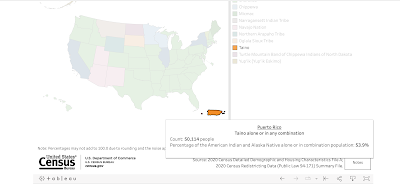
The increase is significant, especially for the Taíno whose total recorded population number in 2022 is 112,682. This means that according to the U.S. Census, the Taino are the 10th largest American Indian population of all the recorded American Indian groups. In Borikén (Puerto Rico) 50,114 identified themselves in the Census as Taíno, while over 26,000 identified themselves as Taíno in New York. Other large Taíno population areas on the U.S. mainland include Florida and Connecticut.
Hernandez continued stating “Our efforts and the significant increase in the number of people who identified as Taíno in 2010, is connected to the recent increase that we see in the report results of the 2022 Census. That means that our strategies as the UCTP are working.”
The increase is significant, especially for the Taíno whose total recorded population number in 2022 is 112,682. This means that according to the U.S. Census, the Taino are the 10th largest American Indian population of all the recorded American Indian groups. In Borikén (Puerto Rico) 50,114 identified themselves in the Census as Taíno, while over 26,000 identified themselves as Taíno in New York. Other large Taíno population areas on the U.S. mainland include Florida and Connecticut.

Click on Image to make larger
The United Confederation of Taino People (UCTP) has maintained an official partnership with the U.S. Census for the last 3 Census counts. One of the UCTP’s principal request to the U.S. Census Bureau was that they highlight “Taíno” as a separate Tribal Category in lieu of more ambiguous terms such as "Spanish Indians.” The UCTP also requested that search options for “Taíno” be as accessible as it is for other Indigenous Nations.
“The new report from the U.S. Census Bureau indicates that they have finally taken our continuous requests seriously” stated R. Mukaro Agueibaná Borrero, the current President of the UCTP and a kasike (chief) of the Guainía Taíno Tribe. Borrero continued stating “We presented what we view as the past discriminatory interpretations of the Census data to the highest level of the Bureau. We also indicated our serious concerns with continued reports of field officers – Census data collectors – in Borikén (Puerto Rico) who allegedly urged community members to identify themselves as White or told individuals that they could not identify as American Indian on the Census.”
On behalf of the UCTP, President Borrero met with Robert L. Santos, Director, U.S. Census Bureau, and Leila Dickerson, NY Regional Director, U.S. Census Bureau, and other Bureau officials earlier this year.
Roger Guaiakan Hernandez, a board member of the UCTP, noted that "In 2010, the UCTP’s Liaison Office in Borikén launched a campaign to increase Taíno participation in the Census. The campaign resulted in the local Census Officials on the island recognizing our work during a special event held at the Tibes Ceremonial Center in Ponce. This had a positive effect on our Census-related efforts in both Puerto Rico and the Diaspora.”
Roger Guaiakan Hernandez, a board member of the UCTP, noted that "In 2010, the UCTP’s Liaison Office in Borikén launched a campaign to increase Taíno participation in the Census. The campaign resulted in the local Census Officials on the island recognizing our work during a special event held at the Tibes Ceremonial Center in Ponce. This had a positive effect on our Census-related efforts in both Puerto Rico and the Diaspora.”
Hernandez continued stating “Our efforts and the significant increase in the number of people who identified as Taíno in 2010, is connected to the recent increase that we see in the report results of the 2022 Census. That means that our strategies as the UCTP are working.”
UCTPTN 11/04/2023