UCTPTN 11.01.2013
11/01/2013
Trinidad & Tobago Celebrates First Peoples Heritage
UCTPTN 11.01.2013
4/25/2011
Santa Rosa Carib Queen Medina dies
Arima, Trinidad (UCTP Taíno News) – Elder Valentina Medina, the Carib Queen of the Santa Rosa Carib Community of Trinidad passed away on April 23, 2011. Queen Medina succumbed to complications arising from breast cancer. She was 78 years old. Medina was the fifth Carib Queen since the introduction of the title in 1875. She served the community in this capacity for 11 years.
Chief of the Santa Rosa Carib Community Ricardo Hernandez-Bharath, who visited Medina just before her passing, stated “she had served her community well.”
Commenting to local news sources Hernandez-Bharath noted that "there will definitely be an indigenous service on the day of the funeral."
The Santa Rosa Carib Council will meet to discuss the appointment of a new Queen in one month.
UCTPTN 04.25.2011
4/17/2009
Indigenous Leaders to Provide Plan of Action to 5 th Summit of the Americas
During the meeting a Declaration and a Plan of Action were developed to promote the aspirations of Indigenous Peoples and to outline actions necessary to accomplish these goals. As noted by NWAC President Beverley Jacobs, “The [3 rd ILSA] Plan of Action provides achievable actions for states to undertake in order to ensure that Indigenous Peoples’ rights are implemented in their respective countries. The goal of ensuring that our human rights are respected and protected can only be achieved if nation states commit to take action.”
The Plan of Action outlines key activities for states to ensure the implementation of Indigenous rights related to six areas to be deliberated during the 5 th Summit of the Americas. A delegation of 10 Indigenous leaders will attend the 5 th Summit of the Americas, including NWAC President Jacobs and, on behalf of the AFN, Grand Chief Edward John. The delegation will meet with OAS State Ministers and will bring forward the 3 rd ILSA Declaration and Plan of Action at a meeting on April 17 th , 2009 leading into the 5 th Summit of the Americas. “The Plan of Action is the key component of our message to the State Ministers of the OAS and it is my hope that these leaders will take our recommendations back to their respective states and promote their implementation,” said Grand Chief Edward John, “Implementation of our human rights is one crucial step toward alleviating the human rights violations that we face.”
The ILSA take place every four years. Other items discussed during the two days included: the full implementation of the United Nations Declaration on the Rights of Indigenous Peoples, environment and resource management, intellectual property, culture and heritage, and sustainable human development, economic empowerment and trade.
The Native Women’s Association of Canada is an aggregate of 13 native women’s organizations and is the national voice of Aboriginal women in Canada. The Assembly of First Nations is the national organization representing First Nations in Canada.
2/25/2009
Indigenous Peoples plan OAS Summit Participation
Indigenous leaders from the Americas will participate in this event, including women, youth and Elder leaders from across hemisphere. A secondary goal is to continue the policy dialogue initiated in the first two Indigenous Summits and move this dialogue forward to focus on implementation of the measures necessary for the previous Declarations and Plans of Actions to be fully realized.
A preliminary ILSA Planning Committee meeting is scheduled to take place February 27-28 in Ottawa, Ontario, to be preceded by a teleconference call in the very near future.
The planning committee meeting will be co-hosted by Grand Chief Edward John, AFN and President Beverley Jacobs, NWAC.
Among the confirmed participants for the planning meeting is Roberto Mukaro Borrero of the United Confederation of Taino People (UCTP). Commenting on the meeting Borrero noted “as this international summit is taking place in Trinidad, this is an historic opportunity to increase the visibility of Caribbean Indigenous Peoples.”
Borrero also noted “Trinidad and Tobago is home to a recognized indigenous community and is the current Chair of the Caribbean Organization of Indigenous Peoples (COIP). It is more than appropriate for this reality to be highlighted before the international community who will be gathered at this event.”
The 5th Summit of the Americas is taking place from April 17-19, 2009 in Port of Spain, Trinidad and Tobago.
UCTPTN 02.25.2009
12/10/2008
CARIBBEAN STATES MADE INDIGENOUS PARTICIPATION AT THE OAS POSSIBLE
P Taíno News) – Indigenous Peoples from throughout the Americas are gathered in the U.S. capital to participate in the Organization of American States (OAS) negotiations on the points of consensus of the draft American Declaration on the Right of Indigenous Peoples.Among those in attendance is the highly respected 'veteran' Indigenous rights activist June Lorenzo of the Laguna Pueblo Tribal Nation of the USA. During the "Day 2" morning caucus session, Lorenzo shared a very interesting fact of OAS history. She noted that in 1999, at the 1st session the OAS held concerning the draft American Declaration, the few Indigenous representatives who could afford to attend at their own expense were not allowed to participate in any meaningful way. They were relegated to sitting at the back of the room as observers and were allowed one 10 minute speech at the very end of the entire week.
This situation changed when the then OAS Ambassador for Antigua & Barbuda (a country that does not even have an existing pre-Colombian Indigenous population) realized the wrong being perpetrated on the First Nations of the Americas and heroically gave up his seat to Hector Huertas, a Kuna representative from Panama. This act set the precedent that gave Indigenous Peoples the opportunity to fully participate in all the OAS proceedings concerning the Draft American Declaration.
Subsequently, a Specific Fund was established by the OAS to enable many more indigenous representatives from all over the Western Hemisphere to be able to travel to wherever the sessions were being held in the Americas.
Also in attendance at the meeting, Barbados born Damon Corrie is deeply interested in finding out why after first opening the door to Indigenous Peoples - have Caribbean States have seemingly ignored the draft American Declaration process. Corrie who is of Guyanese Lokono-Arawak descent, has attended 6 of the 11 sessions and has only seen 3 Caribbean State representatives in attendance during his entire time at the OA
S.Corrie added that "At the very least I would expect the OAS Ambassadors of Guyana, Trinidad and Tobago, St. Vincent and the Grenadines, Dominica and Belize - all countries with existing descendants of pre-Colombian Indigenous populations - to be in attendance at every one of these sessions "
"Moreover, just for the very tremendously significant fact that the Caribbean was historically the first area of the Americas to suffer from the arrival of Columbus and the ensuing European invasion and colonization of the 'New World', should make the Caribbean States take interest in these modern day historic proceedings, which avail them the opportunity to right some of those wrongs."
He continued stating for example that "Barbadians think Indigenous issues do not concern them, but this is only because they do not know their own history. Barbadians do not know that before the African Slave Trade that Barbados was the key commercial center in the Caribbean for the Amerindian Slave trade - buying and selling & importing and exporting Amerindian captives from North America, South America and other Caribbean islands" These are facts recorded in Corrie's book 'The Forgotten Amerindian History of Barbados".
Corrie also noted that "Caribbean people universally condemn the genocide initiated by Columbus on the Amerindian Peoples of yesteryear, and Caribbean political leaders are quite fond of the topic when it suits them, but here and now in the 21st century - when Caribbean States can actually make a huge positive difference and help the surviving remnant populations of that heinous historic injustice - they choose instead to turn their collective backs."
Expressing frustration with the situation, Corrie stated "This on-going 'no-show' by Caribbean States at these OAS Draft American Declaration proceedings is a real source of embarrassment for Caribbean Indigenous representatives. We leave our families to travel thousands of miles to be here and try to make a positive difference in the world for our present and future generations only to see time and time again that the Caribbean States' OAS Ambassadors who are based right here in this very building cannot even make the effort to walk down the hall to participate."
UCTPTN 12.10.2008
9/21/2008
Amerindian Heritage Day to be celebrated in Trinidad
5/21/2008
Caribbean Tops New 7 Natural Wonders Nominees
Amir Dossal, executive director of the United Nations Office for Partnerships, recognized the New7Wonders Foundation's ongoing efforts to promote the UN's Millennium Development Goals. The organization’s previous campaign, The New 7 Wonders of the World announced its results during the Official Declaration ceremony in Lisbon, Portugal on Saturday, July 7, 2007. The “New Wonders” included two sites of significance to Indigenous Peoples - Chichén Itzá (Yucatan, Mexico) and Machu Picchu (Peru).
Nominations can be submitted for the New 7 Wonders of Nature campaign until December 31, 2008. A New 7 Wonders Panel of Experts will then select the 21 finalists, from which voters worldwide will elect the New 7 Wonders of Nature. Nominations must be for a clearly defined natural site or natural monument that was not created or significantly altered by humans for aesthetic reasons. For more information on the campaign, to suggest a site or to vote on your top seven sites visit the New 7 Wonders website at http://www.new7wonders.com/
UCTPTN 05.21.2008
10/15/2006
Carib descendants ponder another holiday
leads followers in prayer at yesterday's Sacred Smoke Ceremony.
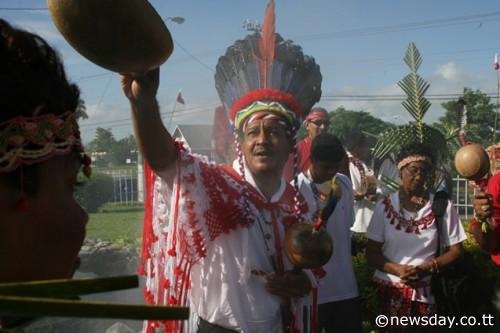
PRESIDENT of the Carib Community in Arima, Ricardo Bharath-Hernandez, yesterday called on the Government to show more “meaningful recognition” to the indigenous people. However, MP for the area, Pennelope Beckles said Cabinet has already appointed a committee to look into the needs of the group.
Bharath-Hernandez, who was speaking at the Carib Centre on Paul Mitchell Street during a function to mark the 7th anniversary of Amerindian Heritage Day, also made an impassioned plea for state protection of sacred sites, lands for his people, and an end to the destruction of medicinal herbs and plants used in craft making, by quarrying activities in the Tamana Forest.
“The Carib community will continue to struggle for meaningful recognition. We think the time is now for government to appropriate a portion of land for the survival of this community,” he said.
The Carib president, who earlier conducted a sacred smoke ceremony at the foot of the statue of Amerindian freedom fighter Hyarima on Hollis Avenue, said the Caribs needed their own village to ensure preservation of their heritage.
“We should have the choice to live together as a community, if we want to,” he said.
“All our indigenous materials for making crafts are being lost, our wild life is being hunted, and medicinal herbs destroyed. Soon all of these things will be lost forever.”
Bharath-Hernandez added, “Our burial grounds are being destroyed and people are digging up all the artifacts and are selling them as far as New York for a few dollars. We have no laws to protect these sites.”
Bharath-Hernandez said the jury was still out on whether the group should demand a public holiday. He said although the group was celebrating its seventh anniversary of recognition, there were still people who did not know about the event. Bharath-Hernandez also heads the Secretariat of the Caribbean Organisation of Indigenous Peoples (COIP).
Beckles said instruments were already handed out to the Cabinet-appointed committee “to liaise with the Carib community to find out what their needs are and to make recommendations to the Cabinet.” She said she was sure that some of the requests made by the group will be “realised”, adding that Government has already begun to structure the quarrying industry.
Monsignor Christian Perreira, parish priest of the Santa Rosa Church, admitted that there was much more “healing” to take place between the First Peoples and the Church.
“This relationship still has to be fleshed out,” he said. “The apology and intention are there, the atonement is there and while in very many ways the First Peoples have accepted that atonement, there is still the healing to come.”
Fr. Perreira added that the country’s oldest feast, The Feast of Santa Rosa, which is shared by the Church and the Carib community, has sought to bridge the divide for the past 220 years.
10/03/2006
Caribbean Indigenous Peoples Turn A New Page in Kaieri (Trinidad)
In a ceremony that was a feature program of CARIFESTA IX, Chief Ricardo Bharath Hernandez accepted the Chairmanship of the organization on behalf of the Santa Rosa Karina (Carib) Community. The Santa Rosa Caribs are currently the only indigenous descendant community in the twin island republic of Trinidad and Tobago officially recognized by the State Government.
In an impassioned acceptance speech, Chief Bharath Hernandez touted some gains for the local community but stressed the need for much more to be done for the Indigenous Peoples of Trinidad. Apparently anticipating the Chief’s challenge, the honorable Minister of Culture and Gender Affairs, Ms. Joan Yuille-Williams announced that a new Cabinet Committee had been established to address long standing issues for the community. Three members of the Santa Rosa Community were appointed on to this special committee, receiving their appointment letters at the event directly from Minister Yuille-Williams.
The ceremony was also attended by the honorable Minister of Amerindian Affairs of the Republic of Guyana, Mrs. Carolyn Rodrigues and the honorable Minister of Utilities & Environment, M.P. for Arima, Ms. Pennelope Beckles.
Indigenous member representatives of COIP were also on hand from Dominica, Guyana, Saint Vincent and the Grenadines, Suriname, and Belize to pledge support of the new COIP Chairman. Representation within COIP is by country with the Secretariat usually rotated every three years to the next member country.
Roberto Mukaro Borrero (Boriken Taino) was honored as a special invited guest representing the United Confederation of Taino People (UCTP) at the ceremony. On behalf of the UCTP Borrero also pledged Taino support of COIP as he presented Chief Hernandez with a gift from his Boriken (Puerto Rico) homeland.
Noting the historic significance of the event, Borrero stated “this is a special moment for our region as we can see by the participation of Government and Indigenous representatives that our Peoples are beginning to be taken more seriously.”
The ceremony included speeches, special presentations, and a dynamic cultural performance featuring Karina and Arawak music and dance by the Surinamese delegation. With the local community attending in full force, the celebration continued into the evening with additional cultural presentations from local groups.
Another historic and precedent-setting event occurred during the momentous gathering as an official “Declaration of Unity” between the Santa Rosa Carib Community and the United Confederation of Taíno People was adopted on September 24, 2006.
“As we move forward in the region it is important that as Caribbean Indigenous Peoples we recognize and respect each other officially, Nation to Nation.” stated Borrero.
The Caribbean Organization of Indigenous Peoples (COIP) was established in 1987 following the first Conference of Indigenous Peoples of the English Speaking Caribbean, held in Saint Vincent and the Grenadines.
9/13/2006
Carifesta IX to feature Caribbean indigenous people...
GEORGETOWN (GINA) - The indigenous people of Guyana will join their counterparts from the Caribbean and the Americas to honour their history, achievements and contribution to the development of the region.
Their gathering will be part of several activities to be held in Trinidad and Tobago at the hosting of Carifesta IX, a ten-day event held under the theme ‘Celebrating our People: Contesting the World Stage’.
Over 20 countries from the Caribbean will be converging on the twin island republic to showcase the splendours of their cultures and traditions. The festival will promote events that serve both the commercial and artistic interests of artists and entrepreneurs. These will include cultural industries, trade and book fairs, film, community and visual arts exhibitions, symposia, super concerts, performing and culinary arts, youth and children’s events.
Performers from the National School of Dance, the Amerindian Dance Troupe and the Dharmic Nritya Sangh of Guyana will be represented at the grand celebration. An Amerindian Dance Troupe from Region Seven will be performing a series of traditional dances at the festival. This group will also be presenting some of their best craft pieces during other events.
As part of the celebrations, the Santa Rosa Carib Community in Trinidad will be hosting a conference for indigenous people and presentations will be made by representatives from different indigenous communities within the Caribbean including newly appointed Minister within the Ministry of Education Dr. Desrey Fox, herself an Amerindian.
It is anticipated that all indigenous groups living in the Caribbean will participate in the conference. Dr. Fox, will also be present at the ceremonial handing over of the Caribbean Organisation of Indigenous People (COIP) in Arima a small Carib community in Trinidad known for its perpetuation of the Carib tradition.
Chief Carib and Deputy Mayor in Arima, Richardo Bharrat will assume chairmanship of COIP which is at present located in Guyana. COIP originated in 1987 following a conference of Indigenous people in St. Vincent and the Grenadines. Member countries of COIP are Dominica, Belize, Guyana, Suriname, St. Vincent and Trinidad and Tobago.
The ceremony will be the first major celebration of Indigenous People in Carifesta IX, and will foster the continued cohesiveness of member countries. Arima, the Larry Gomes Enclosure and the Princess Royal Park, are the selected venues/communities where indigenous groups from around the Caribbean will be displaying their cultural varieties.
The Indigenous group of Guyana will lend some of their talents to the many other events that Guyana will be participating in during Carifesta IX. These include the culinary arts, in which a variety of Guyanese cuisines will be on display and the Guyana Nite Festival, where performances will be done by the Amerindian dance troupe, the National School of Dance and the Dharmic Nritya Sangh.
Organisers of the Guyana Nite Festival will stage a preview of the show at the National Cultural Centre on Sunday September 17. Carifesta IX was launched on Friday September 1, in 13 administrative districts of Trinidad and two in Tobago. Carifesta is coordinated by the Interim Festival Directorate (IFD) the regional advisory body to CARICOM.