Showing posts with label Maroons. Show all posts

8/24/2013

Taino Delegates Join Jamaica’s Marcus Garvey Celebration

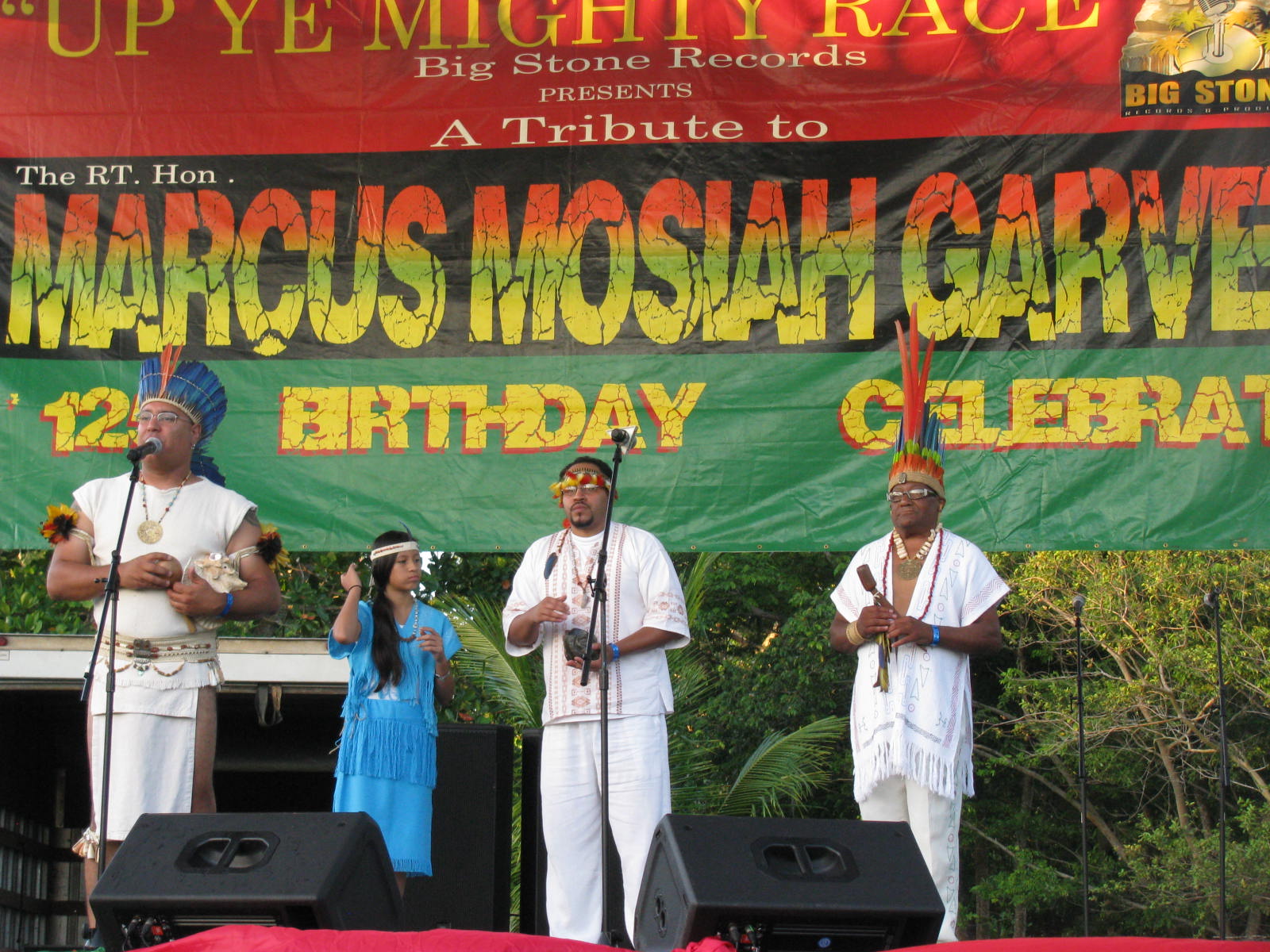
A delegation of Taino People open the Marcus Garvey Celebration at Rio Nuevo Village in Jamaica

St. Mary, Jamaica (UCTP Taino News) – This year’s annual celebration of the birth of Jamaican National Hero, the “Right Excellent Marcus Mosiah Garvey,” was historic in its unprecedented inclusion of an indigenous Taino delegation. The daylong activity was held on Sunday, August 18th at the RioNuevo Village in St. Mary, Jamaica. The well-attended celebration began with an early morning Taino ceremonial call to the “sacred directions” and featured an interactive cultural presentation later in the day. The Taino delegation included representatives of the Nacion Taina de las Antillas and the United Confederation of Taino People. The Taino delegates were invited to attend the Garvey celebration by event sponsor, Irie FM, Jamaica’s number one Reggae music radio station.  Portions of the day’s activities, including special on-site interviews, were broadcast live by Irie FM. 

Between and after their early morning and afternoon presentations on the event’s main stage, the Taino delegates interacted with an extremely interested public at a Taino kanei (rectangular chief’s home) built especially for the occasion. Hundreds and hundreds of Jamaicans flocked to the site throughout the day to speak to the Taino representatives and take photos. These intense cultural exchanges included emotional interactions with elders and leaders of Rastafarian community, as well as with leaders and community members of several Jamaican Maroon communities. The “Maroons” are the descendants of Africans who escaped enslavement and took refugee in the mountainous interior of the island, and according to local history intermarried with remaining Taino families. The Maroons initiated wars against the British Crown leading to the signing of peace treaties, which included land rights for these communities.

Irie FM's Mutabaruka interviews Taino leader R. Mukaro Borrero live in Jamaica 
“This is an historic and spiritually significant moment in our contemporary history as it marks the first occasion that Taino people are participating in an event of this kind in Jamaica, one of our sacred ancestral homelands” noted R. Múkaro Borrero, a representative for the United Confederation of Taino People and elected kasike (chief) of the Guainia Taino Tribe. Borrero continued stating, “I trust our humble participation will set the stage for more intense campaigns to raise a much needed Taino cultural awareness on the island.”


Borrero led the morning opening ceremony and afterward was interviewed live by Mutabaruka, one of Irie FM’s top radio personalities.  Another delegate, Kasike Rene Cibanacan was also interviewed. These in-depth interviews reached thousands of listeners on the island; many were emotionally and spiritually moved to come to the celebration to meet the Taino delegates.

The “Garvey Celebration” was co-sponsored by Rio Nuevo Village; Bigstones; Petcom Dunrobin; Fly Jamaica; JCDC St. Mary; Contractor Music Marketing; and the Jamaica National Heritage Trust. Along with the Taino cultural component, the event featured distinguished speakers, music and dance performances, marching bands, African drummers, storytellers, and more.


11/10/2008

Remembering the Tainos: Jamaica's First People

KINGSTON (JIS) - Jamaica is regarded as a cultural melting pot due to its unique history and the racial diversity that has contributed to the country's cultural heritage.

One such group that is often overlooked are the Tainos, who are featured on the country's Coat of Arms.

"Most people probably handle money with this symbol everyday but probably never give a thought to it and it is ironic that something that is so visible, people know so little about," Senior Research Fellow at the African Caribbean Institute of Jamaica/ Jamaica Memory Bank (ACIJ/JMB), Dr. Julian Cresser, says in an interview with JIS News.

"I do think that more needs to be done, (as) the Tainos are certainly a part of the history syllabus but in terms of just the wider public knowing about them, I do think more could be done to promote knowledge about our indigenous people," he maintains.

The Tainos were the focus of the ACIJ/JMB's recent Open House Programme. "Well throughout our various exhibition programmes we have highlighted various groups that have contributed to the cultural heritage of Jamaica. We have focused in the past on the Chinese in Jamaica, we have looked at German immigration, and this year we decided to look at the Tainos," Dr. Cresser explains.

"What we have realized is that not much attention had been paid to the legacy of the Tainos and so we decided that it would be good for us to have a feature on them," he continues.

The Tainos, who are generally referred to as Arawaks, are recognized as the earliest recorded inhabitants of Jamaica. On this matter, Dr. Cresser notes that there is a distinction to be made between the words Taino and Arawak with the former referring to the inhabitants and the latter to a language.

"We believe the Tainos were the first inhabitants of Jamaica. They would have migrated from South America and reached the Greater Antilles somewhere around 700 to 1000 AD," he informs.

"Most people are more familiar with the name Arawak, we now believe that these groups of people were Arawak speaking people so Arawak refers to a group of languages spoken by these people and you had different groups of Arawak speaking people in the Greater Antilles," he further explains.

In appearance the Taino were short and muscular and had a brown olive complexion and straight hair. They wore little clothes but decorated their bodies with dyes. Religion was a very important aspect of their lives and they were mainly an agricultural people although they did have some technological innovations. Today, some of their practices and different aspects of their culture such as their language, and food, are still in use in Jamaica.

"Some of the things that are definitely part of our cultural heritage today that came from the Tainos are things like the use of cassava, especially the making of bammy that is a very popular part of our food heritage. There is also the use of tobacco, which is not just a part of Jamaica but (is used) right throughout the world. The Tainos used tobacco in a number of their religious ceremonies and rituals and in their daily life for relaxation," Dr. Cresser says.

"The Tainos also cultivated cotton and they had a process by which they wove it and were able to make hammocks. The word hammock is a derivative of a Taino word and so is barbeque, which refers to a way in which they prepared meat. So a number of these things that we see around us we may not realize that it has come down to us from the Tainos," he affirms.

Another interesting aspect of the Tainos is in relation to one of the more popular Jamaican proverbs such as being given "basket to carry water". This proverb generally refers to a situation in which a person is given an impossible task to complete.

However, Dr. Cresser points out that what many people don't realize is that some types of baskets can actually be used to carry water and that this is one such task that was carried out by the Tainos.

"Just recently I was telling somebody that you may hear the phrase "given a basket to carry water" which really means that you have been given inferior tools to do a job. But the Tainos actually used baskets to carry water. They had a process by which they made baskets from very finely woven wreath. And they were able to weave these so intricately to form a water tight basket," he enthuses.

Another important feature of the Tainos was that they had no system of writing and Dr. Cresser cites this as a major reason why Jamaica needs to record its history because to ensure that its done accurately.

"The Tainos as far as we know had no system of writing. What we know about the Tainos comes from archaeological finds, rock and stone art. They were artists and they made a number of drawings in caves. We would have also learned from the writings of the Spaniards who encountered them, as subjective as those writings may be," Dr. Cresser says.

Additionally, he points out that, "it is also believed that some Tainos made their way into the hilly interiors of Jamaica where they would have met and mixed with the earliest African Maroons and it is believed that some of the practices of the Tainos would have filtered down to us through this interaction with the Maroons".

Although the Tainos became extinct centuries ago, Dr. Cresser remains passionate about keeping their memory alive and asserts that it is important to honour and remember them.

"Just generally it is important to understand the history of Jamaica just to see how we have reached this point. The Tainos are our first inhabitants and their contact with the Europeans played a role in shaping Jamaica and I think it is important that we look at that," he emphasizes.

"Some aspects of Taino life have survived until today and because they have survived they are a part of our cultural identity and I think it is very important for people to be aware of all of those things that make up our identity, it is a part of knowing who we are," he further affirms.

The ACIJ/JMB is a division of the Institute of Jamaica, which serves to examine all aspects of Jamaica's cultural heritage and make this information accessible to the public, through its library as well as exhibition and outreach programmes.

Author: Don Dobson
Source: Jamaica Information Service

7/31/2007

Archaeologists discover slaves were wealthy and astute business men

Caribbean archaeologists say recent discoveries have forced them to rethink traditional views about the region's history.

They have just held their biennial conference in Jamaica, where the role of archaeology in understanding the Caribbean history came up for discussion.

The archaeologists say their findings are sometimes in direct contrast to what has been written by the "planter class", especially as it relates to the period of slavery.

Roderick Ebanks, who chaired the Jamaica conference, is one of the archaeologists doing research into the Caribbean's past.

He explained that they have come across the villages of enslaved workers and what they found is very different from what was written by contemporary planters.

At an excavated African workers village in Seville on the North coast of Jamaica there were keys and large padlocks in the buildings indicating there was a lot of material wealth.

As he pointed out the wealth is not surprising when you remember that the slaves create the internal marketing system. Many slaves were wealthy during slavery. Their wealth came not from handouts from planters but from their work in the grounds, their trading and their farms in the hills.

From oral tradition it was known that there was a close relationship between Africans and native Arawaks who were called Taino. Now DNA evidence is showing that the maroons carry a lot of genes of the Taino people. The African male slaves who escaped took Taino wives and those were the people who became the maroon population.

*Source: http//www.cbc.bb (Friday, July 27, 2007)

Related Source:

Mr Ebanks told Neil Nunes of the BBC about some of their findings.

6/15/2007

Suriname OKs mining where species found

Environment minister shrugs off concerns, saying 'these are our resources'

PARAMARIBO, Suriname (AP) - Suriname will let mining companies pursue excavation projects in an eastern jungle region where scientists recently discovered two dozen new species of wildlife, the environment minister said Wednesday.

Environment Minister Joyce Amarello Williams said the government will take measures to protect wildlife diversity while encouraging investment in gold and bauxite exploration and open-pit mining in the small South American nation.

"It is a matter of finding a right and responsible balance between exploiting our natural resources to our benefit and preserving our biodiversity, which is an important part of our wealth," she told The Associated Press.
Earlier this month, a group of scientists from the U.S.-based nonprofit Conservation International announced the discovery of new species — including a frog with distinctive purple markings and six types of fish — in the region's rainforests and swamps.

The group's research was financed by Suriname Aluminum Company LLC and BHP Billiton Maatschappij Suriname, two companies considering mining projects in the area.
Marielle Canter, manager for Conservation International's energy and mining program, said the remote area could be developed responsibly if strong conservation management is enforced to "protect its unique values."
Amarello Williams said she anticipates opposition from conservationists but said Suriname will reach its own conclusions about where to allow development.

"These are our resources and we will decide what will happen," she said.

About 80 percent of Suriname is covered with dense rainforest. Thousands of Brazilians and Surinamese are believed to work in illegal gold mining, creating mercury pollution that has threatened the health of Amerindians and Maroons in Suriname's interior.

Copyright 2007 The Associated Press. All rights reserved.

==============

Click for related content: Survey finds 24 new species in Suriname

Strange species: See some of the colorful creatures documented during Conservation International's survey of Suriname's remote plateaus.

4/12/2007

Suriname authorities to tackle food shortages in Amerindian villages

Paramaribo, Suriname - Several Amerindian villages in the remote southern areas of Suriname are being threatened by serious food shortage, authorities here have confirmed.

According to Ronny Pansa, an official in the ministry of Regional Development, the situation in the villages Kwamalasemutu, Tepu, Kawemhakan, Palumeu and Apetina is very serious after a bad harvest, due to extreme weather conditions and fiddling cankers.

Over the weekend the ministry prepared hampers containing basic food items totaling over 1,600 kilos to distribute in the affected area as of Thursday. The National Coordination Centre for Disaster Management (NCCR) is in charge of the relief operations.

News of the imminent food shortage started trickling in two weeks ago when villagers informed the authorities over the failure of the cassava crop, the main staple food in the area, and which yielded less than average quantities, to sustain the local communities. Over 3,000 individuals live in the five communities.

As a result of the mass flooding of the same area just a year ago, villagers didn’t plant as much as they were accustomed to. Furthermore, fiddling cankers caused massive damage to cassava fields and other crops.

Bad harvest, due to flooding and fiddling cankers, are common in these remote Amerindian villages, close to the border with Brazil. The area is only accessible by plane, making transportation of regular food items such as cooking oil, salt, sugar, rice and flour very expensive. If necessary the authorities will continue the food distributions, said Pansa.

In May 2006 a large part of the Suriname interior was affected by serious flooding after weeks of torrential rains hit the area. Over 25,000 Amerindians and maroons, descendants of runaway African slaves, were affected, while several thousands had to be relocated. Since then the situation has returned to normalcy and a flood monitoring system has been established.

Author: Ivan Cairo
Source: Caribbean Net News

10/13/2006

Famed Welsh Athlete is Part-Taino


UCTP Taino News - Colin Ray Jackson, born February 18, 1967 in Cardiff, Wales is a sprint and hurdling champion of Jamaican and Scottish ancestry.

The athlete who recently turned TV sports commentator and television presenter predominantly for the BBC took part in an episode of the TV genealogy series “Who Do You Think You Are?” in September.

The program aired in the UK and in the genetic tests that are the focus of the show, Jackson genetic tests showed his ancestry to be 55% African, 7% Native American, and 38% European.

Jackson’s seven per cent Native American DNA showed that he is descended from the Tainos, the original indigenous inhabitants of Jamaica, who later mixed with escaped slaves and formed their own Maroon communities. The Maroons also fought against slavery and for Jamaican independence in the 17th century.

Cynthia Rosers, a genealogist at the Jamaican register general’s department, said: “Colin Jackson, is very light skinned. In Jamaica we would call him brown, but in American they would call him ‘redbone’.”

"The fieriness that the maroons had, first with their fight with the Spanish and then the English, I think I've got that in me now” said Jackson.

“When I lined up on many occasions to compete for Great Britain, it took a lot of heart and soul to get out there and to really be at war with my competitors... I feel really proud that I'm still linked genetically to the first settlers of Jamaica."
UCTPTN 10.13.2006